
E.A.5 Edge Device Deployment
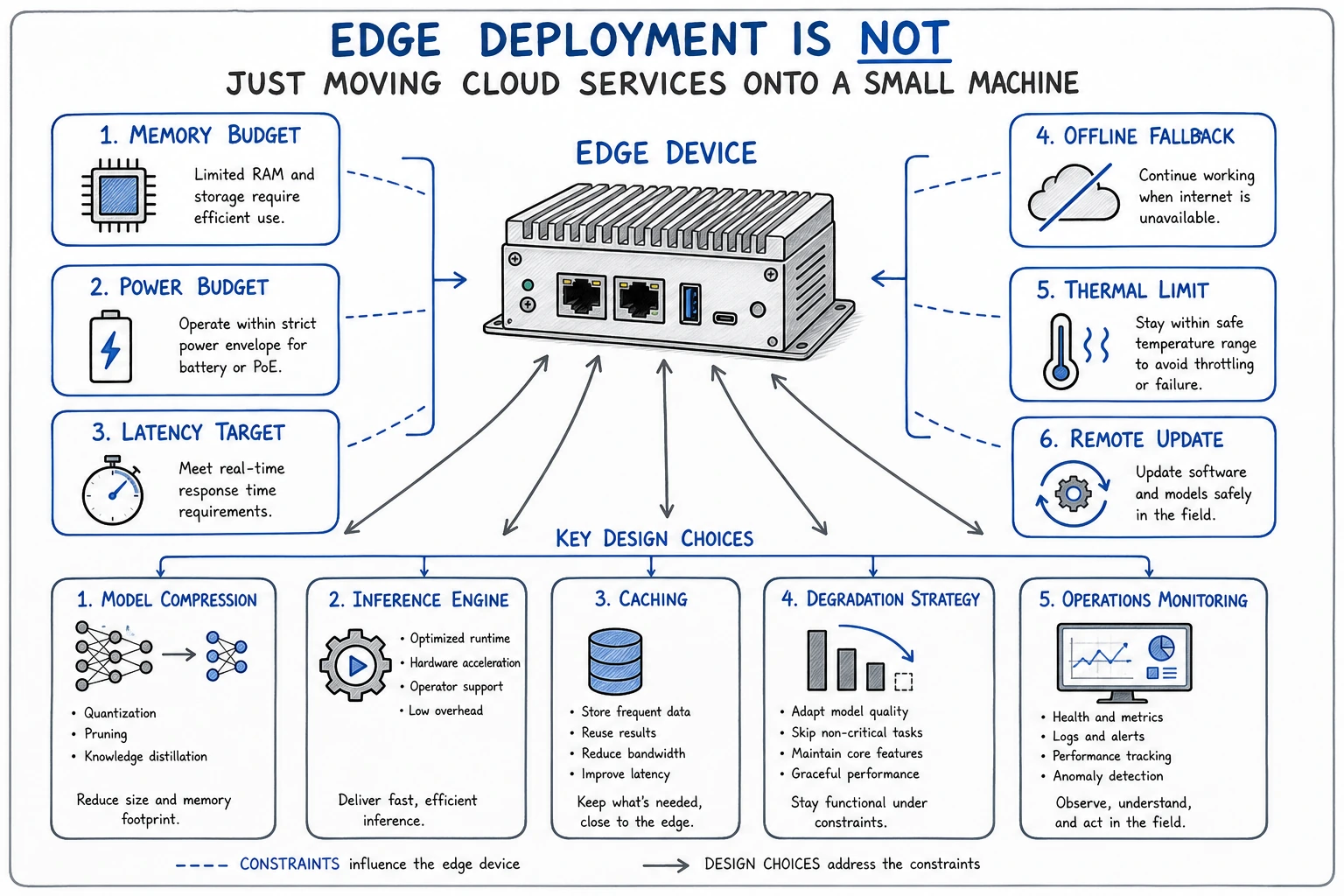
Edge deployment means the model runs near the user, camera, machine, or sensor. The main problem is not model accuracy first; it is whether the device can run the system reliably for a long time.
What You Need
Section titled “What You Need”- Python 3.10+
- No external packages
- A target scenario, such as camera classification, factory inspection, or offline form reading
The Four Checks
Section titled “The Four Checks”- Memory: model, runtime, input buffer, and service all need RAM.
- Power: a device that can run once may still overheat or throttle.
- Latency: some tasks need instant response; some can wait.
- Offline mode: if the network is unstable, the device still needs a local fallback.
Run A Compatibility Filter
Section titled “Run A Compatibility Filter”Create edge_fit.py:
devices = [    {"name": "edge-a", "memory_mb": 512, "power_w": 8, "offline": True},    {"name": "edge-b", "memory_mb": 2048, "power_w": 15, "offline": False},    {"name": "edge-c", "memory_mb": 4096, "power_w": 25, "offline": True},]
model = {    "name": "int8-small-classifier",    "memory_mb": 700,    "power_w": 10,    "latency_ms": 65,    "requires_offline": True,}
for device in devices:    reasons = []
    if device["memory_mb"] < model["memory_mb"]:        reasons.append("memory")    if device["power_w"] < model["power_w"]:        reasons.append("power")    if model["requires_offline"] and not device["offline"]:        reasons.append("offline")
    status = "FIT" if not reasons else "CHECK " + ",".join(reasons)    print(device["name"], status)
Run it:
python edge_fit.pyExpected output:
edge-a CHECK memory,poweredge-b CHECK offlineedge-c FITRead the result from left to right: edge-c is not automatically the fastest or cheapest device, but it is the only one that satisfies the deployment constraints.
Edge Review
Section titled “Edge Review”Read an edge deployment result as a constraint table, not as a model leaderboard. A device can pass accuracy and still fail because it overheats, loses network, runs out of memory, or cannot be updated safely. That is why the compatibility filter keeps separate reasons instead of returning only one score.
When you write a project note, include the target environment: power source, network assumption, expected runtime length, input size, and how logs leave the device. These details make the difference between “the model ran once” and “the system is ready to be operated.”
Make It More Real
Section titled “Make It More Real”Change model["memory_mb"] from 700 to 350 and run again. edge-a still fails because power is too low. This shows why edge deployment is a multi-constraint problem.
Practical Edge Checklist
Section titled “Practical Edge Checklist”Before calling a device “ready,” verify:
- It can start from cold boot.
- It can run for at least 30 minutes without memory growth.
- It handles network loss.
- It saves enough logs for remote troubleshooting.
- It has a simple rollback or replacement path.
Evidence to Keep
Section titled “Evidence to Keep”Keep this page’s proof of learning as a small evidence card:
- Deployment Target
- local inference, edge device, model server, or optimization experiment
- Artifact
- C++ snippet, benchmark, model artifact, serving config, or deployment note
- Metric
- latency, memory, throughput, model size, accuracy drop, or reliability
- Failure Check
- ABI/build issue, hardware mismatch, quantization loss, or serving bottleneck
- Expected Output
- reproducible deployment or optimization evidence, not only theory notes
Common Mistakes
Section titled “Common Mistakes”- Picking the model first, then trying to force it onto a small device.
- Testing only one inference instead of a long-running loop.
- Assuming the device is always online.
- Forgetting that logs, caches, and input images also consume memory.
Practice
Section titled “Practice”Add price_usd to each device and choose the cheapest device that passes all checks. Then add a second model and compare which device works for both.
Reference implementation and walkthrough
The answer should first filter devices by constraints, then compare price only among devices that pass. A cheap device that fails memory, power, or offline requirements is not a valid deployment target.
For the second model, build a shared check such as device["memory_mb"] >= model_a["memory_mb"] + model_b["memory_mb"] if both models must run together, or compare each model separately if only one runs at a time. The final note should explain the trade-off: the best device is the cheapest one that still satisfies the real operating constraints.