
8.2.2 Local Model Runtime
Learning objectives
Section titled “Learning objectives”- Understand why many scenarios prioritize local models
- Understand the relationship between model size, quantization, and hardware constraints
- Distinguish the basic differences between CPU runtime, GPU runtime, and quantized runtime
- Read a minimal local inference flow
- Build judgment about “when to run locally and when an API is a better fit”
First, build a map
Section titled “First, build a map”For beginners, the best way to understand local models is not to “pick a model name” first, but to first see clearly:
flowchart LR A["Business requirements"] --> B["Privacy / cost / latency / offline needs"] B --> C["Decide whether to consider a local model"] C --> D["Check whether resources match"] D --> E["Decide between CPU / GPU / quantization"]So what this section really wants to answer is:
- Why would someone choose not to use an existing API and instead run locally?
- What are you actually trading for local runtime?
A better overall analogy for beginners
Section titled “A better overall analogy for beginners”You can think of cloud APIs and local models as:
- Taking a taxi
- Versus buying your own car
The advantages of taking a taxi:
- Hassle-free
- Available on demand
The advantages of owning a car:
- More controllable
- Potentially cheaper in the long run
- Safer in some cases
But you also have to handle:
- Maintenance
- Parking
- Repairs
The relationship between local models and cloud APIs is very much a trade-off like this.
Why consider local models?
Section titled “Why consider local models?”First, look at the strengths of cloud APIs
Section titled “First, look at the strengths of cloud APIs”The advantages of cloud APIs are obvious:
- Ready to use out of the box
- The model is usually stronger
- Less operational burden
So when a project is just getting started, cloud APIs are often the most convenient choice.
But why do some people still insist on running locally?
Section titled “But why do some people still insist on running locally?”Common reasons usually include:
- Data cannot leave the local machine or the enterprise intranet
- API costs add up too quickly
- The system needs to work offline
- You want stronger control over the model and inference pipeline
In other words, the core value of local models is not “being more advanced,” but:
Rebalancing the trade-off among quality, cost, privacy, and controllability.
First build the most important real-world intuition: model size is not an abstract number
Section titled “First build the most important real-world intuition: model size is not an abstract number”Parameter count directly affects resource usage
Section titled “Parameter count directly affects resource usage”When you see a model described as:
- 7B
- 13B
- 70B
These are not just marketing labels. They usually mean:
- Very different memory / VRAM usage
- Very different loading times
- Very different inference speeds
A rough resource illustration
Section titled “A rough resource illustration”runtime_options = [ {"name": "small_quantized_model", "memory_gb": 4, "quality": "basic"}, {"name": "medium_quantized_model", "memory_gb": 8, "quality": "good"}, {"name": "larger_model", "memory_gb": 16, "quality": "better"}]
for item in runtime_options: print(item)Expected output:
{'name': 'small_quantized_model', 'memory_gb': 4, 'quality': 'basic'}{'name': 'medium_quantized_model', 'memory_gb': 8, 'quality': 'good'}{'name': 'larger_model', 'memory_gb': 16, 'quality': 'better'}What is this code really trying to tell you?
Section titled “What is this code really trying to tell you?”It is not asking you to memorize numbers. It is helping you build a very practical judgment:
Whether a model can run locally is often first a resource-matching problem.
The question is not “Do I want to run it?” but “Can my machine handle it?”
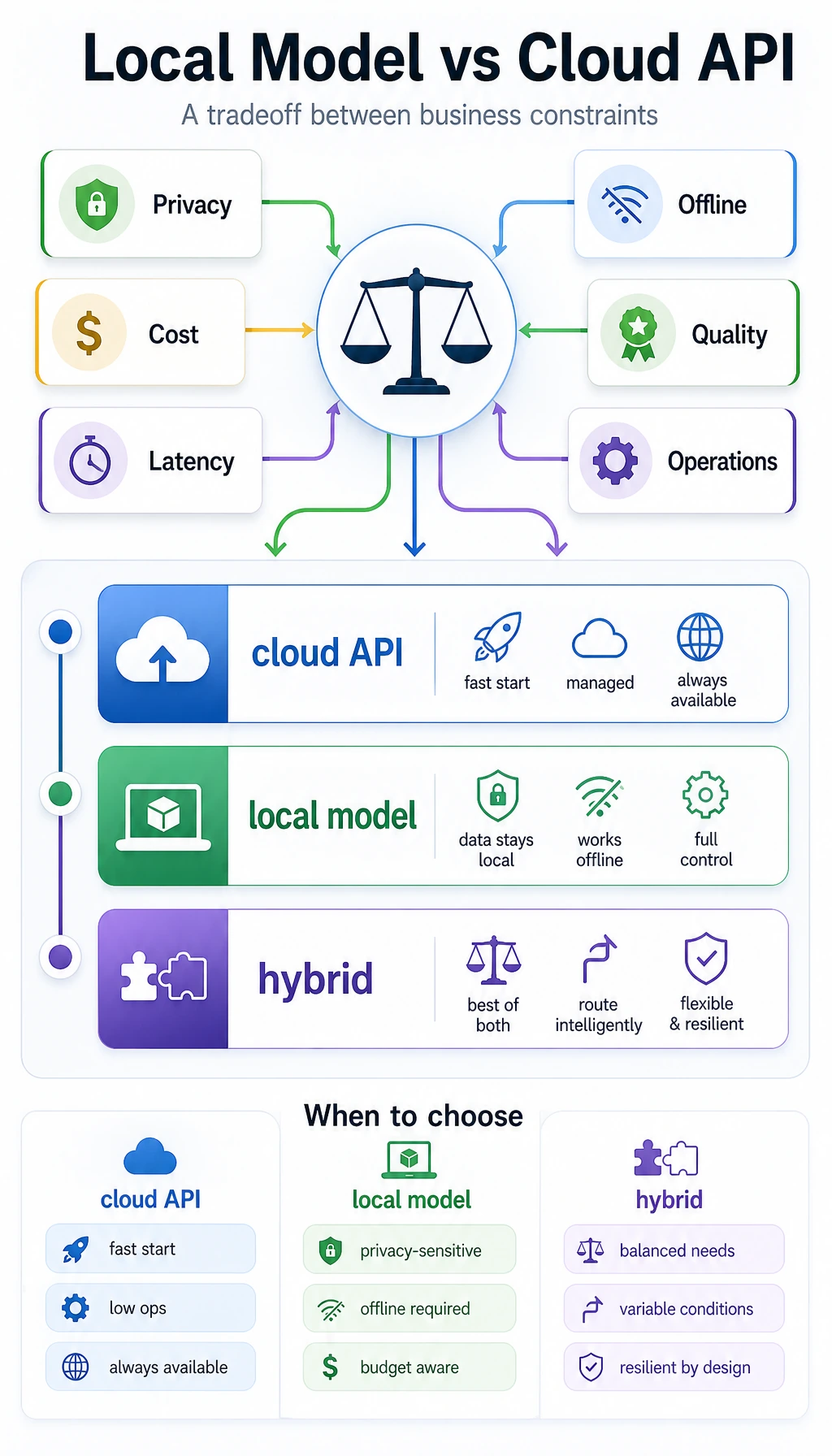
A decision table that is very useful for beginners
Section titled “A decision table that is very useful for beginners”| Priority | First path |
|---|---|
| Fast prototyping | Cloud API |
| Privacy and intranet use | Local model |
| Long-term cost | Local model or a hybrid solution |
| Best possible performance | Often try the cloud API first |
This table is not an absolute rule, but it is very useful for beginners to build a realistic judgment:
- The deployment path is first a business decision, not just a technical preference
Why are quantization and local models always mentioned together?
Section titled “Why are quantization and local models always mentioned together?”Because everyone wants to fit the model into a smaller machine
Section titled “Because everyone wants to fit the model into a smaller machine”The roughest but easiest way to understand quantization is:
Use lower-precision values to represent model parameters, and trade that for lower memory usage.
A minimal illustration
Section titled “A minimal illustration”params = 7_000_000_000 # 7 billion parameters, illustrative
precisions = { "fp16": 2.0, "int8": 1.0, "int4": 0.5}
for name, bytes_per_param in precisions.items(): memory_gb = params * bytes_per_param / (1024 ** 3) print(name, "rough memory GB =", round(memory_gb, 2))Expected output:
fp16 rough memory GB = 13.04int8 rough memory GB = 6.52int4 rough memory GB = 3.26This is only a rough parameter-memory estimate. Real runtime memory also includes KV cache, temporary buffers, tokenizer/runtime overhead, and serving queues.
The benefits and costs of quantization
Section titled “The benefits and costs of quantization”Benefits:
- Easier to run locally
- Easier to fit on edge devices or weaker machines
Costs:
- Accuracy may drop a little
- Some tasks are more sensitive to it
So quantization is also a typical engineering trade-off, not a free magic trick.
Another minimal example of “what if resources are not enough”
Section titled “Another minimal example of “what if resources are not enough””constraints = { "memory_gb": 8, "need_low_latency": False, "privacy_sensitive": True,}
def suggest_runtime(constraints): if constraints["privacy_sensitive"] and constraints["memory_gb"] <= 8: return "Prioritize a small quantized local model." if constraints["need_low_latency"] and constraints["memory_gb"] >= 16: return "Prioritize GPU local inference." return "Start with a cloud API prototype, then evaluate whether to migrate locally."
print(suggest_runtime(constraints))Expected output:
Prioritize a small quantized local model.This example is very suitable for beginners because it reminds you:
- Local deployment is often not about choosing a model first
- It is about checking constraints first
What is the real difference between CPU runtime and GPU runtime?
Section titled “What is the real difference between CPU runtime and GPU runtime?”Characteristics of CPU runtime
Section titled “Characteristics of CPU runtime”Advantages:
- Available on most computers
- Low deployment barrier
Disadvantages:
- Slow
Characteristics of GPU runtime
Section titled “Characteristics of GPU runtime”Advantages:
- Faster
- Better suited for larger models
Disadvantages:
- Higher cost
- Higher environment requirements
A practical rule of thumb
Section titled “A practical rule of thumb”If your scenario is:
- A personal tool
- A low-traffic experiment
- An offline assistant
Then running a small model on CPU may be enough.
If your scenario is:
- Multi-turn interaction
- Sensitive to user waiting time
- A somewhat larger model
Then GPU or a more specialized runtime is more realistic.
A minimal local inference flow
Section titled “A minimal local inference flow”Why start with a mock runtime?
Section titled “Why start with a mock runtime?”Here we will not use a real large model yet. Instead, we will write a mock runtime to make the “load -> infer -> return” flow clear.
class LocalModelRuntime:    def __init__(self, model_name):        self.model_name = model_name        self.loaded = False
    def load(self):        self.loaded = True        print(f"loaded {self.model_name}")
    def generate(self, prompt):        if not self.loaded:            raise RuntimeError("model not loaded")        return f"[{self.model_name}] local reply to: {prompt}"
runtime = LocalModelRuntime("small-local-model")runtime.load()print(runtime.generate("What is the refund policy?"))
Expected output:
loaded small-local-model[small-local-model] local reply to: What is the refund policy?What is this code teaching?
Section titled “What is this code teaching?”It is teaching you the three most basic things about local model runtime:
- The model must be loaded first
- Inference requests must go through the runtime
- The result is then handed back to the upper-level system
This looks simple, but it is already very close to the smallest skeleton of a real inference system.
When beginners build their first project, how should they decide whether to run locally?
Section titled “When beginners build their first project, how should they decide whether to run locally?”A safer order is usually:
- First ask whether you really have privacy / offline / cost constraints
- Then ask whether the current machine can actually handle it
- If you are only building a prototype, prioritize the cloud API
- If you need to control the pipeline or reduce costs long term, seriously consider a local model
This is usually more realistic than starting with “local deployment is cool.”
If you turn this into a project or solution, what is worth showing most?
Section titled “If you turn this into a project or solution, what is worth showing most?”What is usually worth showing most is not:
- “The model runs successfully”
But rather:
- Why you chose local instead of an API
- How hardware and model size match
- Whether quantization was used
- The trade-offs between cold start, latency, and cost
- What scenarios this solution fits and what scenarios it does not
That way, others can more easily see:
- You understand deployment decisions
- Not just that you got inference to run once
The real challenge is not “generation succeeds,” but “stable long-term operation”
Section titled “The real challenge is not “generation succeeds,” but “stable long-term operation””Once you reach a real system, you will encounter these more practical issues:
- How long does cold start take
- How many resources does the resident model consume
- How much concurrency can one machine handle
- Does switching models require reloading
The cold start problem
Section titled “The cold start problem”The first model load is usually slow. This is a big problem for service-oriented systems.
The always-on process problem
Section titled “The always-on process problem”To reduce cold start, you often keep the model resident in memory. But that brings:
- Higher long-term resource usage
So you will find:
The real difficulty of local model runtime is not “making it succeed once,” but “making it live like a service.”
When is a local model especially worth it?
Section titled “When is a local model especially worth it?”A very good fit
Section titled “A very good fit”- Enterprise intranets
- Privacy-sensitive content
- High API cost pressure
- Weak network / offline scenarios
- Need for stronger control over the pipeline
Not necessarily a good fit
Section titled “Not necessarily a good fit”- The team lacks operations capability
- The task heavily depends on cutting-edge large-model quality
- User volume is small, and an API is already convenient enough
In these cases, a cloud model may actually be more appropriate.
A very practical checklist for deciding
Section titled “A very practical checklist for deciding”Before deciding to run locally, you can ask:
- What do I care about most: cost, privacy, or model quality?
- Do I have enough hardware?
- Am I willing to take on deployment and maintenance complexity?
- Is the API solution already good enough?
If these questions are answered clearly, the local model approach usually will not be too blind.
Evidence to Keep
Section titled “Evidence to Keep”Keep this page’s proof of learning as a small evidence card:
- Runtime Choice
- local model, inference server, or unified API
- Request Contract
- endpoint, payload, output format, and error shape
- Latency Or Cost
- one measured or estimated number
- Failure Check
- timeout, memory pressure, model mismatch, or version drift
- Rollback Plan
- fallback model, retry policy, or traffic switch
Common beginner mistakes
Section titled “Common beginner mistakes”Looking only at model parameters, not the runtime
Section titled “Looking only at model parameters, not the runtime”For the same model, changing the runtime can make the experience very different.
Going straight for a large model
Section titled “Going straight for a large model”In many local scenarios, a small model is already enough.
Thinking “it runs” means “it is ready for production”
Section titled “Thinking “it runs” means “it is ready for production””After going live, you still need to look at:
- Stability
- Monitoring
- Concurrency
- Cost
Summary
Section titled “Summary”The most important thing in this section is not remembering a few model names, but building a stable intuition:
The core of local model runtime is making a real-world trade-off among “quality, cost, privacy, hardware, and maintenance complexity.”
It is not a simple replacement for a cloud API, but a completely different deployment choice.
Exercises
Section titled “Exercises”- Based on your current machine, write out a local model runtime plan that you think is reasonable.
- In your own words, explain: why does quantization appear so frequently in local model runtime?
- Why does “the model file can be loaded” not mean “the model service is ready for production”?
- If your system is highly privacy-sensitive but your team has weak operations capability, how would you make the trade-off?
Solution approach and explanation
- A reasonable plan should name the model size, quantization level, runtime, memory budget, expected latency, and fallback. For a laptop, a small quantized model for testing plus cloud/API fallback is often more realistic than pretending to serve a frontier model locally.
- Quantization reduces memory and bandwidth needs by storing weights in fewer bits. That matters locally because VRAM/RAM and memory bandwidth are usually the bottlenecks.
- Production readiness also needs latency targets, concurrency limits, monitoring, error handling, model warmup, security, rollback, and cost planning.
- A privacy-heavy but ops-weak team might keep sensitive retrieval/data local, use a managed model endpoint for nonsensitive generation, and add strict redaction/audit boundaries. Fully self-hosting everything is not automatically safer if the team cannot operate it.