
10.2.2 Data Augmentation Strategies
Learning Objectives
Section titled “Learning Objectives”- Understand why data augmentation can improve generalization
- Distinguish what kinds of problems different common augmentation methods are suited for
- Understand the augmentation assumption that “the label stays the same”
- Build intuition for the augmentation pipeline through runnable examples
First, Build a Map
Section titled “First, Build a Map”If you are coming from Station 6, you can think of this section as:
- You already know that convolutional networks learn features from images
- This section starts solving the problem of “how to keep them from only memorizing the surface appearance of the training set”
So data augmentation is not a small trick in vision; it helps with:
- How the model handles changes in viewpoint, brightness, cropping, and occlusion in the real world
For beginners, the best way to understand this section is not to “memorize how many transform names there are,” but first to see clearly:
flowchart LR A["Original image"] --> B["Apply reasonable transforms"] B --> C["Label stays mostly unchanged"] C --> D["Model sees more variation"] D --> E["Better generalization"]So what this section really wants to answer is:
- Why image classification especially needs augmentation
- When augmentation helps, and when it starts hurting semantics
Why Do Vision Tasks Need Data Augmentation So Much?
Section titled “Why Do Vision Tasks Need Data Augmentation So Much?”The Real World Is Always Changing
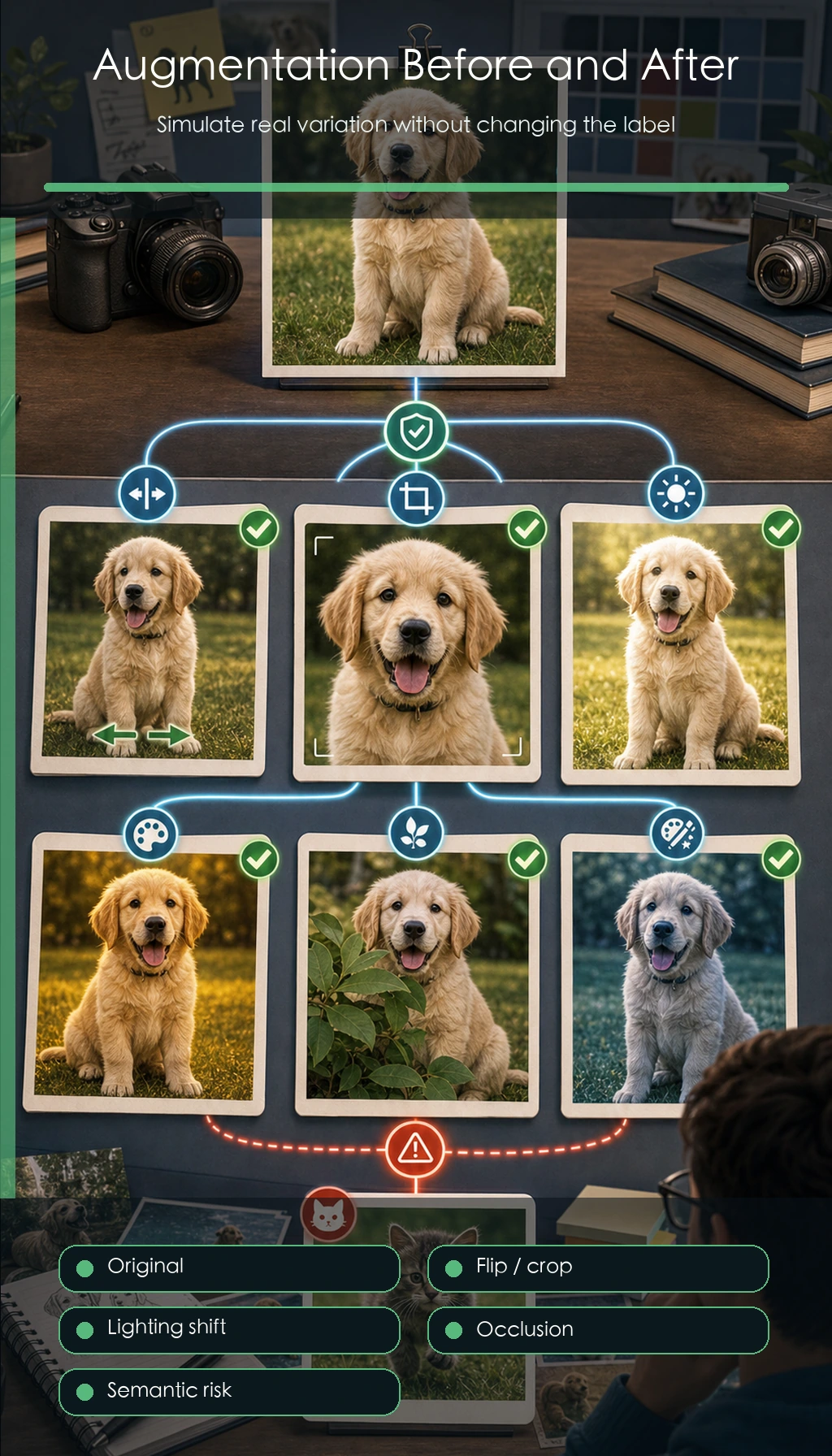
Section titled “The Real World Is Always Changing”The same cat can appear in different images with:
- changes in angle
- changes in lighting
- changes in background
- partial occlusion
If the training set does not cover enough of this, the model can easily mistake incidental background details for real features.
Augmentation Is Not “Creating More Data,” but “Simulating Reasonable Variation”
Section titled “Augmentation Is Not “Creating More Data,” but “Simulating Reasonable Variation””After a proper transform, the meaning of the image usually stays the same.
For example:
- A cat after a horizontal flip is still a cat
- A dog after a slight crop is still a dog
That is why augmentation helps the model learn more robustly.
When You First Learn Data Augmentation, What Should You Focus on Most?
Section titled “When You First Learn Data Augmentation, What Should You Focus on Most?”The most important thing is not a list of APIs, but this sentence:
Augmentation simulates the fact that the same object can appear in different reasonable forms.
Once that idea is clear, when you later see:
- flipping
- cropping
- color jitter
- Mixup / CutMix
it becomes much easier to judge whether they are helping or whether they are already hurting semantics.
An Analogy
Section titled “An Analogy”Data augmentation is like practicing variation questions before an exam. You are not changing the subject; you are preventing yourself from memorizing only the surface form of one problem.
The Most Common Types of Augmentation
Section titled “The Most Common Types of Augmentation”Geometric Augmentation
Section titled “Geometric Augmentation”For example:
- flipping
- translation
- cropping
- rotation
It mainly helps the model handle:
- viewpoint and position changes
Color Augmentation
Section titled “Color Augmentation”For example:
- brightness
- contrast
- saturation
It mainly helps the model handle:
- lighting and shooting-condition changes
Combined and Mixed Augmentation
Section titled “Combined and Mixed Augmentation”For example:
- Cutout
- Mixup
- CutMix
They are more aggressive, but often more effective too.
When You First Do Image Classification, Which Type of Augmentation Should You Start With?
Section titled “When You First Do Image Classification, Which Type of Augmentation Should You Start With?”A more stable order is usually:
-
Start with geometric augmentation Because it is the most intuitive and easiest to connect with “real viewpoint changes.”
-
Then add light color augmentation To handle lighting and capture-condition changes.
-
Finally try more aggressive mixed augmentation Because by then you already have a baseline, so it is easier to tell whether there is real benefit.
First Run a Minimal Augmentation Pipeline Example
Section titled “First Run a Minimal Augmentation Pipeline Example”The example below does not rely on an image library. Instead, it uses a 2D list to simulate a grayscale image, helping you grasp the core idea of augmentation.
image = [    [1, 2, 3],    [4, 5, 6],    [7, 8, 9],]

def horizontal_flip(img):    return [list(reversed(row)) for row in img]

def center_crop(img, size=2):    return [row[:size] for row in img[:size]]

def brightness_shift(img, delta=1):    return [[pixel + delta for pixel in row] for row in img]

print("original:")for row in image:    print(row)
print("\nflip:")for row in horizontal_flip(image):    print(row)
print("\ncrop:")for row in center_crop(image):    print(row)
print("\nbrightness:")for row in brightness_shift(image):    print(row)
Expected output:
original:[1, 2, 3][4, 5, 6][7, 8, 9]
flip:[3, 2, 1][6, 5, 4][9, 8, 7]
crop:[1, 2][4, 5]
brightness:[2, 3, 4][5, 6, 7][8, 9, 10]
What Should You Focus on Most in This Example?
Section titled “What Should You Focus on Most in This Example?”The essence of augmentation is not the image-library API, but:
- applying reasonable transforms to the input
- while trying not to change the label semantics
Why Is “Reasonable” So Important?
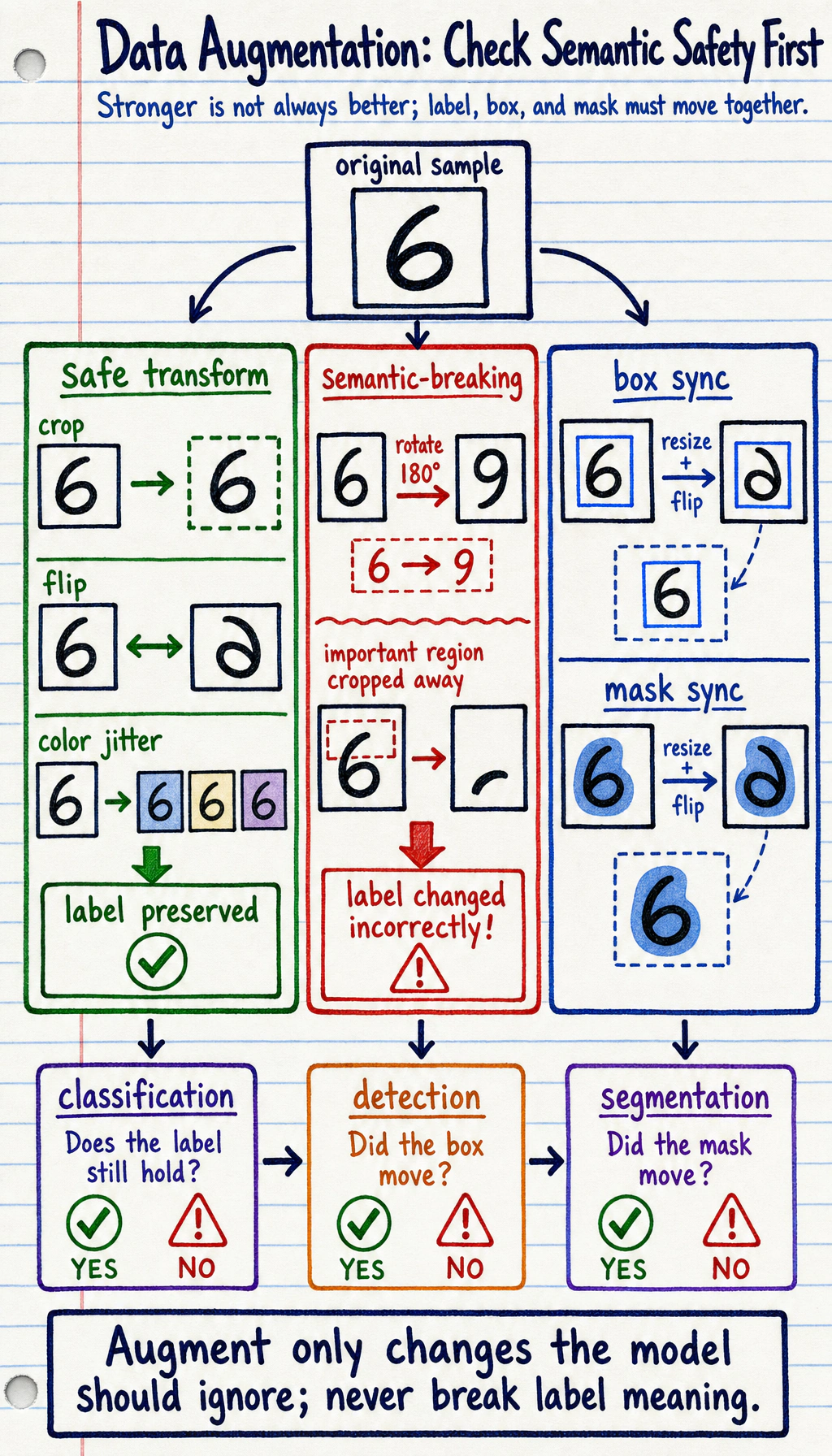
Section titled “Why Is “Reasonable” So Important?”If you randomly rotate digit images like “6” and “9,” the label may really change.
So augmentation is not about blindly making it stronger and stronger. It must also respect the task semantics.
Why Is This Especially Important for Vision Tasks?
Section titled “Why Is This Especially Important for Vision Tasks?”Because in vision, many labels actually depend on geometry and orientation.
For example:
- For ordinary natural images, horizontal flipping may be fine
- For digit recognition, arbitrary rotation may change the class meaning
- In detection and segmentation, augmentation must also update boxes and masks together
So augmentation is not “the more you add, the more advanced it is,” but rather:
- whether you are still respecting the semantic boundaries of the task itself
Why Is Mixup Worth Remembering Separately?
Section titled “Why Is Mixup Worth Remembering Separately?”It Does Not Just Modify the Image — It Mixes the Labels Too
Section titled “It Does Not Just Modify the Image — It Mixes the Labels Too”The core idea of Mixup is:
- mix two images by a ratio
- mix the labels by the same ratio
A Purely Numeric Intuition Example
Section titled “A Purely Numeric Intuition Example”img_a = [1.0, 2.0, 3.0]img_b = [7.0, 8.0, 9.0]label_a = [1.0, 0.0]label_b = [0.0, 1.0]alpha = 0.7
mixed_img = [round(alpha * a + (1 - alpha) * b, 2) for a, b in zip(img_a, img_b)]mixed_label = [round(alpha * a + (1 - alpha) * b, 2) for a, b in zip(label_a, label_b)]
print("mixed_img:", mixed_img)print("mixed_label:", mixed_label)Expected output:
mixed_img: [2.8, 3.8, 4.8]mixed_label: [0.7, 0.3]Why Can This Work Well?
Section titled “Why Can This Work Well?”It encourages the model to learn fewer extreme boundaries and to form a smoother decision surface.
Evidence to Keep
Section titled “Evidence to Keep”Keep this page’s proof of learning as a small evidence card:
- Dataset Split
- train/test images, class names, and class balance
- Prediction
- label, confidence, and at least one misclassified image
- Metric
- accuracy, F1, confusion matrix, and class-level errors
- Failure Check
- augmentation changes label meaning, class imbalance, leakage, or overfitting
- Expected Output
- model result table and saved error examples
Common Pitfalls in Augmentation
Section titled “Common Pitfalls in Augmentation”Mistake 1: More Augmentation Is Always Better
Section titled “Mistake 1: More Augmentation Is Always Better”Too much augmentation can damage useful features.
Mistake 2: Use the Same Augmentation Set for All Tasks
Section titled “Mistake 2: Use the Same Augmentation Set for All Tasks”Classification, detection, and segmentation are not equally sensitive to the same augmentations.
Mistake 3: Add Augmentation Without Validation
Section titled “Mistake 3: Add Augmentation Without Validation”Augmentation is a means, not the goal. In the end, you still need to check whether the validation set really benefits.
The Safest Augmentation Order for Beginners Doing Image Classification for the First Time
Section titled “The Safest Augmentation Order for Beginners Doing Image Classification for the First Time”If you are just starting with vision classification, it is recommended to follow this order:
- Start with horizontal flipping
- Then add light cropping
- Then add light color jitter
- After confirming that the baseline is stable, try Mixup / CutMix
This makes it easier to tell which type of augmentation is actually helping.
What Should You Look At First to Verify Whether Augmentation Is Really Effective?
Section titled “What Should You Look At First to Verify Whether Augmentation Is Really Effective?”Do not only look at training loss. A more stable judgment is:
- Did the validation metrics improve?
- Did the types of mistakes become more reasonable?
- Is the model no longer overly dependent on background or shooting pose?
In other words, the real value of augmentation is not just “a slightly higher score,” but helping the model learn more stable visual features.
Summary
Section titled “Summary”The most important thing in this section is to build one judgment:
The core of data augmentation is to simulate reasonable variation so the model learns to capture more stable visual features, instead of memorizing accidental details from the training set.
Once you have this intuition, you will not get lost when you see more complex augmentation strategies later.
What You Should Take Away from This Section
Section titled “What You Should Take Away from This Section”- Augmentation is not better just because it is stronger; it must match the task semantics
- When you start a project, begin with the most stable types of augmentation first
- Whether the validation set gets better is the real standard for deciding if an augmentation should be kept
If we compress it into one sentence, it is:
The essence of data augmentation is not to “mess up the image,” but to let the model see more reasonable variations without changing the semantics.
Exercises
Section titled “Exercises”- Write a
vertical_flipfunction for the example. - Think about this: why can rotation augmentation be harmful in some tasks?
- Explain in your own words: what is the biggest difference between Mixup and ordinary augmentation?
- If the validation performance drops, would you first suspect that the augmentation is too weak or too strong?
Reference implementation and walkthrough
- A simple
vertical_flipcan useimage[::-1]ornp.flipud(image). If labels include masks or boxes, those labels must be flipped with the image too. - Rotation is harmful when orientation carries meaning, such as digits, traffic signs, medical images, or any task where upside-down examples are unrealistic.
- Mixup blends both images and labels. Ordinary augmentation usually changes one image while keeping the same label.
- If validation performance drops, first visualize augmented samples. The common cause is augmentation that is too strong or semantically wrong, though weak augmentation can still leave overfitting.