
7.6.4 Other PEFT Methods [Optional]
Learning objectives
Section titled “Learning objectives”- Understand where Prompt Tuning, Prefix Tuning, Adapter, and IA3 each make changes
- Know the core differences between these methods and LoRA
- Run a minimal Adapter training example that is truly related to the PEFT topic
- Build intuition for choosing methods in multi-task, low-memory, fast-switching scenarios
Why isn’t LoRA the only answer?
Section titled “Why isn’t LoRA the only answer?”What PEFT is really trying to solve is not “inventing acronyms”
Section titled “What PEFT is really trying to solve is not “inventing acronyms””The core problem of PEFT is very simple:
If we freeze the main body of a large model and train only a very small part of the parameters, can we still adapt the model to a new task?
As long as this goal stays the same, “which small part of the parameters to train” will naturally lead to many variants.
So the biggest difference between these methods is not their names, but:
- Where the trainable parameters are placed
- Which part of the model’s information flow they affect
- How training cost, inference cost, and reusability compare
An analogy: making lightweight modifications to the same computer
Section titled “An analogy: making lightweight modifications to the same computer”You can think of a base model as a computer that is already assembled:
- Prompt Tuning is like putting a few hidden sticky notes on the desktop at startup
- Prefix Tuning is like preloading some context before each software starts
- Adapter is like plugging a tiny expansion card into the motherboard
- IA3 is like adding adjustable gain controls to a few key knobs
None of these rebuild the whole computer. They all add a layer of adjustable structure at different positions.
Why do real projects need these branches?
Section titled “Why do real projects need these branches?”Because engineering constraints are not exactly the same:
- Some teams care most about memory usage
- Some care most about fast task switching
- Some care most about not slowing down inference
- Some want to attach many domain adapters to the same base model
Even though they are all PEFT, the best method may not be the same.
First, clarify the PEFT family map
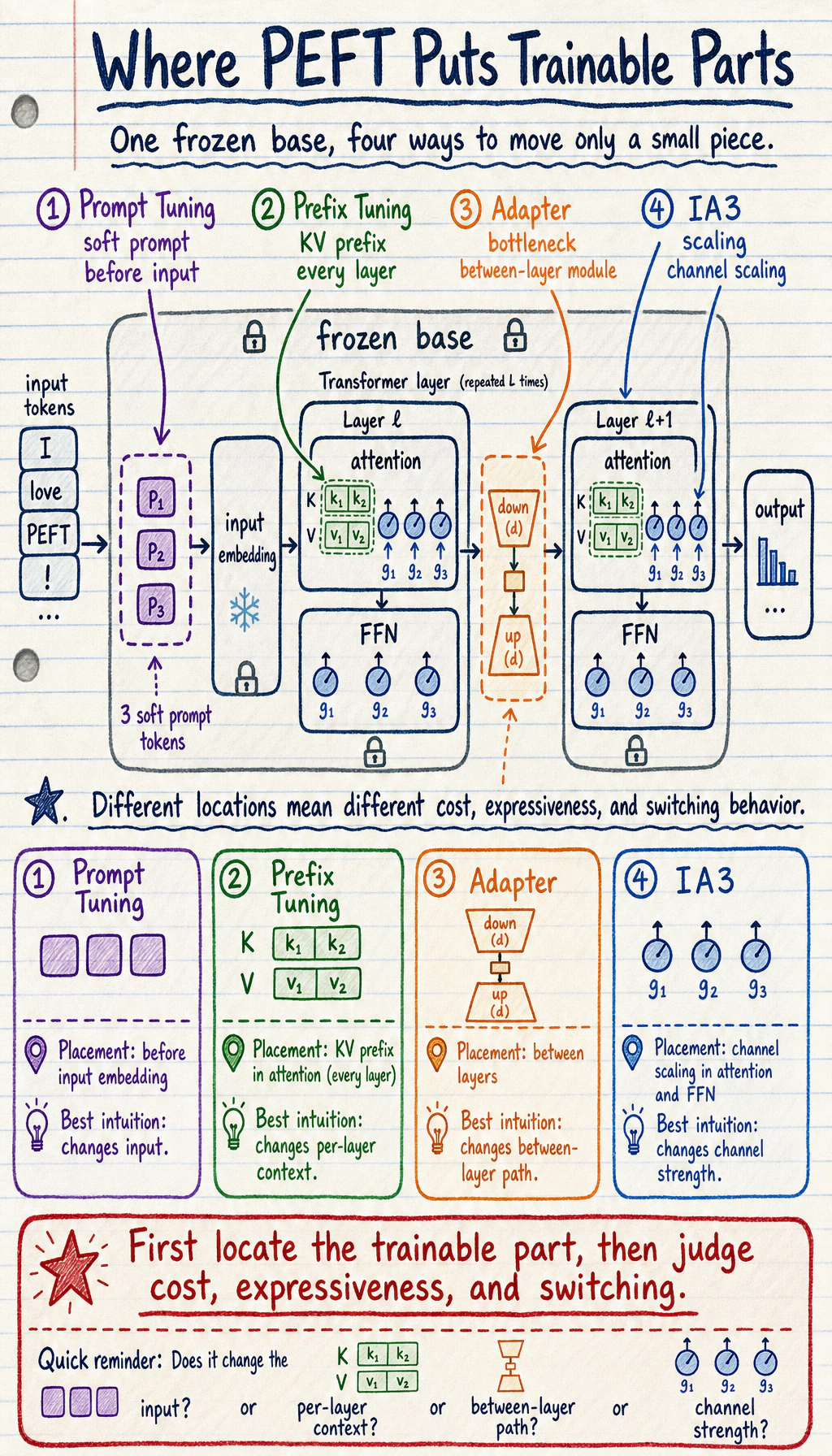
Section titled “First, clarify the PEFT family map”Prompt Tuning: put the trainable part in front of the input
Section titled “Prompt Tuning: put the trainable part in front of the input”The intuition behind Prompt Tuning is:
Instead of changing the internal structure of the model, attach a small set of trainable “soft prompts” before the input embedding.
Here, the prompt is not natural language that you manually write, but a set of trainable vectors.
Its advantages are:
- Extremely few parameters
- Clear concept and easy to understand
- Suitable when there are many tasks and each task adaptation should be very light
Its limitations are:
- Limited ability to transform complex tasks
- Mainly affects the input side, not as deep as layer-level modifications
Prefix Tuning: add “prefix context” to each layer
Section titled “Prefix Tuning: add “prefix context” to each layer”Prefix Tuning goes one step further than Prompt Tuning.
Instead of adding vectors only at the very beginning of the input, it:
prepares an extra trainable key/value prefix for the attention module in each Transformer layer.
You can think of it like this:
- Prompt Tuning is more like inserting a sentence of “task instructions” at the beginning
- Prefix Tuning is like every layer can see an extra piece of contextual guidance when doing attention
So it usually has stronger expressiveness than Prompt Tuning.
Adapter: insert a small module between layers
Section titled “Adapter: insert a small module between layers”Adapter is easy for beginners to understand because it is most like “explicitly adding a plugin.”
A common structure is:
- The original hidden state first goes through a down-projection layer
- A non-linear transformation is applied in the middle
- Then it is projected back to the original dimension
- It is added back to the main path through a residual connection
In other words:
Freeze the main path, and insert a tiny trainable side path next to it.
Its engineering advantages are very clear:
- No major changes to the original model body
- Different tasks can use different adapters
- When switching tasks, you only need to swap the small module
IA3: instead of learning a large matrix, learn “scaling coefficients”
Section titled “IA3: instead of learning a large matrix, learn “scaling coefficients””The idea behind IA3 is even more restrained:
Instead of inserting a small network or learning a large increment, only learn a small number of per-channel scaling vectors.
For example, on attention outputs or feed-forward activations, it can:
- Amplify some dimensions
- Suppress some dimensions
This means:
- Fewer parameters
- Lighter training
- But also relatively more limited expressive power
Looking at the four methods together
Section titled “Looking at the four methods together”| Method | Where it trains | Main trade-off |
|---|---|---|
| Prompt Tuning | Before the input embedding | Extremely few parameters, but limited transformation power |
| Prefix Tuning | KV prefix in each layer’s attention | More expressive than soft prompts, but more complex to implement |
| Adapter | Small bottleneck module between layers | Easy multi-task switching, but adds a little inference compute |
| IA3 | Activation scaling vector | Very lightweight, but weaker for complex behavior changes |
A small glossary for the PEFT family
Section titled “A small glossary for the PEFT family”| Term | Beginner-friendly explanation |
|---|---|
| PEFT | Parameter-Efficient Fine-Tuning: adapt a model by training only a small part of the parameters |
| Soft prompt | Trainable vectors, not readable natural-language instructions |
| KV prefix | Extra trainable key/value vectors that attention can look at |
| Bottleneck | A small down-projection then up-projection module that limits parameter count |
| Residual connection | Add the small adaptation result back to the original hidden state |
| Activation scaling | Multiply some hidden dimensions by learned factors to amplify or suppress them |
First, run a real Adapter example related to PEFT
Section titled “First, run a real Adapter example related to PEFT”The example below will do something very specific:
- Build a very small text classification task
- Freeze the base encoder
- Train only the Adapter and the classification head
This lets you directly see that:
- The main model is unchanged
- A small number of parameters can still learn the task
import torchimport torch.nn as nn
torch.manual_seed(42)
samples = [    ("refund my order", 0),    ("need a refund", 0),    ("cancel and refund", 0),    ("login failed again", 1),    ("cannot login account", 1),    ("password login problem", 1),]label_names = ["refund", "login"]
vocab = {"<pad>": 0}for text, _ in samples:    for token in text.split():        if token not in vocab:            vocab[token] = len(vocab)
max_len = max(len(text.split()) for text, _ in samples)

def encode(text):    ids = [vocab[token] for token in text.split()]    ids += [0] * (max_len - len(ids))    return ids

x = torch.tensor([encode(text) for text, _ in samples], dtype=torch.long)y = torch.tensor([label for _, label in samples], dtype=torch.long)

class FrozenBaseEncoder(nn.Module):    def __init__(self, vocab_size, hidden_dim=16):        super().__init__()        self.embedding = nn.Embedding(vocab_size, hidden_dim)        self.proj = nn.Linear(hidden_dim, hidden_dim)
        for param in self.parameters():            param.requires_grad = False
    def forward(self, token_ids):        emb = self.embedding(token_ids)        mask = (token_ids != 0).unsqueeze(-1)        pooled = (emb * mask).sum(dim=1) / mask.sum(dim=1).clamp(min=1)        hidden = torch.tanh(self.proj(pooled))        return hidden

class AdapterClassifier(nn.Module):    def __init__(self, vocab_size, hidden_dim=16, bottleneck_dim=4, num_labels=2):        super().__init__()        self.base = FrozenBaseEncoder(vocab_size, hidden_dim)        self.adapter_down = nn.Linear(hidden_dim, bottleneck_dim)        self.adapter_up = nn.Linear(bottleneck_dim, hidden_dim)        self.classifier = nn.Linear(hidden_dim, num_labels)
    def forward(self, token_ids):        hidden = self.base(token_ids)        adapted = hidden + self.adapter_up(torch.tanh(self.adapter_down(hidden)))        logits = self.classifier(adapted)        return logits

model = AdapterClassifier(vocab_size=len(vocab))optimizer = torch.optim.Adam(    [p for p in model.parameters() if p.requires_grad],    lr=0.05,)criterion = nn.CrossEntropyLoss()
total_params = sum(p.numel() for p in model.parameters())trainable_params = sum(p.numel() for p in model.parameters() if p.requires_grad)print("total params     =", total_params)print("trainable params =", trainable_params)
for step in range(201):    logits = model(x)    loss = criterion(logits, y)
    optimizer.zero_grad()    loss.backward()    optimizer.step()
    if step % 50 == 0:        preds = logits.argmax(dim=-1)        acc = (preds == y).float().mean().item()        print(f"step={step:03d} loss={loss.item():.4f} acc={acc:.2f}")
with torch.no_grad():    preds = model(x).argmax(dim=-1)    for text, pred in zip([text for text, _ in samples], preds.tolist()):        print(f"{text:22s} -> {label_names[pred]}")
Expected output:
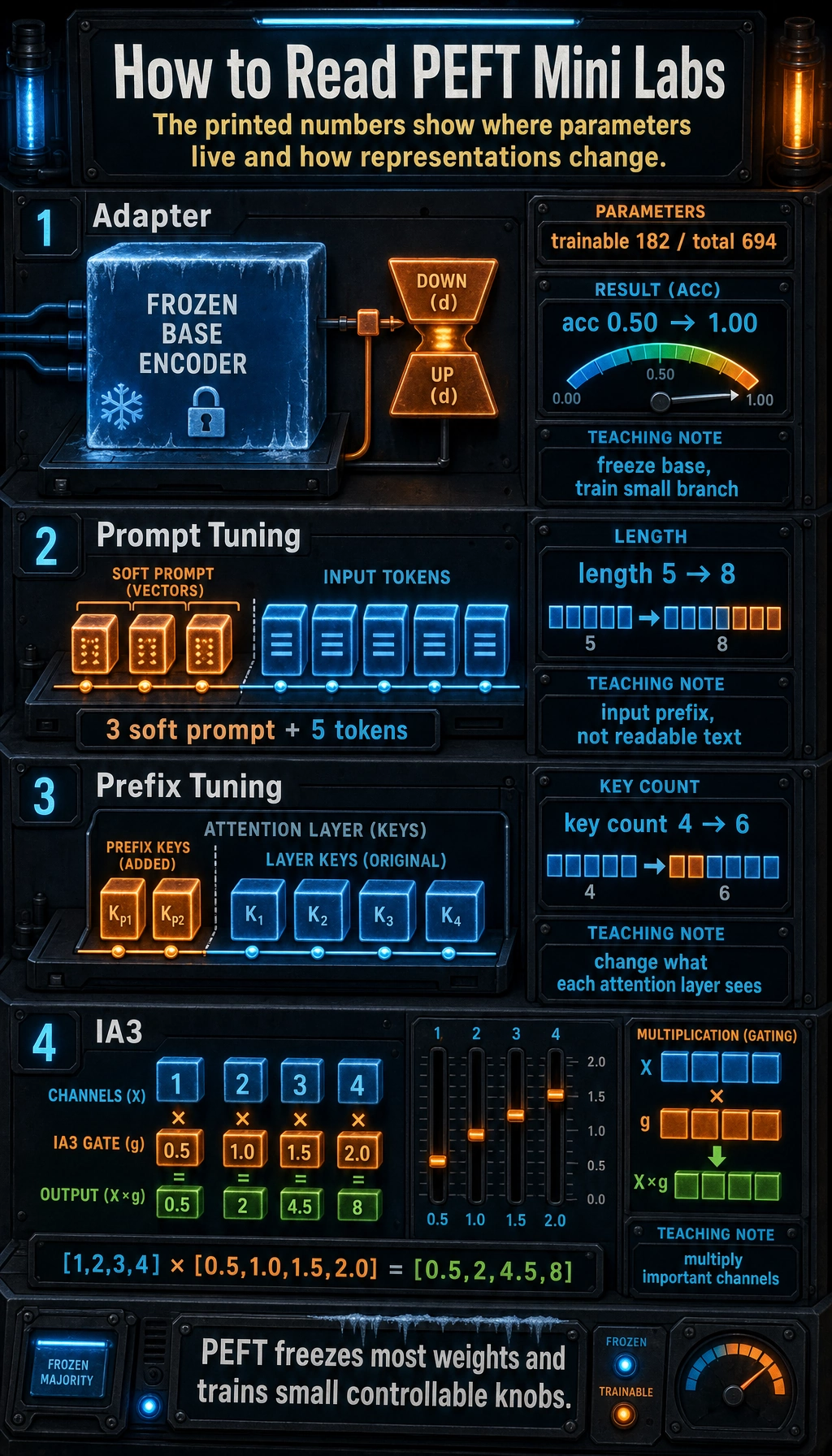
total params = 694trainable params = 182step=000 loss=0.7183 acc=0.50step=050 loss=0.0000 acc=1.00step=100 loss=0.0000 acc=1.00step=150 loss=0.0000 acc=1.00step=200 loss=0.0000 acc=1.00refund my order -> refundneed a refund -> refundcancel and refund -> refundlogin failed again -> logincannot login account -> loginpassword login problem -> loginWhat exactly does this code teach?
Section titled “What exactly does this code teach?”It is not teaching you how to build a complete production-grade fine-tuning system. Instead, it deliberately focuses on Adapter itself:
FrozenBaseEncoderis fully frozenadapter_downandadapter_upare newly added small modulesclassifiermaps the adapted representation to labels
The truly key line is this:
adapted = hidden + self.adapter_up(torch.tanh(self.adapter_down(hidden)))This is the classic Adapter idea:
- Keep the main representation
- Add a small bottleneck branch beside it
- Add it back in residual form
Why is this much better than “just printing the method name”?
Section titled “Why is this much better than “just printing the method name”?”Because now you can directly observe three things:
- Only a very small part of the parameters is trainable
- The main model does not change, yet the task can still be fit
- The new capability comes from a small inserted module, not from retraining the whole network
These three points are the essence of Adapter.
Then look at three shorter structural illustrations
Section titled “Then look at three shorter structural illustrations”Prompt Tuning: concatenate soft prompts before the input
Section titled “Prompt Tuning: concatenate soft prompts before the input”import torch
token_embeddings = torch.randn(1, 5, 8)soft_prompt = torch.randn(1, 3, 8, requires_grad=True)
combined = torch.cat([soft_prompt, token_embeddings], dim=1)print("Original length:", token_embeddings.shape[1])print("Length after concatenation:", combined.shape[1])Expected output:
Original length: 5Length after concatenation: 8The most important thing to remember here is:
- The soft prompt is not readable text
- It is a set of vectors learned during training
- What the model sees is the embedding of “extra input tokens”
Prefix Tuning: do not change the input length, change the context seen by attention in each layer
Section titled “Prefix Tuning: do not change the input length, change the context seen by attention in each layer”import torch
layer_keys = torch.randn(1, 4, 8)prefix_keys = torch.randn(1, 2, 8, requires_grad=True)
all_keys = torch.cat([prefix_keys, layer_keys], dim=1)print("Original number of attention keys:", layer_keys.shape[1])print("Number of keys after adding prefix:", all_keys.shape[1])Expected output:
Original number of attention keys: 4Number of keys after adding prefix: 6The intuition behind this illustration is:
- Normal attention only sees the original sequence
- Prefix Tuning lets each layer’s attention see an additional trainable prefix
IA3: instead of adding a module, multiply key channels by scaling factors
Section titled “IA3: instead of adding a module, multiply key channels by scaling factors”import torch
hidden = torch.tensor([[1.0, 2.0, 3.0, 4.0]])gate = torch.tensor([0.5, 1.0, 1.5, 2.0], requires_grad=True)
scaled = hidden * gateprint("before:", hidden)print("after :", scaled)Expected output:
before: tensor([[1., 2., 3., 4.]])after : tensor([[0.5000, 2.0000, 4.5000, 8.0000]], grad_fn=<MulBackward0>)The core of IA3 is not “becoming more complex,” but “making lightweight adjustments only at the most important positions.”
How should you choose?
Section titled “How should you choose?”If you care most about task switching and modularity
Section titled “If you care most about task switching and modularity”Think first about:
- Adapter
Because it is naturally suitable for:
- One base model
- Many small adapters attached to it
- Loading different adapters for different tasks
If you care most about having even fewer parameters
Section titled “If you care most about having even fewer parameters”You can first look at:
- Prompt Tuning
- IA3
These methods are very lightweight, but keep in mind:
- Fewer parameters does not automatically mean better results
- For complex tasks, expressive power may not be enough
If you want deeper intervention
Section titled “If you want deeper intervention”You can look at:
- Prefix Tuning
Because it affects not only the very beginning of the input, but also how each layer’s attention reads context.
If you want a default industrial choice to try first
Section titled “If you want a default industrial choice to try first”In practice, many teams still try:
- LoRA / QLoRA
The reason is simple:
- Mature ecosystem
- Rich tooling
- Lots of community experience
So this section is not asking you to abandon LoRA, but to let you know:
LoRA is only the most commonly used piece of the PEFT map, not the whole map.
These misconceptions are very common
Section titled “These misconceptions are very common”Misconception 1: fewer parameters always means more advanced
Section titled “Misconception 1: fewer parameters always means more advanced”Not necessarily. Fewer parameters mean:
- Cheaper training
But they can also mean:
- More limited expressive power
Misconception 2: the more method names you know, the more you understand
Section titled “Misconception 2: the more method names you know, the more you understand”What you really need to know is:
- What does it change?
- Which part of the information flow does it affect?
- Why is it suitable for the current task?
Misconception 3: treating the “trainable module” as the only thing that matters
Section titled “Misconception 3: treating the “trainable module” as the only thing that matters”Don’t forget that success also depends heavily on:
- Data quality
- Prompt/template format
- Evaluation method
- Whether fine-tuning is really needed
Evidence to Keep
Section titled “Evidence to Keep”Keep this page’s proof of learning as a small evidence card:
- Method Family
- adapters, prefix/prompt tuning, IA3, or LoRA-like route
- Changed Part
- which parameters or prompts are trained
- Fit
- when this method is appropriate
- Tradeoff
- quality, memory, latency, and engineering complexity
- Decision
- compare against LoRA and prompt baseline
Summary
Section titled “Summary”What you should take away from this section is not the four names, but one main thread:
The essence of PEFT is to insert a small amount of trainable capability at an appropriate location, while changing the large model body as little as possible.
When you encounter a new PEFT variant later, you can also break it down with the same questions:
- Where does it place the trainable parameters?
- Does it affect the input, the inside of a layer, or the space between layers?
- What engineering benefits does it bring, and what does it sacrifice?
Once these three things are clear, method names will no longer feel mysterious.
Exercises
Section titled “Exercises”- Explain in your own words which part of the model Prompt Tuning, Prefix Tuning, Adapter, and IA3 each modify.
- If you want to adapt one base model to 20 different business tasks at the same time, why is Adapter often attractive?
- Change
bottleneck_dimin the Adapter code in this section to a larger or smaller value, and observe how the number of trainable parameters changes. - Think about it: if your hardware is very limited but the task is fairly complex, which PEFT method would you try first? Why?
Reference implementation and walkthrough
- Prompt Tuning learns soft prompt vectors near the input. Prefix Tuning learns prefix states that influence attention. Adapter inserts small trainable modules inside layers. IA3 learns scaling vectors that modulate activations.
- Adapters let each task keep a small task-specific module while sharing the same base model. That makes storage, switching, and multi-task management easier than maintaining many full model copies.
- A larger
bottleneck_dimincreases adapter capacity and trainable parameters. A smaller value saves memory and reduces overfitting risk, but may be too weak for complex behavior changes. - For very limited hardware and a complex task, LoRA or a compact Adapter is often a practical first try. Pure Prompt Tuning may be cheaper, but it can be too weak when the task needs deeper behavior adaptation.