
5.6.5 Kaggle Competition Practice (Elective)
Learning Objectives
Section titled “Learning Objectives”- Understand the Kaggle platform and competition workflow
- Learn how to participate in a beginner-level competition (Titanic)
- Learn techniques from high-quality Notebooks
Key Terms Before You Read the Code
Section titled “Key Terms Before You Read the Code”- Notebook means an online or local interactive document, usually Jupyter-style, where text, code, output, and charts are written together.
- Leaderboard is Kaggle’s public ranking table. It is useful feedback, but overusing it can make you overfit the public test set.
- Submission file is the CSV file you upload for scoring. Its column names and row order must match the competition rules exactly.
- Public score vs. local validation: the public score comes from Kaggle’s hidden labels, while local validation comes from your own split. If they disagree, your validation setup may be unreliable.
- Baseline is the first simple model used as a comparison point. Without a baseline, you cannot tell whether later changes truly improved the project.
First, Build a Map
Section titled “First, Build a Map”The easiest way for beginners to go wrong on Kaggle is to focus only on the leaderboard and not know what they are actually practicing.
A better way to understand it is:
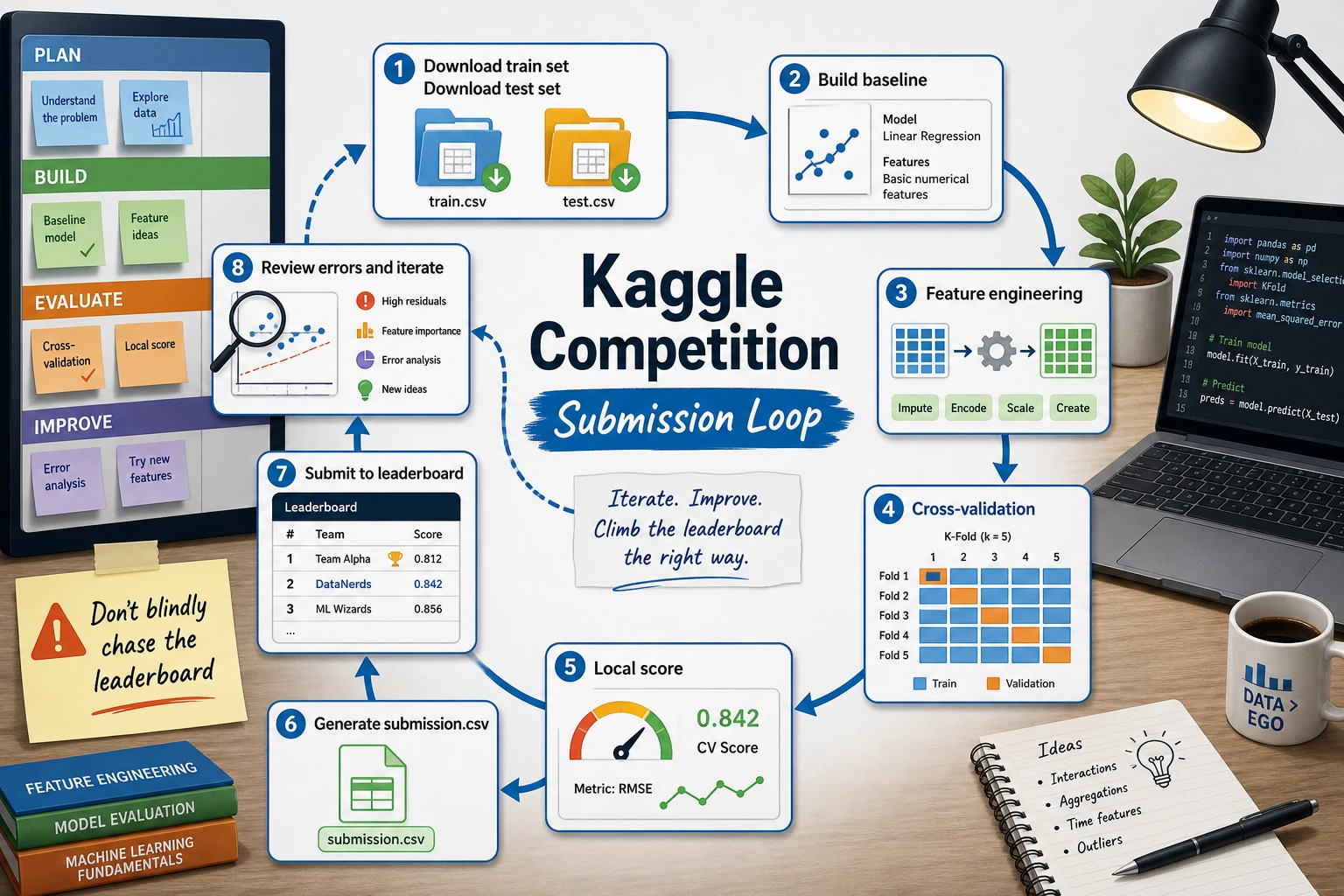
flowchart LR A["Competition data"] --> B["EDA"] B --> C["Feature engineering"] C --> D["Build a baseline"] D --> E["Cross-validation"] E --> F["Submit"] F --> G["Keep iterating based on results"]So the most important thing in this section is not “how high a score can you get,” but how to put the entire ML workflow you learned earlier into a real evaluation environment.
What You Really Need to Practice Here
Section titled “What You Really Need to Practice Here”What is most valuable for beginners on Kaggle is not really “what rank did I get,” but:
- Completing a full project for the first time with real data and real evaluation rules
- Learning to turn baseline, cross-validation, feature engineering, and submission records into a closed loop
- Learning to tell whether “good local validation” and “good leaderboard score” are actually the same thing
Kaggle Platform Basics
Section titled “Kaggle Platform Basics”Core Features
Section titled “Core Features”| Feature | Description |
|---|---|
| Competitions | Competitions (beginner / standard / prize) |
| Datasets | Massive free datasets |
| Notebooks | Online Jupyter environment (free GPU) |
| Discussion | Forum (learn from others’ ideas) |
| Learn | Official free courses |
Competition Workflow
Section titled “Competition Workflow”flowchart LR A["Join competition"] --> B["Download data"] B --> C["EDA exploration"] C --> D["Feature engineering"] D --> E["Train model"] E --> F["Generate submission file"] F --> G["Upload submission.csv"] G --> H["Check leaderboard"] H --> |"Improve"|C
style A fill:#e3f2fd,stroke:#1565c0,color:#333 style E fill:#fff3e0,stroke:#e65100,color:#333 style H fill:#e8f5e9,stroke:#2e7d32,color:#333Beginner Competition: Titanic Survival Prediction
Section titled “Beginner Competition: Titanic Survival Prediction”Full Solution Workflow
Section titled “Full Solution Workflow”import pandas as pdimport numpy as npfrom sklearn.ensemble import RandomForestClassifier, GradientBoostingClassifierfrom sklearn.model_selection import cross_val_scorefrom sklearn.pipeline import Pipelinefrom sklearn.compose import ColumnTransformerfrom sklearn.preprocessing import StandardScaler, OneHotEncoderfrom sklearn.impute import SimpleImputer
# 1. Load data (download from Kaggle or use seaborn)import seaborn as snsdf = sns.load_dataset('titanic').dropna(subset=['embarked'])
# 2. Feature engineeringdf['family_size'] = df['sibsp'] + df['parch'] + 1df['is_alone'] = (df['family_size'] == 1).astype(int)
# 3. Define featuresnum_features = ['age', 'fare', 'family_size']cat_features = ['sex', 'embarked', 'class']all_features = num_features + cat_features
X = df[all_features]y = df['survived']
# 4. Build Pipelinepreprocessor = ColumnTransformer([ ('num', Pipeline([ ('imputer', SimpleImputer(strategy='median')), ('scaler', StandardScaler()), ]), num_features), ('cat', Pipeline([ ('imputer', SimpleImputer(strategy='most_frequent')), ('encoder', OneHotEncoder(drop='first', sparse_output=False)), ]), cat_features),])
# 5. Model comparisonmodels = { 'Random Forest': RandomForestClassifier(n_estimators=200, random_state=42), 'GBDT': GradientBoostingClassifier(n_estimators=200, random_state=42),}
for name, model in models.items(): pipe = Pipeline([ ('preprocessor', preprocessor), ('classifier', model), ]) scores = cross_val_score(pipe, X, y, cv=5, scoring='accuracy') print(f"{name}: {scores.mean():.4f} ± {scores.std():.4f}")What Is the Safest Goal for Your First Kaggle Competition?
Section titled “What Is the Safest Goal for Your First Kaggle Competition?”When you play Kaggle for the first time, it is not recommended to set your goal as “ranking up.” A safer goal is:
- Submit your first valid result
- Build a clear baseline
- Complete at least two rounds of documented improvements
- Be able to explain why each change improved the score or why it did not
If you can do these four things, you have already learned the most important parts.
Generate a Submission File
Section titled “Generate a Submission File”# Standard submission format in Kaggle competitions# Assume test_df is the test set# pipe.fit(X_train, y_train)# predictions = pipe.predict(test_df[all_features])## submission = pd.DataFrame({# 'PassengerId': test_df['PassengerId'],# 'Survived': predictions# })# submission.to_csv('submission.csv', index=False)# print(f"Submission file shape: {submission.shape}")Techniques for Improving Competition Scores
Section titled “Techniques for Improving Competition Scores”Score Improvement Path
Section titled “Score Improvement Path”| Stage | Focus | Expected Improvement |
|---|---|---|
| Baseline | Simple model + default parameters | — |
| Feature engineering | Create new features, optimize encoding | Significant |
| Model selection | Try multiple models | Moderate |
| Hyperparameter tuning | GridSearch / Optuna | Small |
| Model ensembling | Stacking / Blending | Small but stable |
Common Pitfalls for Beginners on Kaggle
Section titled “Common Pitfalls for Beginners on Kaggle”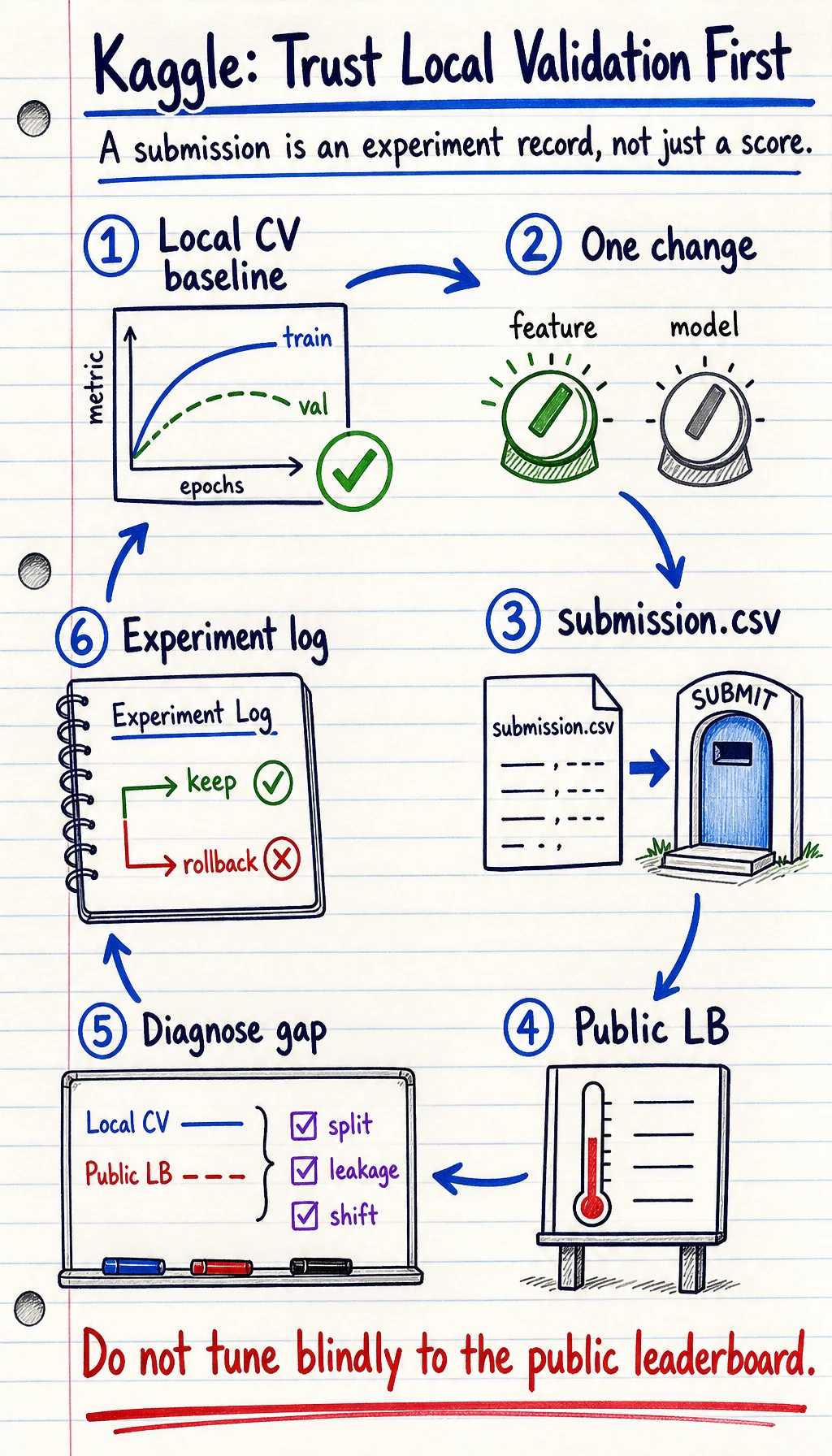
- Repeatedly trying things on the public leaderboard and overfitting to it
- Having no local cross-validation and only watching the online score
- Changing too many things at once, so you cannot tell what caused the improvement
- Copying a high-scoring Notebook directly, without being able to explain what you actually learned
So a safer approach is:
- First make your local validation process solid
- Change only one major factor at a time
- Turn every submission into an experiment record
Learn from High-Quality Notebooks
Section titled “Learn from High-Quality Notebooks”| What to Look At | Why |
|---|---|
| Most upvoted Notebooks | Community-approved ideas |
| EDA Notebooks | Learn data exploration techniques |
| High-ranking competitors’ shared notebooks | Learn feature engineering and ensembling strategies |
| Discussion section | Understand data leakage, scoring pitfalls, and more |
Recommended Beginner Competitions
Section titled “Recommended Beginner Competitions”| Competition | Type | Difficulty | Description |
|---|---|---|---|
| Titanic | Classification | Beginner | Classic starter competition with rich community resources |
| House Prices | Regression | Beginner | House price prediction, good for feature engineering practice |
| Digit Recognizer | Image classification | Beginner | MNIST, can try a simple CNN |
| Spaceship Titanic | Classification | Beginner | An upgraded version of Titanic |
The Safest Way for Beginners to Participate in Kaggle
Section titled “The Safest Way for Beginners to Participate in Kaggle”- Choose only beginner-level tasks
- Build a baseline first, and do not chase complex ensembling
- Change only one thing at a time
- Record what changed in each submission and why the score changed
This way, you learn a method, not just how to copy a high-scoring Notebook.
If You Treat Kaggle as a Course Training Ground, How Should You Use It?
Section titled “If You Treat Kaggle as a Course Training Ground, How Should You Use It?”A very recommended way is:
- Use Kaggle to find a real-world task
- Use the methods from the course to build a baseline
- Iterate using the evaluation and feature engineering ideas from the course
- Finally, organize the results into your own project review
In this way, Kaggle will not lead you into “just chasing rankings,” but instead become the best practical amplifier for the fifth stage.
Suggested Version Roadmap
Section titled “Suggested Version Roadmap”| Version | Goal | Delivery Focus |
|---|---|---|
| Basic version | Get the minimum loop working | Can input, process, and output, while keeping one set of examples |
| Standard version | Form a presentable project | Add configuration, logs, error handling, README, and screenshots |
| Challenge version | Close to portfolio quality | Add evaluation, comparison experiments, failure sample analysis, and next-step roadmap |
It is recommended to finish the basic version first. Do not try to make everything complete from the start. Each time you level up, write into the README what new capabilities were added, how they were verified, and what issues remain.
Evidence to Keep
Section titled “Evidence to Keep”Keep this page’s proof of learning as a small evidence card:
- Project Goal
- prediction, segmentation, Kaggle, or end-to-end ML portfolio target
- Pipeline
- data split, preprocessing, model, evaluation, and report artifacts
- Result
- metric table, chart, predictions, failure samples, and README note
- Failure Check
- non-reproducible run, leakage, overfitting, weak baseline, or missing deployment boundary
- Expected Output
- ML project folder with pipeline, metrics, and failure review
Summary
Section titled “Summary”| Key Point | Description |
|---|---|
| Start with beginner competitions | Titanic / House Prices |
| Build a baseline before optimizing | Do not jump into complex models right away |
| Study excellent Notebooks | Learn from the best |
| Feature engineering matters most | It gives much more return than tuning |
| Keep submitting and iterating | Submit every improvement and check the effect |
Hands-on Challenges
Section titled “Hands-on Challenges”Challenge 1: Titanic Sprint to 0.80+
Section titled “Challenge 1: Titanic Sprint to 0.80+”Register an account on Kaggle, join the Titanic competition, and use all the skills learned in this course (feature engineering + Pipeline + model tuning) to try to reach a score of 0.80+.
Challenge 2: House Prices Practice
Section titled “Challenge 2: House Prices Practice”Join Kaggle’s House Prices competition, use a larger dataset to practice regression tasks, and focus on missing value handling and high-dimensional categorical feature encoding.
Project reference and review notes
- For Titanic, reaching 0.80+ is a stretch target. The real learning target is a reproducible baseline, feature iteration, validation record, and submission log.
- Use
Pipelineor an equivalent reproducible workflow so preprocessing is applied consistently. Never use test labels or leaderboard feedback as if it were validation data. - Change one major factor per submission and record what changed, local validation score, public score, and your interpretation.
- For House Prices, prioritize missing-value strategy, categorical encoding, and cross-validation before trying complex ensembles.
- Studying notebooks is useful only if you can explain why an idea works and adapt it to your own pipeline.