
9.9.3 Runtime Management
Learning Objectives
Section titled “Learning Objectives”- Understand what concurrency, timeouts, retries, and circuit breakers are protecting against
- Learn how to build a minimal runtime manager
- Understand why runtime metrics are just as important as model metrics
- Build an engineering mindset that prioritizes system stability over one-off success
Why are Agents especially prone to runtime problems?
Section titled “Why are Agents especially prone to runtime problems?”One request is often not one call
Section titled “One request is often not one call”A typical Agent workflow includes:
- Model inference
- Tool calling
- Retrieval
- Another round of inference
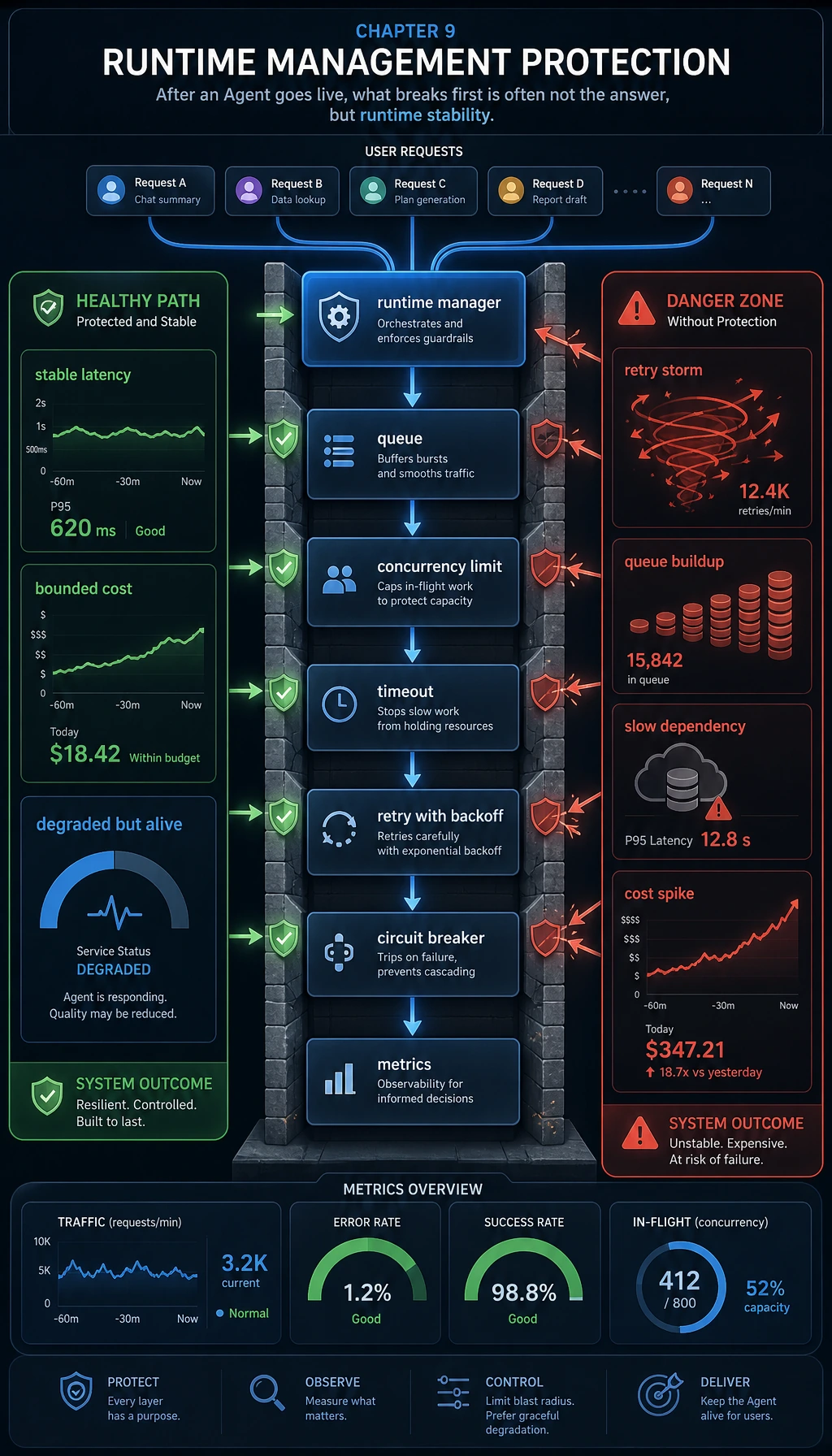
This means a single user request may contain several sub-calls. The longer the chain, the more runtime fluctuations are amplified.
What shows up first after deployment is often not “wrong answers,” but “unstable execution”
Section titled “What shows up first after deployment is often not “wrong answers,” but “unstable execution””Typical symptoms:
- More timeouts under high concurrency
- Retry storms after temporary upstream failures
- Requests queuing too long
- A few slow requests dragging down overall throughput
So runtime management is essentially about protecting system availability.
The four most important runtime mechanisms
Section titled “The four most important runtime mechanisms”Concurrency control
Section titled “Concurrency control”Limit the number of tasks running at the same time so resources are not exhausted all at once.
Timeouts
Section titled “Timeouts”Set a boundary for each step to prevent requests from hanging forever.
Retries
Section titled “Retries”Retry only a limited number of times for temporary errors, instead of starting over for every error.
Circuit breaking
Section titled “Circuit breaking”When a dependency keeps failing, stop calling it for a while to avoid amplifying the failure.
First, run a minimal runtime manager
Section titled “First, run a minimal runtime manager”import asyncio
class AgentRuntime: def __init__(self, max_concurrency=2, timeout_sec=0.8, max_retries=1, breaker_threshold=2): self.semaphore = asyncio.Semaphore(max_concurrency) self.timeout_sec = timeout_sec self.max_retries = max_retries self.breaker_threshold = breaker_threshold
self.breaker_open = False self.failure_streak = 0 self.metrics = { "total": 0, "success": 0, "timeout": 0, "error": 0, "retry": 0, "rejected_by_breaker": 0, "latency_ms_total": 0.0, }
async def _upstream_call(self, task): await asyncio.sleep(task["latency"]) if task.get("should_fail"): raise RuntimeError("upstream_error") return {"task_id": task["id"], "result": f"ok:{task['payload']}"}
async def handle(self, task): self.metrics["total"] += 1
if self.breaker_open: self.metrics["rejected_by_breaker"] += 1 return {"ok": False, "error": "circuit_open"}
last_error = None
for attempt in range(self.max_retries + 1): if attempt > 0: self.metrics["retry"] += 1
try: async with self.semaphore: result = await asyncio.wait_for( self._upstream_call(task), timeout=self.timeout_sec, )
latency_ms = task["latency"] * 1000 self.metrics["success"] += 1 self.metrics["latency_ms_total"] += latency_ms self.failure_streak = 0 return {"ok": True, "result": result, "attempts": attempt + 1}
except asyncio.TimeoutError: last_error = "timeout" if attempt == self.max_retries: self.metrics["timeout"] += 1 self.failure_streak += 1 break except Exception as e: last_error = str(e) if attempt == self.max_retries: self.metrics["error"] += 1 self.failure_streak += 1 break
if self.failure_streak >= self.breaker_threshold: self.breaker_open = True
return {"ok": False, "error": last_error}
def summary(self): avg_latency = ( self.metrics["latency_ms_total"] / self.metrics["success"] if self.metrics["success"] else 0.0 ) return {**self.metrics, "avg_latency_ms": round(avg_latency, 2)}
async def main(): runtime = AgentRuntime(max_concurrency=2, timeout_sec=0.7, max_retries=1, breaker_threshold=2)
tasks = [ {"id": "r1", "payload": "refund", "latency": 0.2}, {"id": "r2", "payload": "slow", "latency": 1.0}, {"id": "r3", "payload": "fail", "latency": 0.1, "should_fail": True}, {"id": "r4", "payload": "normal", "latency": 0.3}, {"id": "r5", "payload": "after_breaker", "latency": 0.1}, ]
results = [] for task in tasks: results.append(await runtime.handle(task))
print("results:") for item in results: print(item)
print("\nmetrics:") print(runtime.summary()) print("breaker_open:", runtime.breaker_open)
asyncio.run(main())Expected output:
results:{'ok': True, 'result': {'task_id': 'r1', 'result': 'ok:refund'}, 'attempts': 1}{'ok': False, 'error': 'timeout'}{'ok': False, 'error': 'upstream_error'}{'ok': False, 'error': 'circuit_open'}{'ok': False, 'error': 'circuit_open'}
metrics:{'total': 5, 'success': 1, 'timeout': 1, 'error': 1, 'retry': 2, 'rejected_by_breaker': 2, 'latency_ms_total': 200.0, 'avg_latency_ms': 200.0}breaker_open: True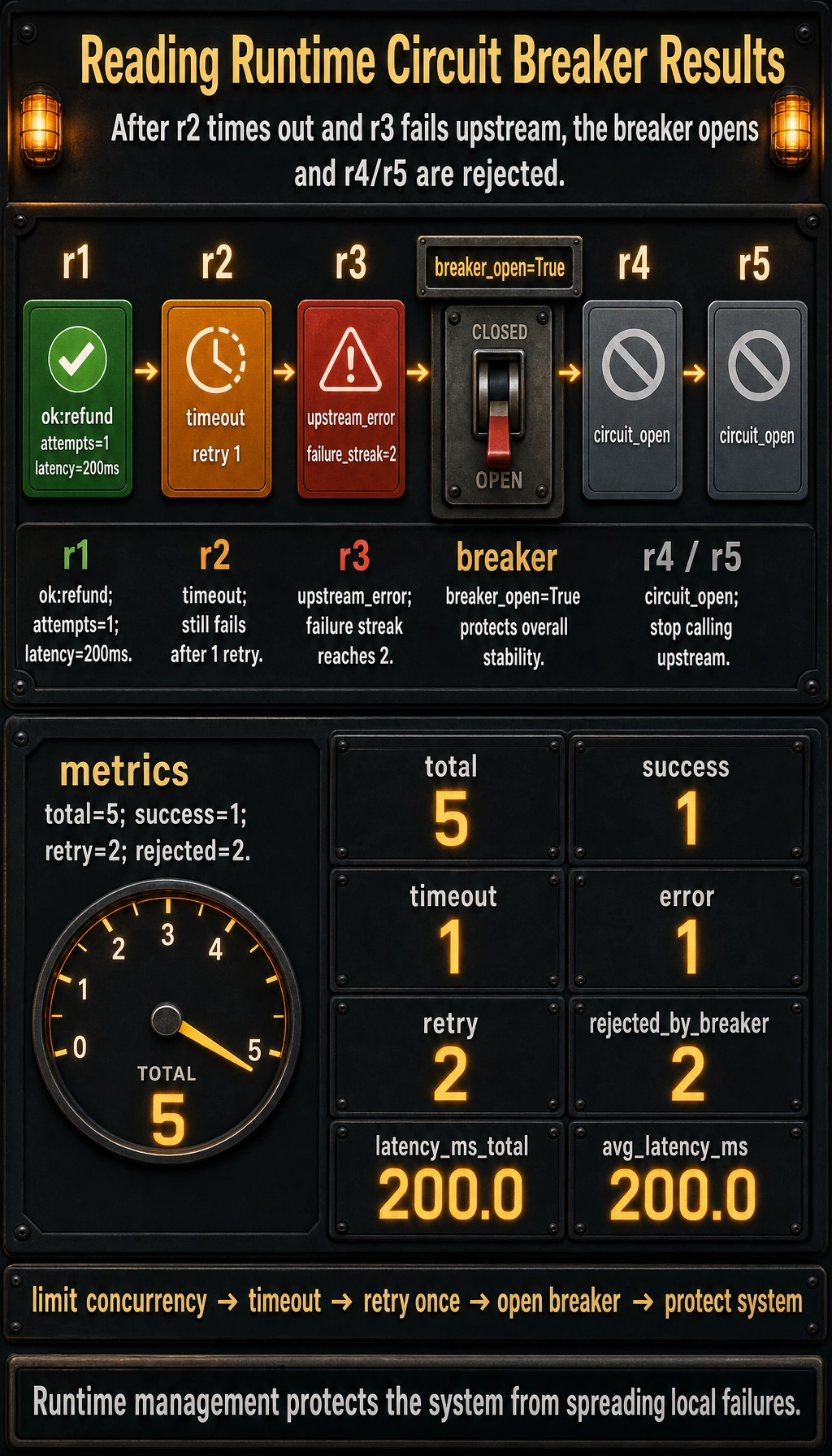
Which parts of this code should you pay the most attention to?
Section titled “Which parts of this code should you pay the most attention to?”Semaphore: concurrency limitingwait_for: timeoutattempt > 0: retry countingbreaker_open: circuit breaking
Why is this already very close to real runtime problems?
Section titled “Why is this already very close to real runtime problems?”Because it covers three real production scenarios:
- Normal success
- Slow requests timing out
- Continuous failures triggering protection
How should runtime metrics be interpreted?
Section titled “How should runtime metrics be interpreted?”Start with these:
success / total: success ratetimeout / total: timeout rateretry / total: retry ratiorejected_by_breaker: number of requests rejected by the circuit breakeravg_latency_ms: average successful latency
If the timeout rate is high, check first:
- Is the upstream service slow?
- Is the timeout threshold too small?
- Is concurrency too high, causing queueing?
If the retry ratio is high, check first:
- Are you retrying errors that cannot be recovered?
- Is the upstream service unstable?
The most common runtime optimization directions
Section titled “The most common runtime optimization directions”Rate limiting and backpressure
Section titled “Rate limiting and backpressure”When the system is close to saturation, you should actively:
- Reject low-priority requests
- Or cap the queue length
Fallback and degradation
Section titled “Fallback and degradation”For example:
- Disable expensive tool chains
- Switch to cached results
- Return a lighter-weight safe response
Use different policies for different dependencies
Section titled “Use different policies for different dependencies”Different tools should not share exactly the same:
- Timeout
- Retry
- Circuit-breaker thresholds
Because their stability and cost are different.
Most common misconceptions
Section titled “Most common misconceptions”Misconception 1: Higher concurrency is always better
Section titled “Misconception 1: Higher concurrency is always better”Too much concurrency can directly overwhelm both your system and the upstream service.
Misconception 2: Retries always improve success rate
Section titled “Misconception 2: Retries always improve success rate”If error classification is wrong, retries will only amplify the failure.
Misconception 3: Only look at average latency
Section titled “Misconception 3: Only look at average latency”High-percentile latency and timeout rate often reflect the real user experience much better.
Evidence to Keep
Section titled “Evidence to Keep”Keep this page’s proof of learning as a small evidence card:
- Runtime
- queues, workers, state store, tool services, and model endpoint
- Persistence
- checkpoints, event log, memory store, and recovery path
- Ops Signal
- latency, cost, error rate, trace coverage, and saturation
- Failure Check
- stuck run, duplicate action, partial failure, or runaway cost
- Recovery Action
- resume, rollback, cancel, human handoff, or degrade gracefully
Summary
Section titled “Summary”The most important thing in this section is to build a deployment mindset:
The core of Agent runtime management is not to keep trying until every request succeeds, but to protect overall system stability with concurrency control, timeouts, retries, and circuit breaking.
Once this layer is in place, the system truly has a foundation for production deployment.
Exercises
Section titled “Exercises”- Change the example
max_concurrencyto1and3, and compare the results. - Increase
timeout_secand observe how the timeout rate changes. - Why can’t “number of retries” be designed independently of “error type”?
- Think about it: if a certain tool is especially expensive, what protection would you add at the runtime layer?
Reference implementation and walkthrough
- With
max_concurrency=1, runs are easier to reason about but slower. Withmax_concurrency=3, throughput improves, but shared resources, rate limits, and trace ordering become more important. - Increasing
timeout_secshould reduce timeout errors for slow but healthy calls, but it can also make stuck tasks occupy runtime capacity longer. Watch both success rate and waiting time. - Retries depend on error type: timeout and temporary rate limit may be retried, validation errors should be fixed before retry, and permission errors should stop or ask for approval.
- For an expensive tool, add budget limits, concurrency limits, caching, pre-checks, cheaper fallback models or tools, and alerts when spending or call volume exceeds the expected range.