
E.B.4 Metaprogramming
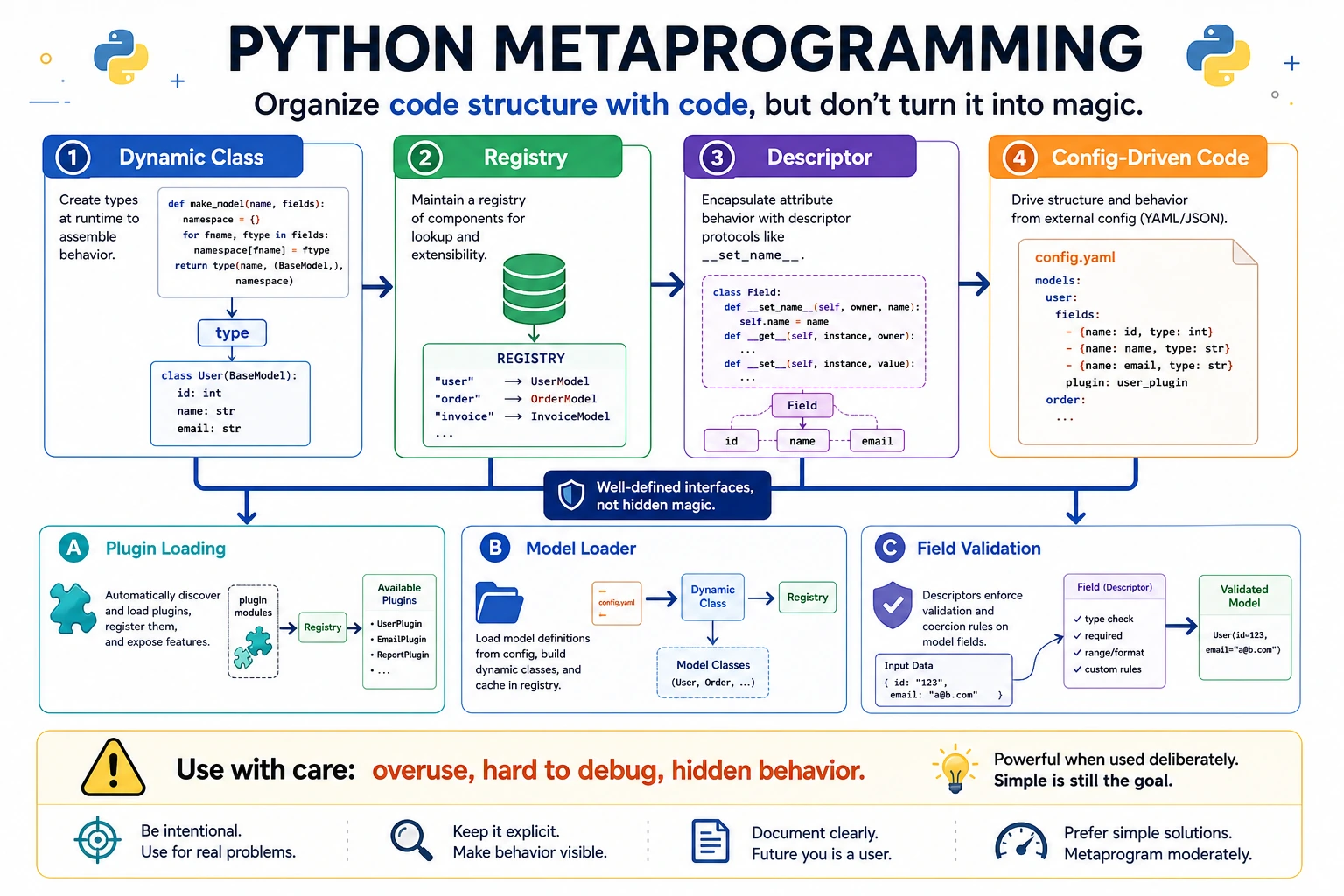
Metaprogramming means using code to organize or generate code structure. In day-to-day Python engineering, the most useful version is usually not clever magic; it is automatic registration, field validation, and reducing repeated boilerplate.
What You Need
Section titled “What You Need”- Python 3.10+
- No external packages
- Comfort with classes
Key Terms
Section titled “Key Terms”- Registry: a mapping that remembers available implementations.
- Decorator registration: using a decorator to add a class or function to a registry.
- Descriptor: an object that controls attribute read/write behavior.
__set_name__: lets a descriptor know which attribute name it was assigned to.- Dynamic class: a class created at runtime, often with
type.
Run A Registry And Descriptor Example
Section titled “Run A Registry And Descriptor Example”Create metaprogramming_demo.py:
REGISTRY = {}

def register(name):    def decorator(cls):        REGISTRY[name] = cls        return cls
    return decorator

@register("csv")class CsvLoader:    def load(self):        return "csv rows"

@register("json")class JsonLoader:    def load(self):        return "json rows"

class NonEmpty:    def __set_name__(self, owner, name):        self.private_name = "_" + name
    def __get__(self, instance, owner):        if instance is None:            return self        return getattr(instance, self.private_name, None)
    def __set__(self, instance, value):        if not value:            raise ValueError("name cannot be empty")        setattr(instance, self.private_name, value)

class JobConfig:    name = NonEmpty()

loader = REGISTRY["json"]()print(loader.load())print(sorted(REGISTRY))
config = JobConfig()config.name = "daily-import"print(config.name)
try:    config.name = ""except ValueError as error:    print("error:", error)
Run it:
python metaprogramming_demo.pyExpected output:
json rows['csv', 'json']daily-importerror: name cannot be emptyThe registry removes a manual mapping table. The descriptor keeps validation next to the field definition.
Review The Magic Boundary
Section titled “Review The Magic Boundary”Metaprogramming is acceptable when the magic boundary is easy to inspect. In this example, REGISTRY is printed, and invalid config raises a visible error. That makes the dynamic behavior reviewable instead of mysterious.
When using this pattern in an AI system, prefer explicit registry names such as retriever, reranker, summarizer, or validator. Avoid dynamic behavior that silently changes based on hidden imports. A teammate should be able to print the registry and understand which tools are available.
When It Is Worth Using
Section titled “When It Is Worth Using”Metaprogramming is useful when:
- Many classes need automatic registration.
- A framework needs to discover plugins.
- Many fields share the same validation behavior.
- Configuration should generate repeated structure.
Avoid it when a normal class or dictionary is clearer.
Review The Magic Boundary
Section titled “Review The Magic Boundary”Metaprogramming is helpful only when the generated behavior is still easy to discover. Before keeping a registry, dynamic import, or decorator-based loader, write down how a teammate would find the available tools and how they would disable one broken entry.
If the answer requires reading hidden import side effects, the abstraction is too magical. Prefer explicit names, printed registry contents, and small tests that prove the right handler was selected for the right input.
Evidence to Keep
Section titled “Evidence to Keep”Keep this page’s proof of learning as a small evidence card:
- Python Pattern
- decorator, iterator, generator, concurrency primitive, or metaprogramming hook
- Code Artifact
- minimal runnable example plus printed output
- Use Case
- where this pattern improves an AI app, pipeline, tool, or server
- Failure Check
- hidden side effects, unreadable abstraction, race condition, or overengineering
- Expected Output
- small advanced-Python example with a practical AI-system use note
Common Mistakes
Section titled “Common Mistakes”- Using dynamic tricks just to look advanced.
- Hiding behavior so deeply that debugging becomes painful.
- Removing small, harmless repetition at the cost of readability.
Practice
Section titled “Practice”Add a yaml loader and confirm sorted(REGISTRY) includes it. Then create an IntegerRange(min_value, max_value) descriptor for a retry_count field.
Reference implementation and walkthrough
The yaml loader should register itself through the same mechanism as the existing loaders, so sorted(REGISTRY) includes yaml without manually editing a separate mapping table.
For IntegerRange, the descriptor should reject non-integers and values outside the allowed range. A useful self-check sets retry_count = 3, then tries retry_count = -1 or "3" and confirms a clear exception appears. The point is not cleverness; it is keeping repeated validation rules close to the field definition.