
7.2.3 Core Concepts of Large Models
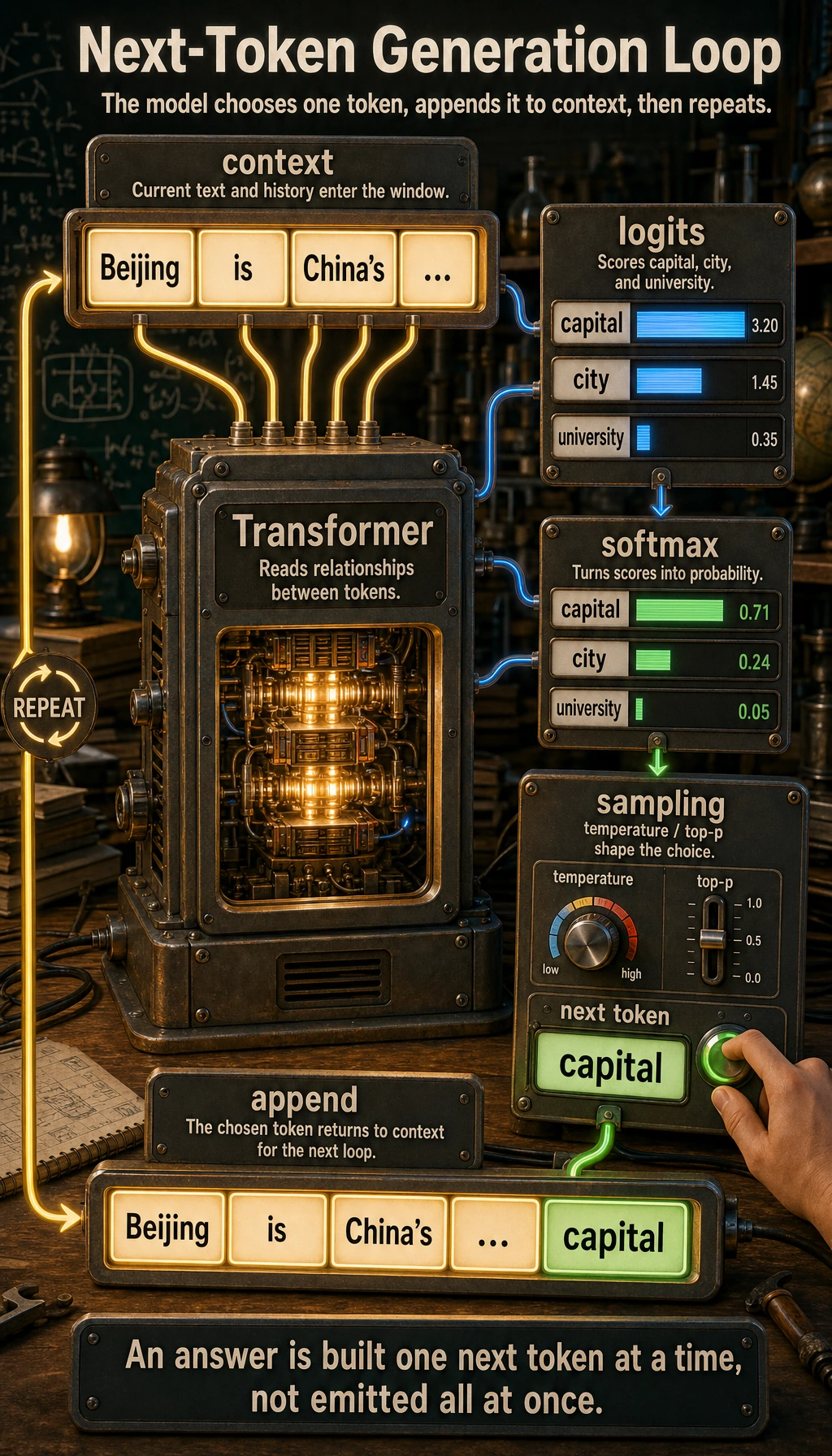
Concept Map
Section titled “Concept Map”| Concept | Practical meaning |
|---|---|
| token | the unit the model reads and writes |
| context window | token budget shared by system prompt, history, evidence, user question, and output |
| embedding | vector representation of tokens |
| attention | relevance-weighted information mixing across tokens |
| logits | raw scores before probabilities |
| temperature | knob that flattens or sharpens the probability distribution |
| pretraining | broad capability from large-scale text |
| instruction tuning / alignment | makes capability behave more like an assistant |
Lab 1: Next-Token Prediction
Section titled “Lab 1: Next-Token Prediction”import numpy as np
context = "Beijing is China's"candidates = ["capital", "city", "university"]logits = np.array([4.0, 2.0, 0.5])
def softmax(x): e = np.exp(x - x.max()) return e / e.sum()
probs = softmax(logits)best = candidates[np.argmax(probs)]
print("Context:", context)for token, prob in zip(candidates, probs): print(f"Candidate token={token}, probability={prob:.3f}")print("Most likely next token:", best)Expected output:
Context: Beijing is China'sCandidate token=capital, probability=0.858Candidate token=city, probability=0.116Candidate token=university, probability=0.026Most likely next token: capital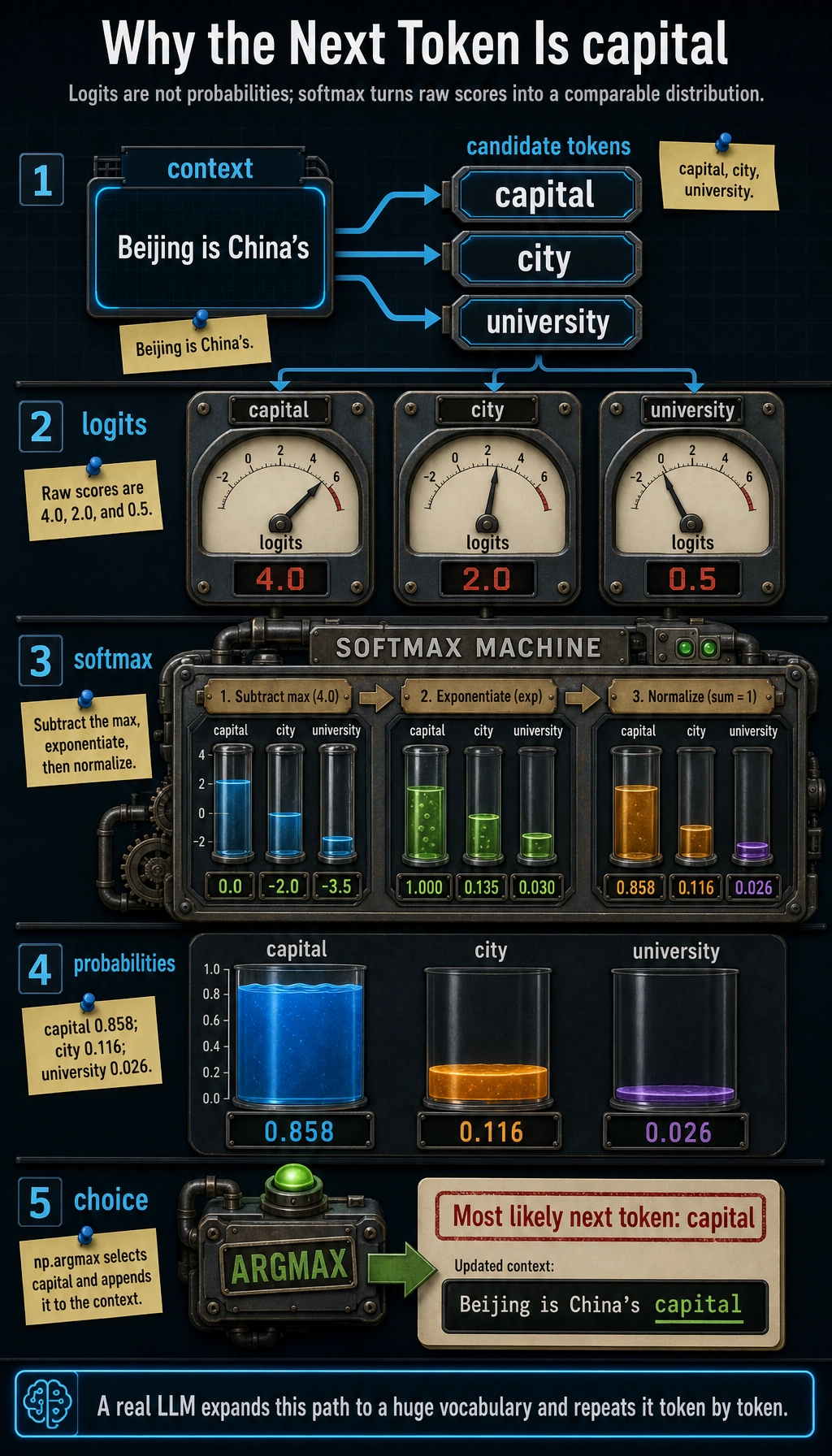
Real models do this over a very large vocabulary. The principle is the same: output scores, convert to probabilities, choose the next token.
Context Window Is a Budget
Section titled “Context Window Is a Budget”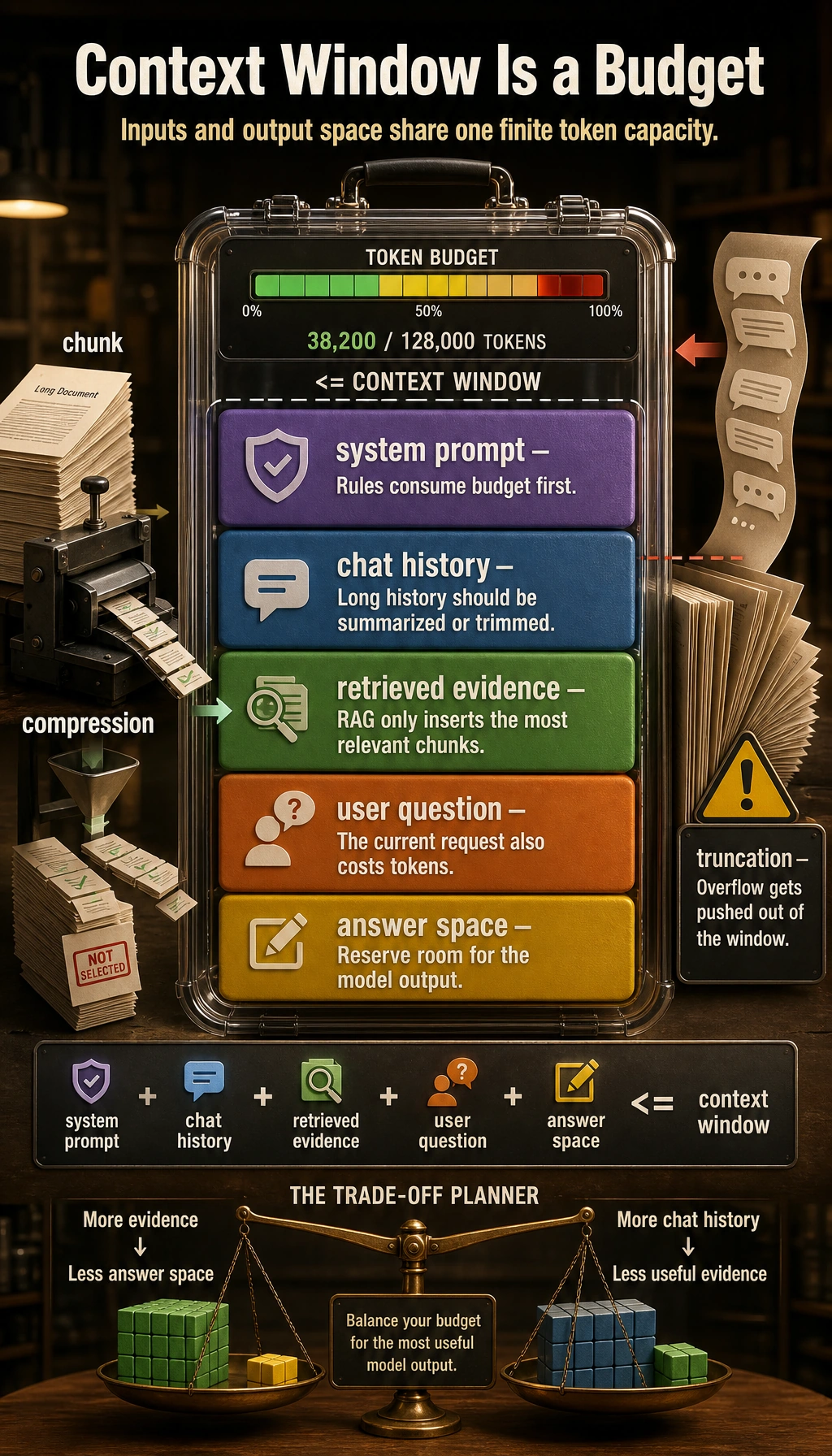
The context window is not infinite memory. It is a fixed token budget:
system prompt + chat history + retrieved evidence + user question + answer space <= context windowPractical consequences:
- Long documents must be selected, compressed, or chunked.
- RAG must reserve space for both evidence and the final answer.
- Chat history should be summarized or trimmed when it stops helping.
- Bigger context helps only if the right information is placed inside it.
Context Is a Working Desk, Not a Knowledge Base
Section titled “Context Is a Working Desk, Not a Knowledge Base”A useful analogy is a desk. A bigger desk lets you place more notes in front of the model, but it does not guarantee the right note is present, correct, or used at the right moment.
This distinction matters in applications:
| Misunderstanding | Better Engineering View |
|---|---|
| “The context window is large, so the model remembers everything.” | Context only contains what you place in the current request. |
| “Put the whole document in the prompt.” | Select the relevant parts and leave room for reasoning and output. |
| “If the answer is wrong, just use a larger context.” | First check retrieval quality, evidence placement, and output validation. |
| “Chat history is memory.” | History is just previous text until you summarize, trim, or store it deliberately. |
This is the bridge into Chapter 8. RAG is not just “more text in the prompt”; it is the practice of choosing the right evidence before the model answers.
Lab 2: Temperature Changes Sampling
Section titled “Lab 2: Temperature Changes Sampling”import numpy as np
tokens = ["Beijing", "Shanghai", "Guangzhou"]logits = np.array([3.0, 1.5, 0.5])
def softmax_with_temperature(logits, temperature=1.0): scaled = logits / temperature exp_values = np.exp(scaled - scaled.max()) return exp_values / exp_values.sum()
for temp in [0.5, 1.0, 2.0]: probs = softmax_with_temperature(logits, temperature=temp) print(f"temperature={temp}") for token, prob in zip(tokens, probs): print(f" {token}: {prob:.4f}")Expected output:
temperature=0.5 Beijing: 0.9465 Shanghai: 0.0471 Guangzhou: 0.0064temperature=1.0 Beijing: 0.7662 Shanghai: 0.1710 Guangzhou: 0.0629temperature=2.0 Beijing: 0.5685 Shanghai: 0.2686 Guangzhou: 0.1629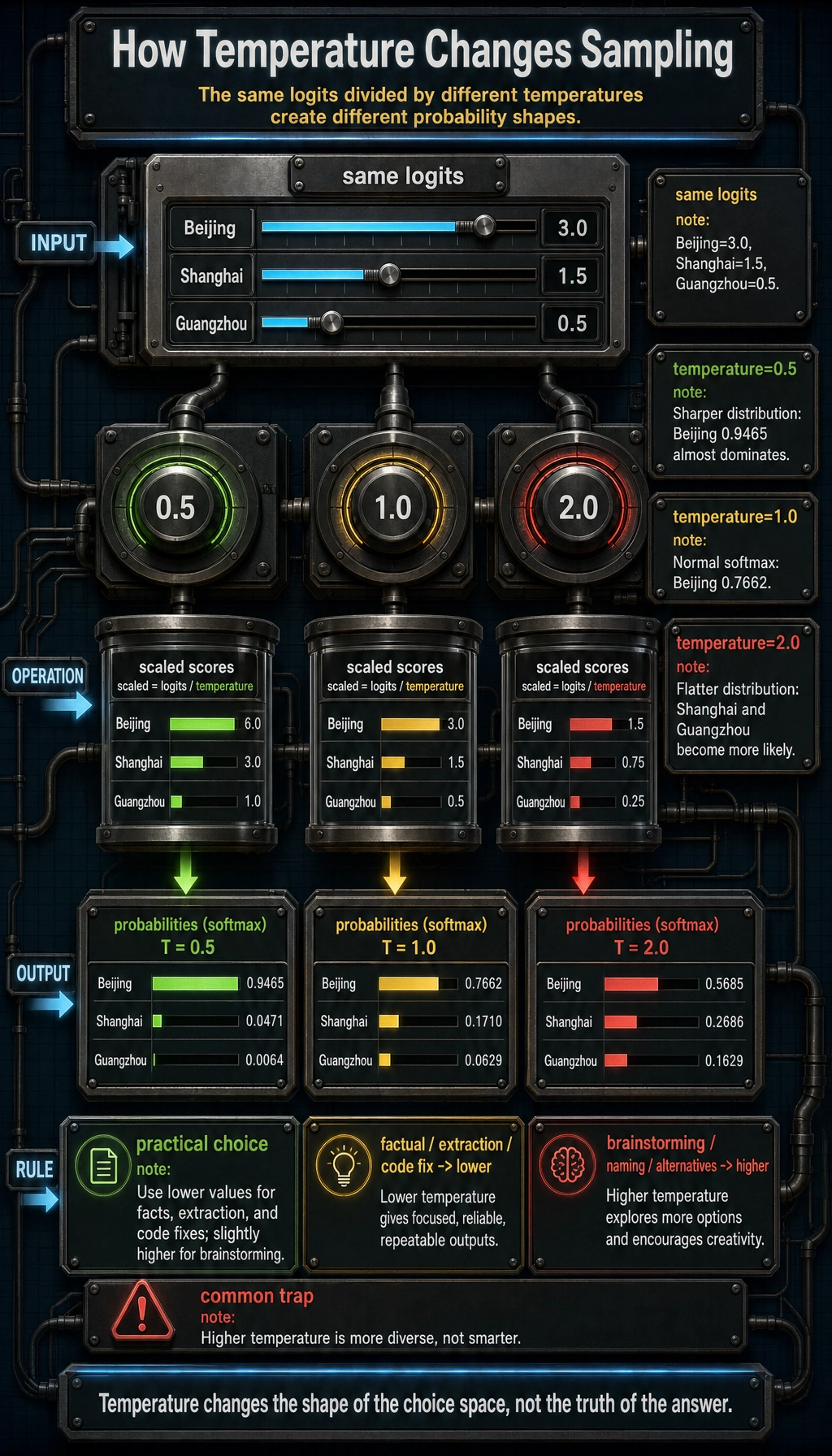
Interpretation:
- lower temperature makes the top choice dominate;
- higher temperature makes lower-ranked tokens more likely;
- higher temperature does not mean smarter, only more diverse.
For factual support, extraction, and code fixes, start lower. For brainstorming, naming, and drafting alternatives, a higher temperature can help.
Lab 3: Attention as Relevance-Weighted Mixing
Section titled “Lab 3: Attention as Relevance-Weighted Mixing”import numpy as np
X = np.array([ [1.0, 0.0], [0.0, 1.0], [1.0, 1.0],])
Q = XK = XV = X
scores = Q @ K.Tscaled_scores = scores / np.sqrt(K.shape[1])
def softmax(row): e = np.exp(row - row.max()) return e / e.sum()
attention_weights = np.apply_along_axis(softmax, 1, scaled_scores)output = attention_weights @ V
print("Attention scores:\n", np.round(scaled_scores, 3))print("Attention weights:\n", np.round(attention_weights, 3))print("Output representations:\n", np.round(output, 3))Expected output:
Attention scores: [[0.707 0. 0.707] [0. 0.707 0.707] [0.707 0.707 1.414]]Attention weights: [[0.401 0.198 0.401] [0.198 0.401 0.401] [0.248 0.248 0.503]]Output representations: [[0.802 0.599] [0.599 0.802] [0.752 0.752]]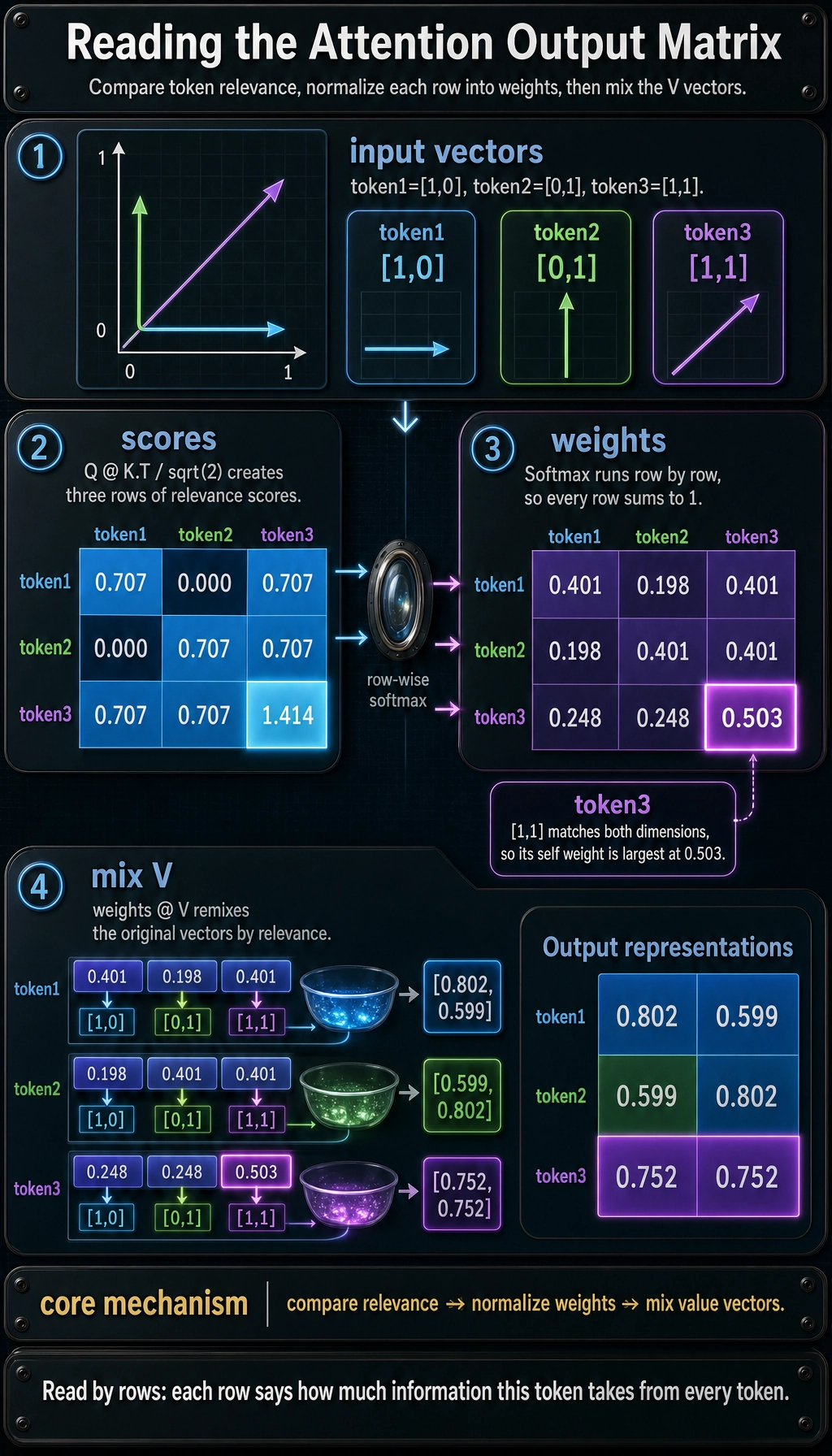
You do not need to memorize the formula yet. Keep the mechanism:
Capability Layers
Section titled “Capability Layers”| Layer | What it contributes | Does it change model weights? |
|---|---|---|
| pretraining | broad language and world-pattern capability | yes |
| instruction tuning | better response style and task following | yes |
| preference learning / RLHF | more helpful and safer behavior | yes |
| prompt | task instructions and examples at runtime | no |
| RAG | external evidence at runtime | no |
| tool calling / Agent | actions beyond text generation | no or partly |
| fine-tuning / LoRA | repeated domain behavior adaptation | yes |
Misconceptions to Avoid
Section titled “Misconceptions to Avoid”- A token is not always one word or one character.
- A larger context window is not the same as better memory.
- Temperature controls diversity, not truth.
- Attention weights are useful intuition, but not a complete explanation of reasoning.
- Pretraining gives capability; product reliability still needs data, evaluation, and controls.
Evidence to Keep
Section titled “Evidence to Keep”Keep this page’s proof of learning as a small evidence card:
- Next Token
- one probability or sampling example
- Context Budget
- prompt + retrieved text + output all compete for space
- Temperature Effect
- deterministic vs more diverse output compared
- Attention Note
- relevance-weighted mixing is not factual proof
- Failure Probe
- fluent answer can still be wrong
Exercises
Section titled “Exercises”- Change the first logit in Lab 1 from
4.0to2.2. How does the winner’s confidence change? - In Lab 2, try
temperature=0.1andtemperature=5.0. - In Lab 3, change the third token vector from
[1.0, 1.0]to[2.0, 0.0]. What happens? - Design a 1,000-token RAG budget: system prompt, evidence, user question, answer space.
- Explain why a model can be capable but still need RAG or alignment.
Operation guide and checkpoints
- Lowering the winning logit should reduce its softmax confidence because the score gap becomes smaller. The winner may stay the same, but certainty drops.
temperature=0.1makes output more deterministic and peaked.temperature=5.0flattens the distribution and makes lower-ranked tokens more likely.- Changing the vector changes attention similarity. The token may attend more to a different neighbor because relevance is computed from vector relationships.
- One workable budget is 120 tokens for system instructions, 650 for evidence, 80 for the user question, and 150 for the answer. The important habit is reserving answer space explicitly.
- Capability is not the same as groundedness or safety. RAG supplies current/private evidence; alignment shapes acceptable behavior and refusal boundaries.
Summary
Section titled “Summary”The core concepts are connected:
- Tokens fill the context.
- The Transformer mixes token information.
- Logits score possible next tokens.
- Sampling chooses one token.
- Adaptation makes the behavior useful.
Once this loop is clear, RAG, agents, fine-tuning, and evaluation become engineering choices around the same model core.