
9.7.6 Multi-Agent Challenges and Solutions
Learning Objectives
Section titled “Learning Objectives”- Understand the most common failure modes of multi-Agent systems
- Learn to break problems down into communication, coordination, cost, and quality
- Read a minimal example of conflict handling and deduplication
- Understand why the key to multi-Agent systems is often not being smarter, but being more controllable
Why Are Multi-Agent Systems More Error-Prone?
Section titled “Why Are Multi-Agent Systems More Error-Prone?”The Most Common Problems in a Single Agent
Section titled “The Most Common Problems in a Single Agent”Common single-Agent problems are usually:
- Reasoning mistakes
- Choosing the wrong tool
- Unstable outputs
Multi-Agent Systems Add Another Layer of System Complexity
Section titled “Multi-Agent Systems Add Another Layer of System Complexity”In addition to errors made by individual Agents, multi-Agent systems introduce new issues:
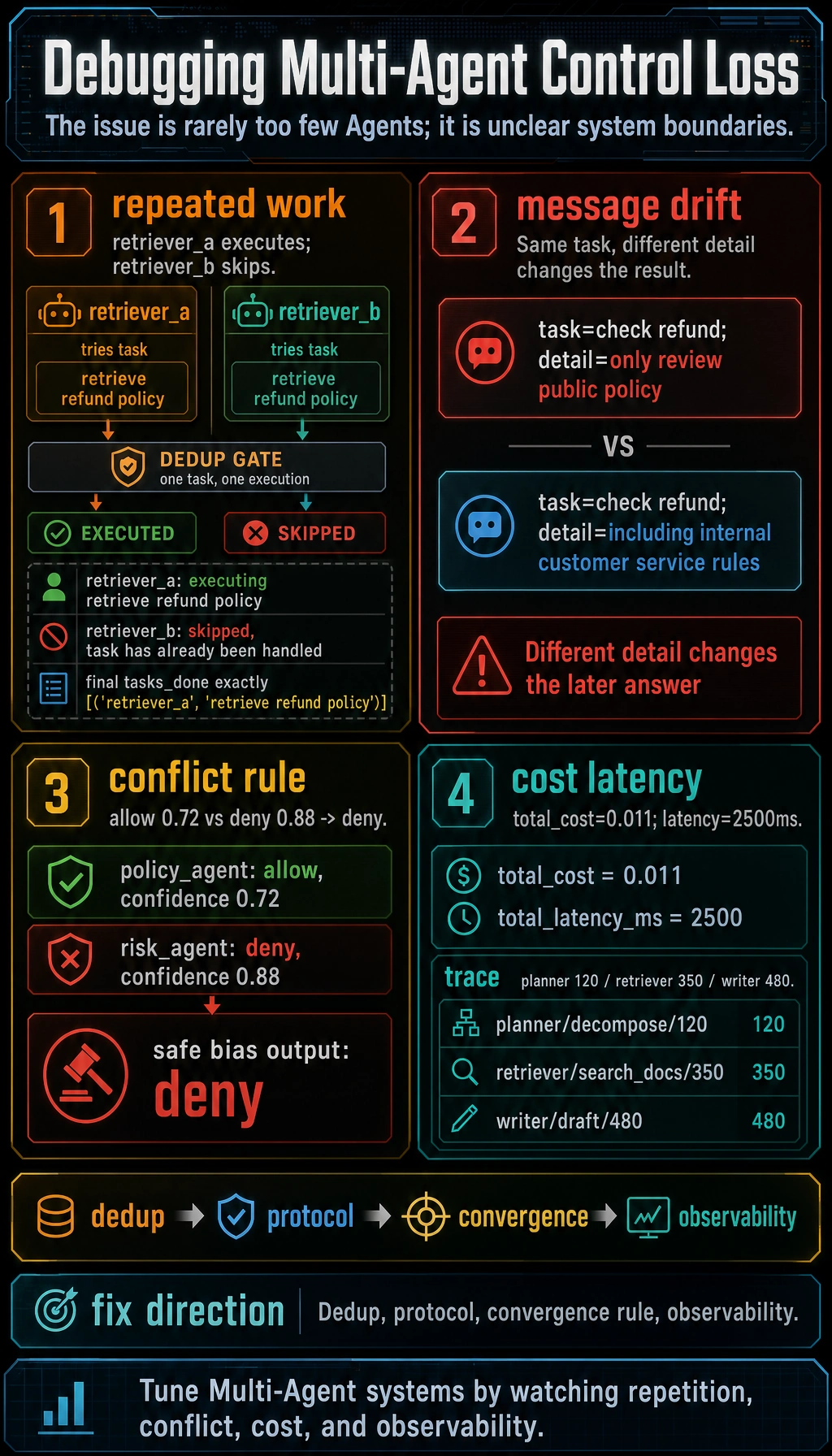
- Two Agents do the same work twice
- The same message is understood differently by different Agents
- A subtask is completed, but the main task never converges
- Cost and latency stack up layer by layer
In other words:
Multi-Agent = single-agent intelligence problems + distributed coordination problems.
That’s why it sounds more powerful, but in practice it’s often more fragile.
Common Challenge 1: Repeated Work
Section titled “Common Challenge 1: Repeated Work”Why Is Repetition So Easy?
Section titled “Why Is Repetition So Easy?”As long as task boundaries are not clear enough, it’s easy to see:
- The planner assigns it once
- The worker does another retrieval on its own
- The reviewer repeats the same check again
A Minimal Example
Section titled “A Minimal Example”tasks_done = []
def run_task(agent, task): tasks_done.append((agent, task))
run_task("retriever_a", "retrieve refund policy")run_task("retriever_b", "retrieve refund policy")
print(tasks_done)Expected output:
[('retriever_a', 'retrieve refund policy'), ('retriever_b', 'retrieve refund policy')]This example is very simple, but it already shows:
Without deduplication, multi-Agent systems can easily “look busy” while actually wasting effort.
A Minimal Fix
Section titled “A Minimal Fix”assigned = set()tasks_done = []
def run_task_once(agent, task): if task in assigned: return f"{agent}: skipped, task has already been handled" assigned.add(task) tasks_done.append((agent, task)) return f"{agent}: executing {task}"
print(run_task_once("retriever_a", "retrieve refund policy"))print(run_task_once("retriever_b", "retrieve refund policy"))print(tasks_done)Expected output:
retriever_a: executing retrieve refund policyretriever_b: skipped, task has already been handled[('retriever_a', 'retrieve refund policy')]Common Challenge 2: Message Distortion and State Desynchronization
Section titled “Common Challenge 2: Message Distortion and State Desynchronization”Why Does Distortion Happen?
Section titled “Why Does Distortion Happen?”Because what Agents pass around is not the “real world,” but:
- Text messages
- JSON messages
- Intermediate state
Once message formats are inconsistent or fields are unclear, the system can easily end up with:
- I thought you meant A
- But you were actually expressing B
An Example
Section titled “An Example”message_a = {"task": "check refund", "detail": "only review public policy"}message_b = {"task": "check refund", "detail": "including internal customer service rules"}
print(message_a)print(message_b)Expected output:
{'task': 'check refund', 'detail': 'only review public policy'}{'task': 'check refund', 'detail': 'including internal customer service rules'}These two messages differ by only a little, but the impact on the result can be huge. If the system does not constrain the message protocol, it can easily drift off course later.
An Engineering Lesson
Section titled “An Engineering Lesson”As soon as a system starts using fields like:
taskdetailcontextnotes
with vague semantics, you should be alert to whether the communication design is already loosening up.
Common Challenge 3: How Do You Converge Conflicting Conclusions?
Section titled “Common Challenge 3: How Do You Converge Conflicting Conclusions?”Multi-Agent Systems Easily Reach Different Conclusions
Section titled “Multi-Agent Systems Easily Reach Different Conclusions”For example:
- A policy Agent says “allowed”
- A business rules Agent says “not allowed”
This is not an exception; it’s the norm.
A Minimal Conflict Example
Section titled “A Minimal Conflict Example”results = { "policy_agent": {"decision": "allow", "confidence": 0.72}, "risk_agent": {"decision": "deny", "confidence": 0.88}}
print(results)Expected output:
{'policy_agent': {'decision': 'allow', 'confidence': 0.72}, 'risk_agent': {'decision': 'deny', 'confidence': 0.88}}Conflict Resolution Must Define at Least One Rule
Section titled “Conflict Resolution Must Define at Least One Rule”The simplest and most common rules are:
- Highest confidence wins
- Reviewer makes the final decision
- Supervisor makes the final decision
- Conservative bias first (common for high-risk tasks)
For example, a conservative-bias version:
Continue in the same file or interpreter session after the conflict example so results is already defined.
def resolve_with_safe_bias(results):    decisions = [r["decision"] for r in results.values()]    if "deny" in decisions:        return "deny"    return "allow"
print(resolve_with_safe_bias(results))
Expected output:
denyIf you do not design a convergence rule, the system becomes:
Multiple Agents are all working hard, but nobody can make the final call.
Common Challenge 4: Costs and Latency Grow Exponentially
Section titled “Common Challenge 4: Costs and Latency Grow Exponentially”Why Does Multi-Agent Get Expensive So Quickly?
Section titled “Why Does Multi-Agent Get Expensive So Quickly?”Because every additional Agent usually adds another layer of:
- Inference cost
- Context assembly
- State passing
- Tool calls
A Very Intuitive Example
Section titled “A Very Intuitive Example”agents = [ {"name": "planner", "cost": 0.002, "latency_ms": 400}, {"name": "researcher", "cost": 0.003, "latency_ms": 700}, {"name": "writer", "cost": 0.004, "latency_ms": 900}, {"name": "reviewer", "cost": 0.002, "latency_ms": 500},]
total_cost = sum(a["cost"] for a in agents)total_latency = sum(a["latency_ms"] for a in agents)
print("total_cost =", total_cost)print("total_latency_ms =", total_latency)Expected output:
total_cost = 0.011total_latency_ms = 2500If these steps are still executed serially, the overall latency becomes even more noticeable.
A Very Important Engineering Judgment
Section titled “A Very Important Engineering Judgment”Many times, the biggest problem in multi-Agent systems is not poor quality, but:
A 10% quality improvement, but a 3x increase in cost and latency.
So you must consciously ask:
- Is this step really worth keeping?
- Can two roles be merged?
- Can the reviewer be triggered only for high-risk tasks?
Common Challenge 5: The System Is Not Observable
Section titled “Common Challenge 5: The System Is Not Observable”Why Is This a Big Problem?
Section titled “Why Is This a Big Problem?”Once a multi-Agent system fails, if you can only see the final answer, you probably have no idea:
- Which Agent made the mistake
- Whether the problem was in communication, assignment, or tools
- Who first pushed the system off track
At Minimum, Record These Pieces of Information
Section titled “At Minimum, Record These Pieces of Information”- task_id
- agent_name
- action
- input summary
- output summary
- latency
A minimal trace example:
trace = [    {"task_id": "t1", "agent": "planner", "action": "decompose", "latency_ms": 120},    {"task_id": "t1", "agent": "retriever", "action": "search_docs", "latency_ms": 350},    {"task_id": "t1", "agent": "writer", "action": "draft", "latency_ms": 480}]
for item in trace:    print(item)
Expected output:
{'task_id': 't1', 'agent': 'planner', 'action': 'decompose', 'latency_ms': 120}{'task_id': 't1', 'agent': 'retriever', 'action': 'search_docs', 'latency_ms': 350}{'task_id': 't1', 'agent': 'writer', 'action': 'draft', 'latency_ms': 480}Without this kind of trace, debugging a multi-Agent system becomes extremely difficult.
Common Challenge 6: Role Boundary Drift
Section titled “Common Challenge 6: Role Boundary Drift”What Is Role Boundary Drift?
Section titled “What Is Role Boundary Drift?”Originally:
- The planner is responsible for breaking down tasks
- The writer is responsible for writing answers
But gradually, the system becomes:
- The planner also starts retrieving
- The writer also starts judging task priority
In the end, every role becomes more and more like an “all-purpose Agent.”
Why Is This Dangerous?
Section titled “Why Is This Dangerous?”Because it will make:
- Responsibilities blurry
- Debugging harder
- Responsibility boundaries disappear
So you should regularly check a multi-Agent system:
Has this Agent’s responsibility already gone out of bounds?
A More Practical “Challenge Checklist”
Section titled “A More Practical “Challenge Checklist””If you are building a multi-Agent system, this checklist is very useful:
| Problem | Common Symptoms |
|---|---|
| Repeated work | Multiple Agents do the same thing |
| Message distortion | Different understanding of the same task |
| Conflict does not converge | Multiple conclusions, nobody makes the final call |
| Costs too high | Too many roles, each step too long |
| State desynchronization | Someone keeps working based on old information |
| Hard to debug | You only see the final output, not the intermediate process |
The Solution Is Not “More Complex,” but “Clearer”
Section titled “The Solution Is Not “More Complex,” but “Clearer””When many people run into problems, their first reaction is:
- Add another coordination Agent
- Add another judge Agent
- Add another summarization Agent
But the direction that makes a multi-Agent system truly more stable is often not to keep stacking roles, but to make things clearer:
- Clearer messages
- Clearer division of labor
- Clearer termination conditions
- Clearer observation methods
In other words:
Fixing multi-Agent systems is often not about “adding more complexity,” but about “drawing the boundaries clearly again.”
Evidence to Keep
Section titled “Evidence to Keep”Keep this page’s proof of learning as a small evidence card:
- Roles
- owner, worker, reviewer, or specialist responsibilities
- Message Contract
- artifact, request, response, and handoff state
- Coordination
- routing, task split, conflict resolution, and final owner
- Failure Check
- duplicated work, lost context, no accountable owner, or message loop
- Eval Action
- compare multi-agent result against single-agent baseline
Summary
Section titled “Summary”The most important thing in this section is not just listing the challenges, but understanding this:
The real difficulty in multi-Agent systems is not the capability of a single Agent, but whether the system as a whole can converge, be observed, and be controlled.
Once you start looking at multi-Agent systems through the four categories of “repetition, conflict, cost, and observability,” system tuning becomes much clearer.
Exercises
Section titled “Exercises”- Redesign the conflict resolution logic in this section with a “reviewer makes the final call” version.
- Think about it: if a multi-Agent system keeps retrieving the same information over and over, would you first change task assignment, the communication protocol, or shared state?
- Design your own multi-Agent trace structure, including at least
task_id,agent,action, andlatency_ms. - Explain in your own words: why, when a multi-Agent system has problems, is it often not because “the model is too weak,” but because “the system boundaries are unclear”?
Reference implementation and walkthrough
- In a reviewer-final-call design, each Agent submits its conclusion with evidence and uncertainty. The reviewer compares them against criteria, chooses or merges an answer, and records the reason for the decision.
- If the system repeatedly retrieves the same information, first inspect shared state and communication protocol. The agents may not know what has already been retrieved or where evidence is stored.
- A useful trace includes
task_id,agent,action,input_ref,output_ref,latency_ms,status, anderror. Add evidence references for reviewable decisions. - Many failures come from unclear boundaries: who owns the task, what evidence counts, when to stop, and who decides. A stronger model cannot compensate for a poorly specified organization loop.