
9.4.5 Episodic and Procedural Memory [Optional]
Learning objectives
Section titled “Learning objectives”- Understand the difference between episodic memory and procedural memory
- Understand why these two kinds of memory are especially important for complex tasks
- Use a runnable example to understand the smallest loop of “extracting a workflow from experience”
- Learn how to judge whether a piece of information is better stored as an episode or as a workflow
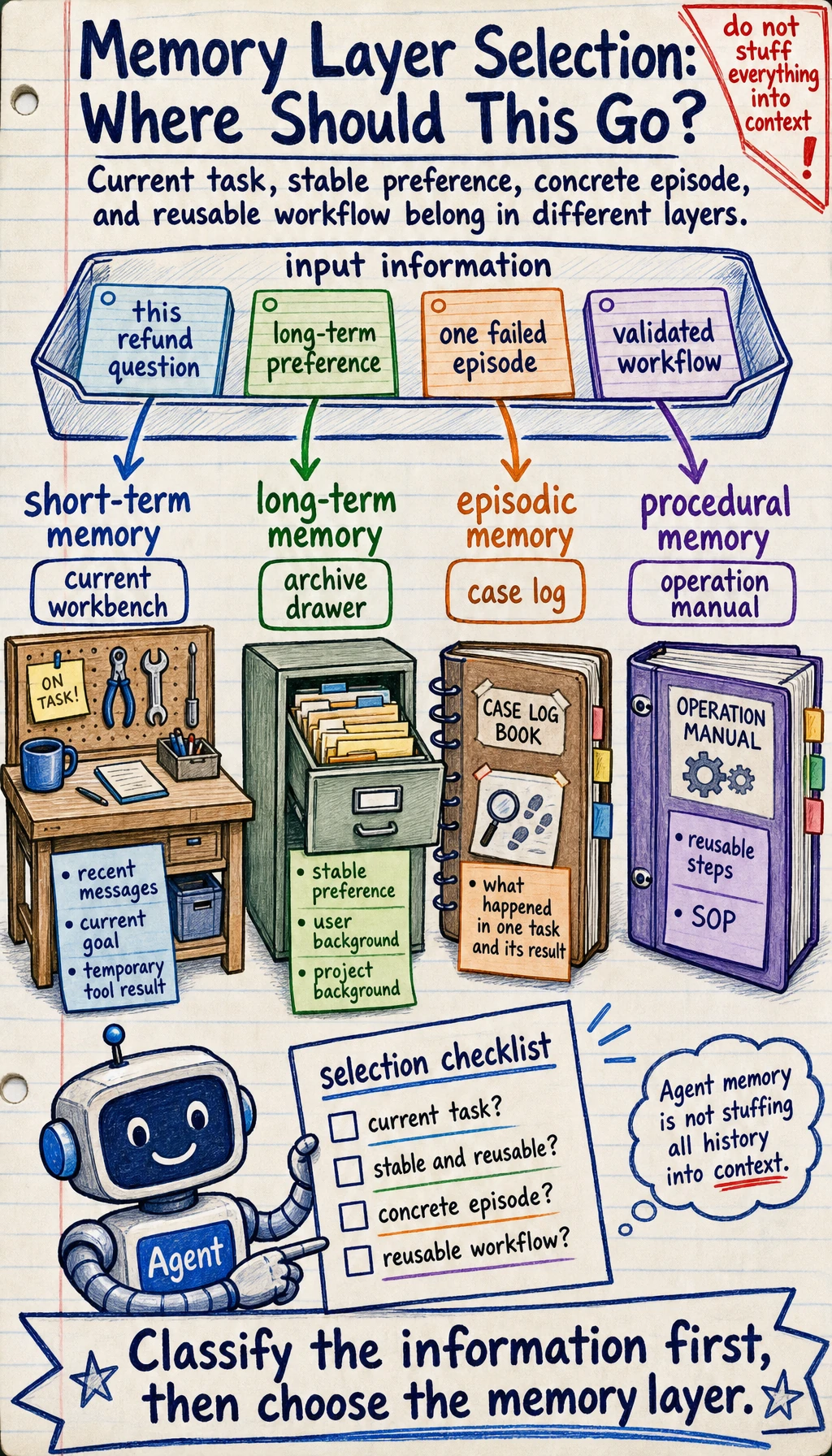
Use this map as a decision aid: short-term state helps with the current run, long-term memory stores stable facts, episodic memory keeps concrete experiences, and procedural memory keeps reusable methods.
What exactly is episodic memory?
Section titled “What exactly is episodic memory?”It is more like a single experience
Section titled “It is more like a single experience”For example:
- Last week, I handled a refund dispute because the learning progress exceeded the threshold
- During one weekly report generation, a database API timeout caused the task to fail
The characteristics of this kind of memory are:
- It has time and context
- It includes a specific event process
- It is not always directly reusable
Why does an Agent need episodic memory?
Section titled “Why does an Agent need episodic memory?”Because complex systems often need to refer to things that happened in the past:
- What problems the user encountered before
- How a similar task ended last time
- Which situations are likely to fail
This kind of information is not a static archive, but it is very helpful for decision-making.
What is procedural memory?
Section titled “What is procedural memory?”It is more like skills and workflows
Section titled “It is more like skills and workflows”For example:
- When handling a refund issue, first check the order, then check the policy, then determine eligibility
- When creating a competitor report, first collect data, then categorize it, then summarize it
The focus of this kind of memory is not “which specific time in the past,” but rather “what method can be reused the next time a similar task appears.”
Why is procedural memory important?
Section titled “Why is procedural memory important?”Because it helps an Agent avoid planning from scratch every time. Many tasks are not completely new problems, but rather:
- New instance + old workflow
In this case, procedural memory can significantly reduce reasoning burden.
What is the biggest difference between them?
Section titled “What is the biggest difference between them?”Episodic memory answers “what happened”
Section titled “Episodic memory answers “what happened””Example:
- “Last time I generated a weekly report, too many logs caused the summary quality to drop”
Procedural memory answers “how similar problems are usually handled”
Section titled “Procedural memory answers “how similar problems are usually handled””Example:
- “The general steps for generating a weekly report are: pull data -> cluster issues -> generate summary -> review”
An analogy
Section titled “An analogy”Episodic memory is like a project postmortem. Procedural memory is like an SOP manual.
Both are important, but they serve different purposes.
First, run an “experience -> workflow” example
Section titled “First, run an “experience -> workflow” example”The example below does two things:
- Records several specific episodes
- Extracts a reusable workflow from those episodes
from dataclasses import dataclass

@dataclassclass Episode:    task_type: str    context: str    steps: list    result: str

episodes = [    Episode(        task_type="refund_case",        context="The user asked whether an unshipped order can be refunded",        steps=["Check order status", "Check refund policy", "Determine eligibility", "Return conclusion"],        result="success",    ),    Episode(        task_type="refund_case",        context="The user asked whether a refund is allowed after learning progress exceeded 20%",        steps=["Check order status", "Check refund policy", "Determine eligibility", "Return conclusion"],        result="success",    ),    Episode(        task_type="weekly_report",        context="Weekly report generation task",        steps=["Pull data", "Cluster issues", "Write summary"],        result="partial_failure",    ),]

def build_procedural_memory(episodes, min_support=2):    grouped = {}    for episode in episodes:        key = (episode.task_type, tuple(episode.steps))        grouped[key] = grouped.get(key, 0) + 1
    workflows = {}    for (task_type, steps), count in grouped.items():        if count >= min_support:            workflows[task_type] = list(steps)    return workflows

procedural_memory = build_procedural_memory(episodes)print("procedural_memory:", procedural_memory)
Expected output:
procedural_memory: {'refund_case': ['Check order status', 'Check refund policy', 'Determine eligibility', 'Return conclusion']}What does this code actually show?
Section titled “What does this code actually show?”It shows that:
- Episodic memory can accumulate “specific things we have done”
- After enough repetitions, it can be abstracted into procedural memory
In other words, procedural memory is often not written from scratch, but distilled from repeatedly successful episodes.
Why didn’t weekly_report enter procedural memory?
Section titled “Why didn’t weekly_report enter procedural memory?”Because it appeared only once, so there was not enough support.
This matches reality very well:
- A one-time success or failure is not necessarily worth turning into a standard workflow immediately
Why is this more insightful than writing a workflow directly?
Section titled “Why is this more insightful than writing a workflow directly?”Because it shows a very realistic process of knowledge accumulation:
- Do it first
- Then review it
- Finally abstract it into a workflow
This is exactly the path many mature Agent systems follow as they evolve.
How is episodic memory usually used in a system?
Section titled “How is episodic memory usually used in a system?”Retrieve similar cases
Section titled “Retrieve similar cases”When facing a current problem, the system can first check:
- Whether a similar situation happened before
- How it was handled
- What the final result was
Review failures
Section titled “Review failures”If a certain type of task often fails, episodic memory is very suitable for answering:
- Which step is likely to go wrong
- Which context tends to trigger failure
Serve as training material for procedural memory
Section titled “Serve as training material for procedural memory”It can also become the raw data for later workflow abstraction.
How is procedural memory usually used in a system?
Section titled “How is procedural memory usually used in a system?”As the default template for the planner
Section titled “As the default template for the planner”Once a task type is recognized, the system can directly load:
- A default workflow
As a skill library
Section titled “As a skill library”In essence, many procedural memories are like:
- Reusable skills
- Standard operating procedures
- Task templates
As a safety boundary
Section titled “As a safety boundary”Procedural memory can also act as a “don’t improvise” mechanism. For high-risk tasks, for example, the system may only be allowed to follow approved workflows.
Evidence to Keep
Section titled “Evidence to Keep”Keep this page’s proof of learning as a small evidence card:
- Memory Type
- short-term, long-term, episodic, or procedural
- Write Rule
- when memory is created or updated
- Retrieve Rule
- query, relevance, recency, and permission check
- Failure Check
- stale memory, privacy leak, contradiction, or over-retrieval
- Cleanup Action
- summarize, merge, expire, delete, or ask for confirmation
Common pitfalls
Section titled “Common pitfalls”Mistake 1: Calling all history episodic memory
Section titled “Mistake 1: Calling all history episodic memory”Not all history is worth keeping as an episode. Episodes are better for records with:
- A clear task
- A process
- A result
Mistake 2: Assuming every episode automatically becomes procedural memory
Section titled “Mistake 2: Assuming every episode automatically becomes procedural memory”Procedural memory needs:
- Repetition
- Stability
- Transferability
Mistake 3: Never updating procedural memory after it is written
Section titled “Mistake 3: Never updating procedural memory after it is written”If the workflow changes, procedural memory should also be updated. Otherwise, it will go from “experience” to “outdated experience.”
Summary
Section titled “Summary”The most important thing in this section is to establish a clear accumulation logic:
Episodic memory preserves specific experiences, while procedural memory abstracts repeatedly validated experiences into reusable workflows.
Once you understand this logic, a memory system is no longer just an “archive,” but something that truly helps an Agent learn.
Exercises
Section titled “Exercises”- Add two more successful
weekly_reportcases to the example so that it can also accumulate procedural memory. - Think about which tasks are better handled by checking episodes, and which tasks are better handled by directly applying a workflow.
- Why is procedural memory more like a “skill library” rather than just a “history log”?
- If a workflow has become outdated, how would you design an update mechanism?
Reference implementation and walkthrough
- Adding successful
weekly_reportcases should reveal repeated steps; once repeated steps stabilize, they can be promoted into procedural memory. - Episodes help when context and past outcomes matter. Procedural memory helps when the task is repeatable and the best action sequence is already known.
- Procedural memory is a skill library because it stores reusable methods, decision points, and checks, not just a record of what happened.
- Use workflow versions, owner review, test cases, and deprecation notes so outdated procedures can be updated or retired safely.