
5.4.5 Hyperparameter Tuning
What You Will Build
Section titled “What You Will Build”This lesson shows:
- the difference between parameters and hyperparameters;
- how to use
GridSearchCV; - how to use
RandomizedSearchCVwhen the search space grows; - how to keep a final holdout untouched;
- how to avoid over-tuning.
Keyword Decoder
Section titled “Keyword Decoder”| Term | Practical meaning |
|---|---|
| parameter | learned by the model during fit() |
| hyperparameter | chosen by you before training, such as tree depth |
| search space | the candidate values you allow the search to try |
| CV score | cross-validation score used to choose settings |
| final holdout | untouched data used once after tuning |
| budget | number of combinations or trials you can afford |
python -m pip install -U scikit-learnRun the Complete Lab
Section titled “Run the Complete Lab”Create tuning_lab.py:
from sklearn.datasets import load_breast_cancerfrom sklearn.ensemble import RandomForestClassifierfrom sklearn.metrics import accuracy_score, f1_score, recall_scorefrom sklearn.model_selection import GridSearchCV, RandomizedSearchCV, StratifiedKFold, train_test_split

X, y = load_breast_cancer(return_X_y=True)X_train, X_final, y_train, y_final = train_test_split(    X, y, test_size=0.2, random_state=42, stratify=y)cv = StratifiedKFold(n_splits=5, shuffle=True, random_state=42)
print("grid_search_lab")grid = GridSearchCV(    RandomForestClassifier(random_state=42),    param_grid={        "n_estimators": [80, 160],        "max_depth": [3, 5, None],        "min_samples_leaf": [1, 3],    },    scoring="f1",    cv=cv,    n_jobs=-1,)grid.fit(X_train, y_train)print("best_params=", grid.best_params_)print(f"best_cv_f1={grid.best_score_:.3f}")final_pred = grid.best_estimator_.predict(X_final)print(    f"final accuracy={accuracy_score(y_final, final_pred):.3f} "    f"recall={recall_score(y_final, final_pred):.3f} "    f"f1={f1_score(y_final, final_pred):.3f}")
print("random_search_lab")random_search = RandomizedSearchCV(    RandomForestClassifier(random_state=42),    param_distributions={        "n_estimators": [60, 100, 160, 220],        "max_depth": [3, 5, 8, None],        "min_samples_leaf": [1, 2, 3, 5],        "max_features": ["sqrt", "log2", None],    },    n_iter=8,    scoring="f1",    cv=cv,    random_state=42,    n_jobs=-1,)random_search.fit(X_train, y_train)print("best_params=", random_search.best_params_)print(f"best_cv_f1={random_search.best_score_:.3f}")
print("top_3_grid_results")rows = sorted(    zip(grid.cv_results_["mean_test_score"], grid.cv_results_["params"]),    key=lambda item: item[0],    reverse=True,)[:3]for score, params in rows:    print(f"score={score:.3f} params={params}")
Run it:
python tuning_lab.pyExpected output:
grid_search_labbest_params= {'max_depth': 5, 'min_samples_leaf': 3, 'n_estimators': 80}best_cv_f1=0.968final accuracy=0.956 recall=0.972 f1=0.966random_search_labbest_params= {'n_estimators': 100, 'min_samples_leaf': 1, 'max_features': 'log2', 'max_depth': 8}best_cv_f1=0.972top_3_grid_resultsscore=0.968 params={'max_depth': 5, 'min_samples_leaf': 3, 'n_estimators': 80}score=0.968 params={'max_depth': 5, 'min_samples_leaf': 3, 'n_estimators': 160}score=0.968 params={'max_depth': None, 'min_samples_leaf': 3, 'n_estimators': 160}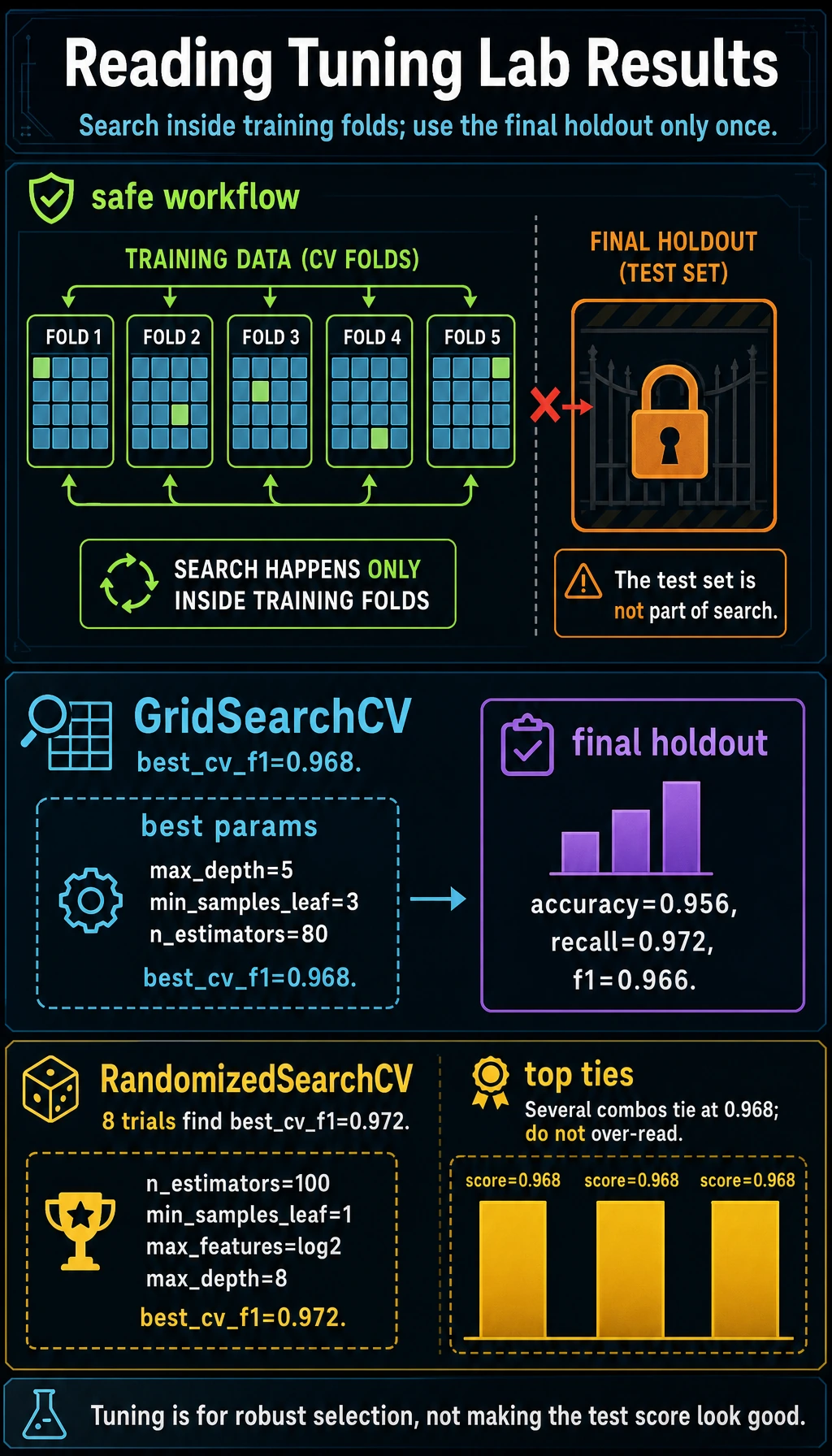
Parameters vs Hyperparameters
Section titled “Parameters vs Hyperparameters”Random Forest learns split rules from data. Those learned split rules are parameters.
You choose settings such as:
n_estimators;max_depth;min_samples_leaf;max_features.
Those are hyperparameters. They shape how learning happens.
Grid Search
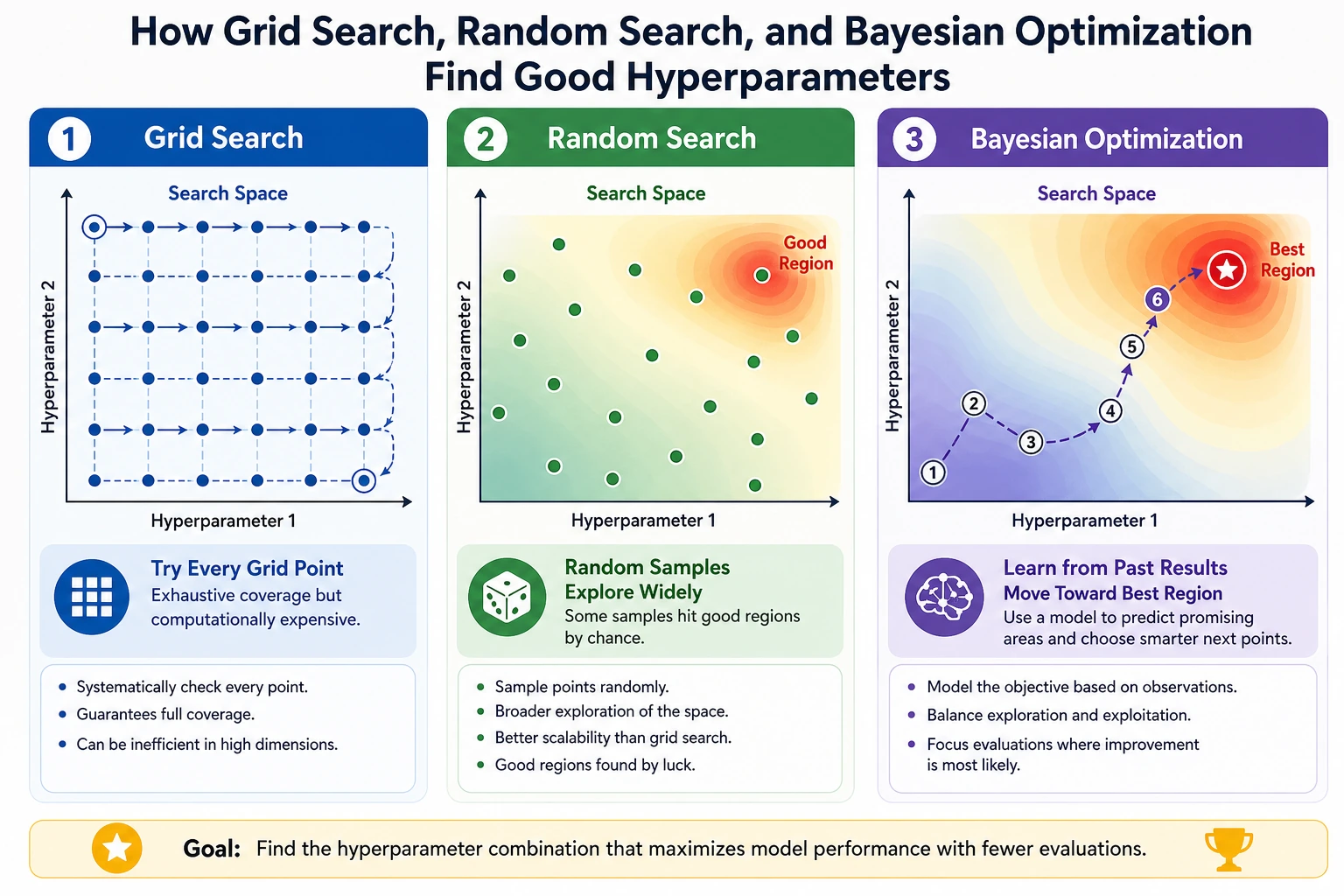
Section titled “Grid Search”Grid search tries every combination you list:
param_grid={ "n_estimators": [80, 160], "max_depth": [3, 5, None], "min_samples_leaf": [1, 3],}This grid has 2 x 3 x 2 = 12 combinations. With 5-fold CV, that means 60 model fits.
Use grid search when:
- the search space is small;
- you understand which values are plausible;
- you want a simple, repeatable baseline.
Random Search
Section titled “Random Search”Random search samples a limited number of combinations from a larger space:
n_iter=8In the lab, it tried only 8 combinations but searched a wider space and found a slightly higher CV F1:
best_cv_f1=0.972Use random search when:
- there are many hyperparameters;
- training is expensive;
- you want to explore before designing a narrower grid.
Final Holdout
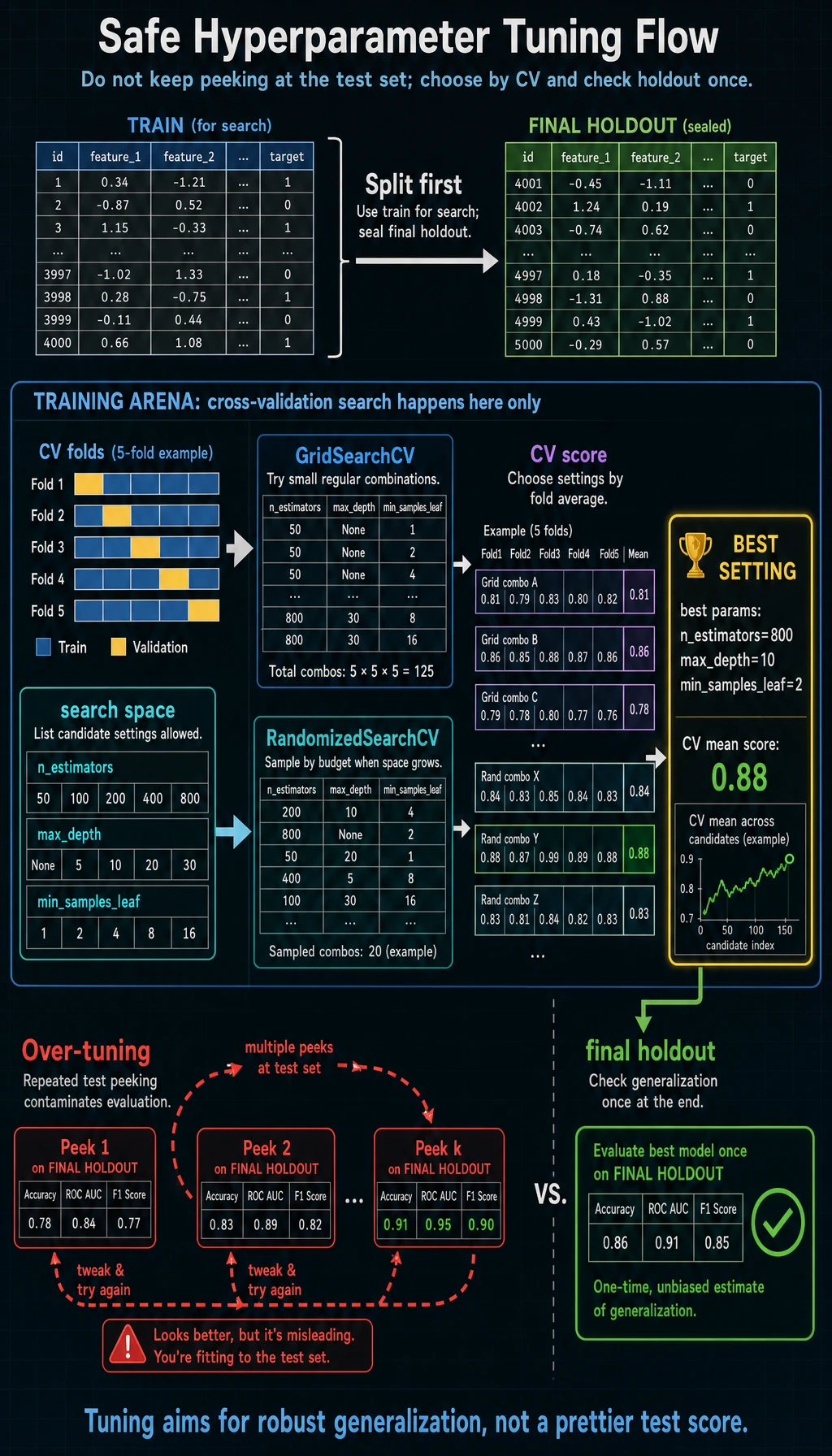
Section titled “Final Holdout”The final holdout is the part we did not use in CV search:
X_train, X_final, y_train, y_final = train_test_split(...)After the search chooses the best settings, we evaluate once:
final accuracy=0.956 recall=0.972 f1=0.966Do not keep changing the grid after looking at the final holdout. If you do, it stops being a final holdout and becomes part of tuning.
Reading Search Results
Section titled “Reading Search Results”The top grid results are very close:
score=0.968 params={'max_depth': 5, 'min_samples_leaf': 3, 'n_estimators': 80}score=0.968 params={'max_depth': 5, 'min_samples_leaf': 3, 'n_estimators': 160}When scores tie, prefer the simpler or cheaper model. More trees or deeper trees are not automatically better.
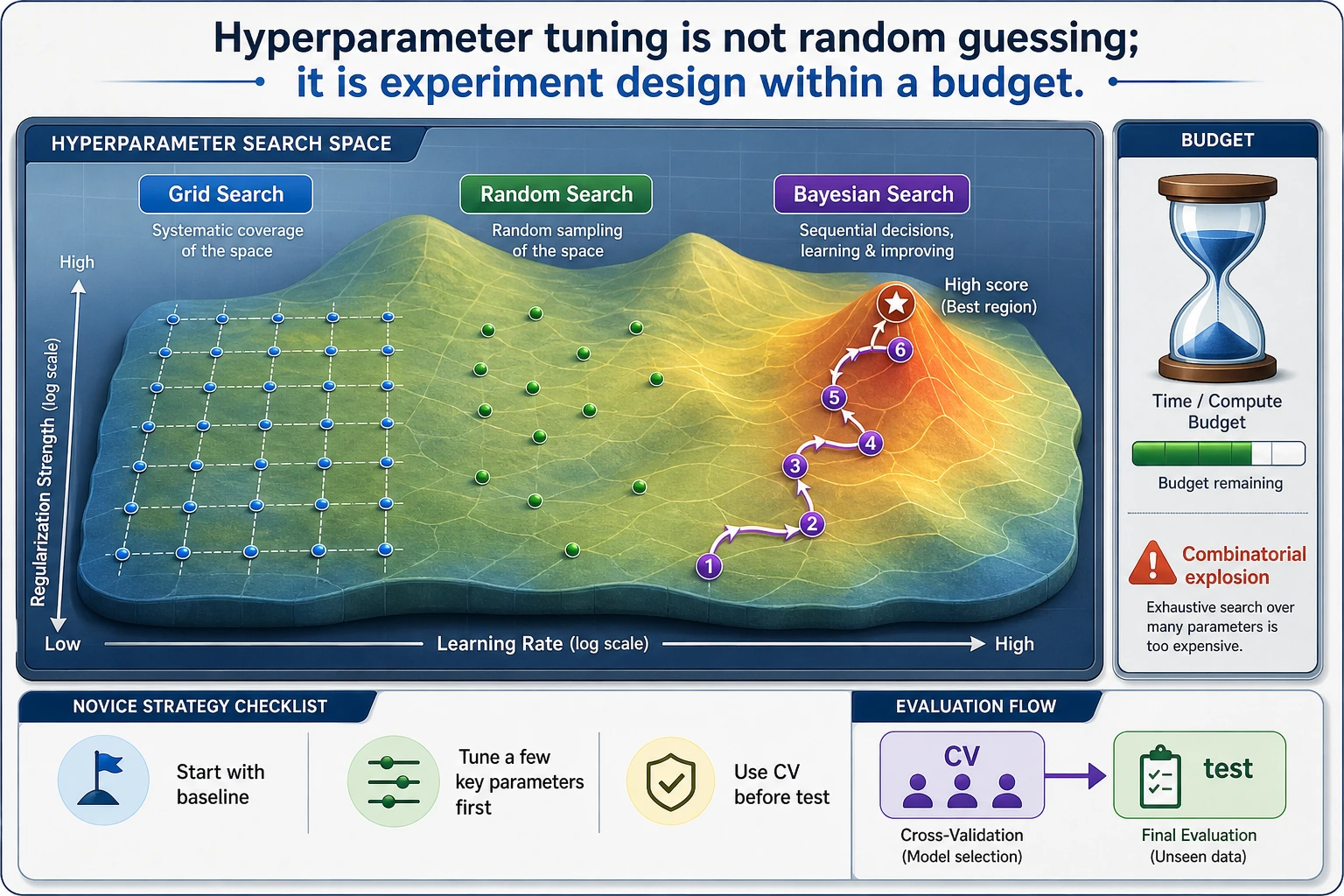
Practical Tuning Strategy
Section titled “Practical Tuning Strategy”| Stage | Action |
|---|---|
| Start | Build a simple baseline with default settings |
| Diagnose | Check bias/variance and metric choice |
| First search | Use a small grid around important parameters |
| Wider search | Use random search when combinations explode |
| Final check | Evaluate once on untouched holdout |
| Production | monitor drift and retrain policy |
For experienced readers: Bayesian tools such as Optuna are useful when each trial is expensive or the search space is large. They are not a replacement for clean validation design.
Practical Debugging Checklist
Section titled “Practical Debugging Checklist”| Symptom | Likely cause | Fix |
|---|---|---|
| Search takes too long | grid too large | reduce candidates, use random search |
| CV score rises but final holdout drops | over-tuning | simplify search, keep a fresh holdout |
| Best model is much more complex | metric difference is tiny | choose cheaper/simpler model |
| Different runs choose different params | unstable data or small folds | use repeated CV or inspect variance |
| Tuning does not help | model class or features are limiting | improve features or model family first |
Practice
Section titled “Practice”- Change scoring from
"f1"to"recall". Which parameters change? - Add
max_depth=10to the grid. Does it improve CV score? - Increase
n_iterfrom8to16. Does random search improve enough to justify the cost? - Print
mean_fit_timefromcv_results_and choose a cheaper model when scores tie. - Add a final untouched test set to one earlier lesson that currently uses only CV.
Reference implementation and walkthrough
- Optimizing recall may choose more aggressive parameters that catch more positives, even if precision or F1 falls. The “best” parameters depend on the business cost encoded in the scoring metric.
max_depth=10helps only if the previous grid was underfitting. If CV score does not improve or variance grows, the deeper option should not be selected.- Doubling
n_iteris worthwhile only when the score gain is meaningful relative to runtime. Small gains within noise are not worth a much slower workflow. mean_fit_timehelps break ties. If two candidates score nearly the same, prefer the faster or simpler model unless the slower one has a clear operational benefit.- The final untouched test set should be used once after tuning. It estimates how the selected workflow performs on data that did not shape model or hyperparameter choices.
Evidence to Keep
Section titled “Evidence to Keep”Keep this page’s proof of learning as a small evidence card:
- Evaluation Setup
- split, cross-validation, metric, baseline, and comparison target
- Result
- score table, curve, confusion matrix, validation result, or search outcome
- Decision
- whether to change data, features, model, threshold, or hyperparameters
- Failure Check
- leakage, unstable validation, wrong metric, or tuning on the test set
- Expected Output
- evaluation record that supports a next modeling decision
Pass Check
Section titled “Pass Check”You are done when you can explain:
- hyperparameters are chosen before training;
- grid search is exhaustive over a small listed space;
- random search is useful when the space is larger;
- final holdout must not be used for repeated tuning;
- tuning cannot rescue bad features or the wrong validation design.