
9.6.2 Agent Framework Overview
Learning objectives
Section titled “Learning objectives”- Understand why Agent projects often introduce frameworks
- Distinguish differences in abstraction levels across frameworks
- Know what frameworks usually save you from, and what they make you lose
- Build an initial perspective for choosing frameworks
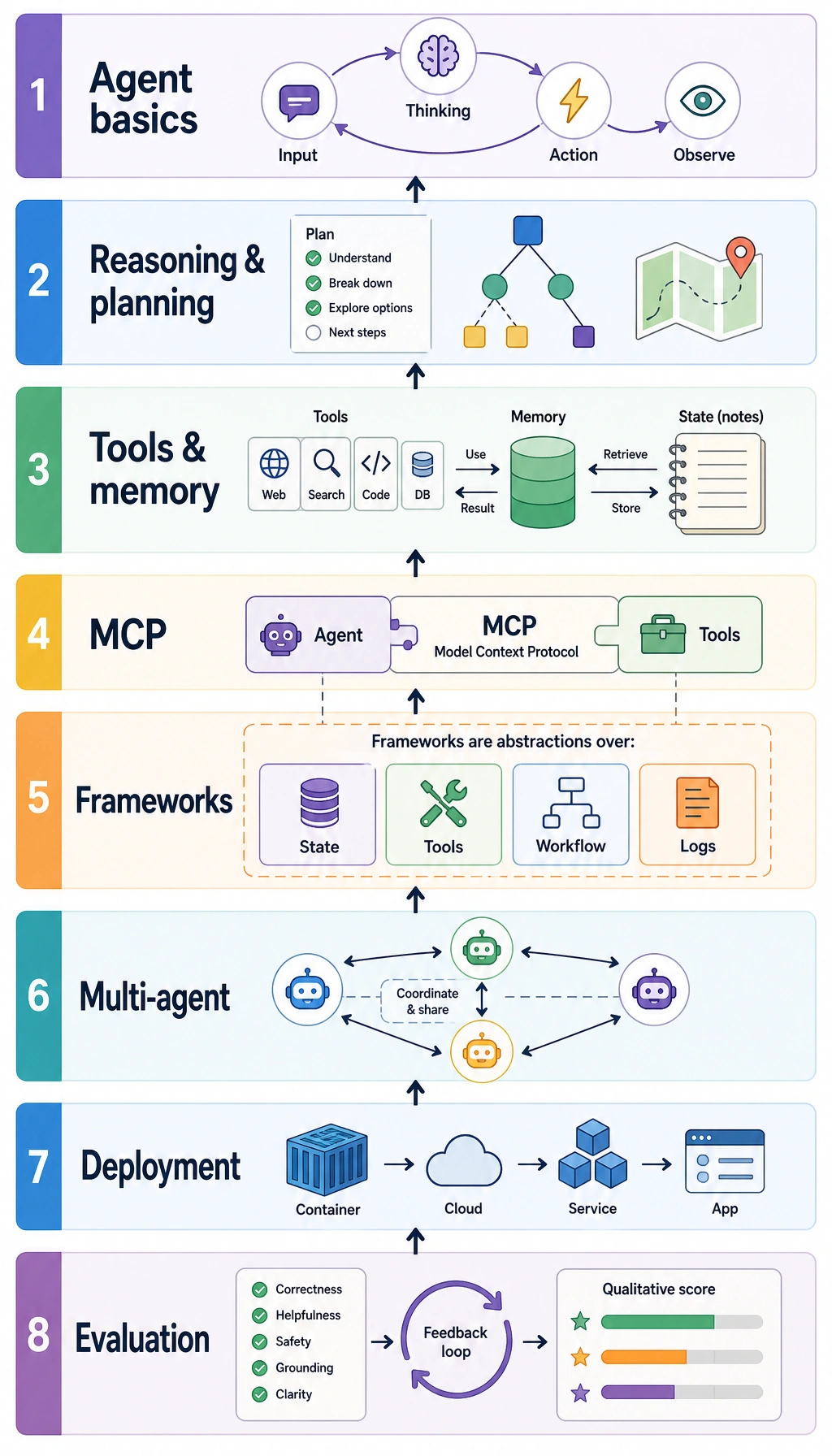
Read this map as a trade-off view: lower-level frameworks give more control, higher-level frameworks reduce setup cost, and retrieval-oriented frameworks are stronger when the system is centered on documents and knowledge.
Why do we need Agent frameworks?
Section titled “Why do we need Agent frameworks?”What happens if you write everything yourself without a framework?
Section titled “What happens if you write everything yourself without a framework?”A slightly more complex Agent system usually requires you to handle:
- State management
- Tool calling
- Message passing
- Failure retries
- Trace
- Multi-Agent collaboration
Of course, you can write it by hand, but you will quickly run into:
- Lots of repetitive boilerplate code
- Inconsistent structure across projects
- Increasing difficulty in debugging and extending
What do frameworks actually solve?
Section titled “What do frameworks actually solve?”You can remember it with one sentence:
A framework does not build the product for you; it helps you set up the high-frequency structure first.
For example:
- Graph-based state flow
- Tool registration mechanisms
- Abstractions for Agent collaboration
- Execution and observability interfaces
The biggest differences among frameworks are usually not about “can it do it,” but about “how does it do it”
Section titled “The biggest differences among frameworks are usually not about “can it do it,” but about “how does it do it””A very important perspective: abstraction level
Section titled “A very important perspective: abstraction level”Many frameworks can:
- Connect tools
- Run workflows
- Support multiple Agents
But they differ in abstraction level:
- Some are closer to “building blocks at the lower level”
- Some are closer to “high-level role orchestration”
- Some are more focused on retrieval and data organization
An analogy
Section titled “An analogy”You can think of different frameworks as different kinds of kitchens:
- Some give you pots, pans, and utensils, and you cook yourself
- Some give you semi-finished meal kits that you combine following instructions
- Some are especially good at certain types of dishes
So the difference between frameworks is often not “who is stronger,” but:
Who fits your current task and team habits better.
Let’s first look at a coarse-grained map
Section titled “Let’s first look at a coarse-grained map”The following table is not an exact ranking, but a way to build intuition quickly:
| Framework direction | What it is good at | Common feeling |
|---|---|---|
| Graph/Workflow-oriented | Complex state flow, explicit control | Flexible but more engineering-heavy |
| Retrieval/Knowledge-oriented | Documents, indexing, RAG | Stronger data orientation |
| Role/Team-oriented | Multi-Agent role collaboration | Quick to start, but higher-level abstraction |
| General experimentation-oriented | Rapid demo building | Flexible, but you need to fill in the engineering layers yourself |
The most important purpose of this map is:
Don’t ask “which is best” first. Ask “which category does my problem resemble more?”
What work do frameworks usually save you from?
Section titled “What work do frameworks usually save you from?”State flow and node management
Section titled “State flow and node management”For example:
- Where the current task state is stored
- Where the next step goes
- How to roll back on errors
Tool integration and message structure
Section titled “Tool integration and message structure”For example:
- Tool registration
- Wrapping call results
- Error handling
Execution and observation
Section titled “Execution and observation”For example:
- Trace
- Step records
- Visualization of intermediate states
So the most common value of a framework is not “the model becomes smarter,” but:
The system is organized more clearly.
Frameworks also bring trade-offs
Section titled “Frameworks also bring trade-offs”The higher the abstraction, the easier it is to lose low-level control
Section titled “The higher the abstraction, the easier it is to lose low-level control”A framework saves you effort, but it also brings:
- The cost of learning the framework itself
- Framework constraints
- The need to understand its internal abstractions when debugging
A very common problem
Section titled “A very common problem”Many beginners do not fail because they cannot build an Agent. They fail because they:
- Have not clarified the task yet
- But have already learned many framework interfaces
In the end, what they learn is framework usage, not the essence of Agents.
So the right order is usually:
First understand the system, then use a framework to speed things up.
A minimal “framework-like” example
Section titled “A minimal “framework-like” example”The example below is not from a real framework, but a very small example that has the flavor of framework abstraction.
class MiniWorkflow:    def __init__(self):        self.steps = []
    def add_step(self, name, fn):        self.steps.append((name, fn))
    def run(self, state):        for name, fn in self.steps:            state = fn(state)            print(name, "->", state)        return state
def retrieve(state):    state["docs"] = ["refund policy"]    return state
def answer(state):    state["answer"] = f"Generate an answer based on {state['docs']}"    return state
wf = MiniWorkflow()wf.add_step("retrieve", retrieve)wf.add_step("answer", answer)
wf.run({"query": "What is the refund policy?"})
Expected output:
retrieve -> {'query': 'What is the refund policy?', 'docs': ['refund policy']}answer -> {'query': 'What is the refund policy?', 'docs': ['refund policy'], 'answer': "Generate an answer based on ['refund policy']"}Why does this code feel “framework-like”?
Section titled “Why does this code feel “framework-like”?”Because it is already abstracting:
- step
- state
- workflow organization
Real frameworks are simply more complete and more sophisticated versions of this direction.
When is it more suitable to avoid a framework?
Section titled “When is it more suitable to avoid a framework?”If your system is:
- A small experiment
- A single Agent
- Few tools
- Very simple state flow
Then writing it yourself is not necessarily worse.
Many times:
- Hand-written code is easier to understand in terms of the essence
- A framework may instead add abstraction overhead
So do not treat “using a framework” as the only sign of maturity.
A very practical framework-selection approach
Section titled “A very practical framework-selection approach”First ask these questions:
- Is my system highly complex?
- Is the state flow obviously complex?
- Is multi-Agent collaboration the core?
- Is retrieval/document capability the main focus?
- Does the team prefer low-level control or faster startup?
If you can answer these questions, framework comparison becomes much clearer.
Evidence to Keep
Section titled “Evidence to Keep”Keep this page’s proof of learning as a small evidence card:
- Problem Shape
- workflow graph, retrieval app, role team, or experiment
- Framework Choice
- what abstraction it adds and what control it hides
- Trace
- state, node, tool call, message, or run id
- Failure Check
- framework magic hides state, retries, or permissions
- Decision
- choose framework only after the single-agent loop is clear
Common pitfalls for beginners
Section titled “Common pitfalls for beginners”Learn the framework first, then the system
Section titled “Learn the framework first, then the system”This is the easiest way to end up “able to call APIs, but unable to make architectural decisions.”
Choose a framework just because it is popular
Section titled “Choose a framework just because it is popular”Popularity does not mean it fits your current project.
Treat the framework as the capability itself
Section titled “Treat the framework as the capability itself”A framework is only an organizing approach, not a guarantee of system quality.
Summary
Section titled “Summary”The most important point in this section is not to memorize a list of framework names, but to understand:
The essence of an Agent framework is to abstract away high-frequency state flow, tool flow, and collaboration structure, helping you organize systems faster.
Once you understand this, when you look at specific frameworks later, it will feel more like comparing “ways of organizing” rather than chasing trends.
Exercises
Section titled “Exercises”- Using your own project scenario, decide whether it is more suitable for a “graph/workflow-oriented” framework or a “role-collaboration-oriented” framework.
- Think about this: why might hand-written code be better for projects with lower complexity?
- Explain in your own words: what work does a framework really save you from?
- If your team especially values controllability, what style of framework would you be more inclined to choose?
Project reference and review notes
- Choose graph/workflow orientation when the hard part is state, branching, retry, and observability. Choose role-collaboration orientation when the hard part is dividing work among specialized roles and reviewing their outputs.
- Hand-written code can be better for low-complexity projects because it has fewer abstractions, fewer hidden defaults, and a shorter debugging path.
- A framework saves repeated plumbing: message passing, state containers, tool binding, tracing, retries, memory hooks, and common workflow patterns. It does not save you from understanding the system design.
- If controllability is the priority, prefer explicit workflow or graph-style frameworks, or even a small hand-written orchestration layer, because state transitions and failure paths are easier to inspect.