
9.1.3 Agent Development History
Learning Objectives
Section titled “Learning Objectives”After completing this section, you will be able to:
- Understand that Agent did not appear out of nowhere as a brand-new concept
- Explain the evolutionary relationship between rule systems, workflows, and modern Agents
- See why large models made Agents truly usable
- Experience the differences between systems from different stages through a small example
If you want a broader AI timeline, read this page together with A.3 AI Development History: 15 Stages and Key Papers. This section focuses only on the Agent thread.
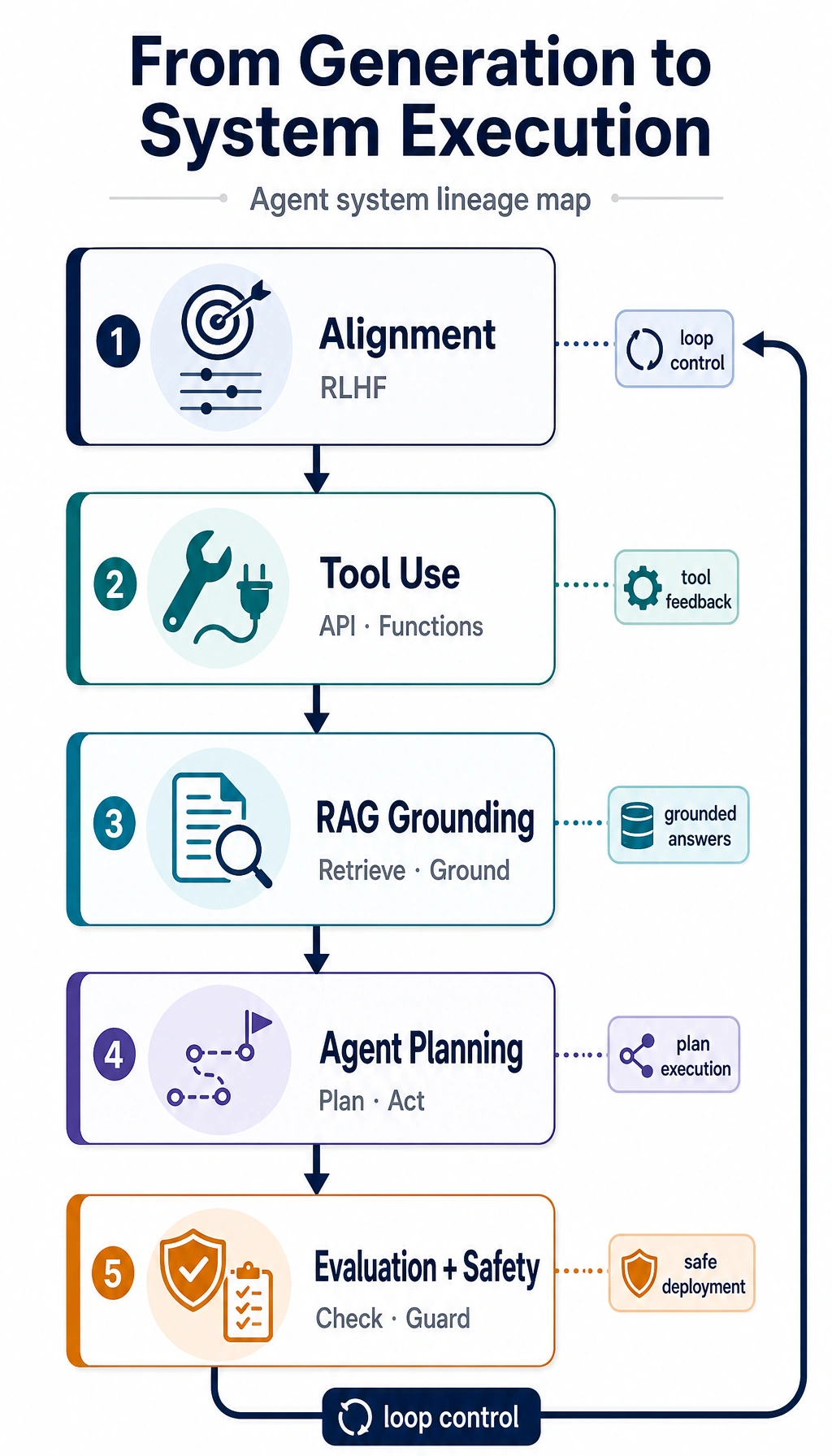
Read this image from bottom to top: fixed scripts solve stable tasks, workflows add structure, tool-using LLM systems add judgment, and modern Agents begin to manage goals, tools, memory, and feedback loops together.
Before Agents, automation already existed
Section titled “Before Agents, automation already existed”Early automation was more like “fixed scripts”
Section titled “Early automation was more like “fixed scripts””Before large models existed, many automation systems were already at work:
- Scheduled tasks
- Automatic form processing
- Rule engines
- RPA process bots
These systems are valuable, but they all share one trait:
The path is basically written in advance.
Rule-based bots are more like “acting strictly by the script”
Section titled “Rule-based bots are more like “acting strictly by the script””For example, a customer service rule bot might work like this:
- If the user mentions “refund,” reply with the refund policy
- If the user mentions “certificate,” reply with certificate instructions
It usually does not really plan, and it is not very flexible at changing tactics.
The workflow era: stronger than rules, but still relatively fixed
Section titled “The workflow era: stronger than rules, but still relatively fixed”Workflows are “composable fixed processes”
Section titled “Workflows are “composable fixed processes””Later, systems became a bit more complex, and we started to see:
- Conditional branches
- Multi-step chaining
- Tool combination
For example:
- Identify the user’s intent
- Query the database
- Use a template to generate a reply
This is already stronger than pure rules, but in many cases it is still a “pre-designed path.”
Why are workflows still important today?
Section titled “Why are workflows still important today?”Because they are:
- Stable
- Controllable
- Easy to debug
So even though Agents are very popular today, many real-world projects still rely heavily on workflows.
Why has this workflow approach not become outdated even today?
Section titled “Why has this workflow approach not become outdated even today?”Because it satisfies the three most practical needs in engineering:
- Stability
- Controllability
- Auditability
That is also why many beginners later realize:
- A system that is “more like an Agent” is not always more valuable than a workflow
In many real scenarios, a workflow is not a leftover from an old era, but more like:
The foundation that is still very important in the Agent era.
Why was it hard to build a general-purpose Agent before large models?
Section titled “Why was it hard to build a general-purpose Agent before large models?”Because “understanding the task” itself is hard
Section titled “Because “understanding the task” itself is hard”In the past, systems were good at:
- Executing according to rules
- Processing structured fields
But they were not good at:
- Understanding open-ended natural language instructions
- Deciding the next step in uncertain situations
So many systems could only “automate,” not really “agentify”
Section titled “So many systems could only “automate,” not really “agentify””They could get things done, but what they handled was usually:
- Fixed, explicit, structured tasks
Not:
- Ambiguous, context-dependent tasks that require dynamic judgment
What exactly did large models change?
Section titled “What exactly did large models change?”They made the bridge from “natural language -> executable actions” much stronger
Section titled “They made the bridge from “natural language -> executable actions” much stronger”One of the biggest changes brought by large models is not just that they chat better, but that they are better at:
- Understanding open-ended instructions
- Generating structured output
- Choosing tools
- Organizing intermediate steps
This means systems can finally:
Stop hard-coding every step manually, and instead let the model help decide the next step.
This is why modern Agents exploded in popularity
Section titled “This is why modern Agents exploded in popularity”When large models gained:
- Instruction following
- Tool calling
- Long context
- Stronger planning ability
Agents truly moved from concept to practical use.
Why do many people see this as the moment the “threshold was crossed”?
Section titled “Why do many people see this as the moment the “threshold was crossed”?”Because before large models, automation systems mostly could only:
- Follow templates
- Follow fixed structures
But large models significantly improved, for the first time:
- Understanding open-ended instructions
- Generating structured actions
- Continuing a task under vague conditions
This gives many people a strong feeling:
The system is no longer just “doing things by following a process,” but is starting to look like something that can organize steps around a goal on its own.
A small “evolutionary” example
Section titled “A small “evolutionary” example”Below, let’s use the same task to look at the flavor of three different stages.
Rule-based bot
Section titled “Rule-based bot”def rule_bot(query): if "refund" in query: return "Please check the refund policy." if "certificate" in query: return "Please check the certificate instructions." return "Sorry, I do not understand your question."
print(rule_bot("How do I get a refund"))print(rule_bot("How do I get a certificate"))Expected output:
Please check the refund policy.Please check the certificate instructions.Workflow system
Section titled “Workflow system”def workflow_bot(query): if "refund" in query: doc = "Refund policy: You can get a refund within 7 days if your learning progress is below 20%." return f"Based on the knowledge base: {doc}" if "certificate" in query: doc = "Certificate instructions: You can receive a certificate after completing the project and passing the test." return f"Based on the knowledge base: {doc}" return "No workflow node matched."
print(workflow_bot("How do I get a refund"))Expected output:
Based on the knowledge base: Refund policy: You can get a refund within 7 days if your learning progress is below 20%.Simplified Agent
Section titled “Simplified Agent”def tool_search_policy(keyword): docs = { "refund": "Refund policy: You can get a refund within 7 days if your learning progress is below 20%.", "certificate": "Certificate instructions: You can receive a certificate after completing the project and passing the test." } for k, v in docs.items(): if k in keyword: return v return "No related policy found."
def simple_agent(query): steps = [] steps.append("First, determine the question type")
if "refund" in query or "certificate" in query: steps.append("Decide to call the policy retrieval tool") evidence = tool_search_policy(query) steps.append(f"Evidence obtained: {evidence}") answer = f"Based on the retrieved policy, here is the answer: {evidence}" else: steps.append("No suitable tool can be determined right now") answer = "Sorry, I still do not know how to handle this task."
return steps, answer
steps, answer = simple_agent("If I have not learned much, can I get a refund?")print(steps)print(answer)Expected output:
['First, determine the question type', 'Decide to call the policy retrieval tool', 'Evidence obtained: Refund policy: You can get a refund within 7 days if your learning progress is below 20%.']Based on the retrieved policy, here is the answer: Refund policy: You can get a refund within 7 days if your learning progress is below 20%.In this example, although the Agent is still simplified, it already reflects the structure of “judge -> choose a tool -> use the result.”
From the AutoGPT wave to today
Section titled “From the AutoGPT wave to today”What did the early wave bring?
Section titled “What did the early wave bring?”Early on, people saw that large models could:
- Write plans on their own
- Call tools on their own
- Execute in loops on their own
This led to many attempts at “fully automated Agents.”
Later, people became more rational
Section titled “Later, people became more rational”In practice, people found that:
- Completely free-form Agents are not necessarily stable
- Multi-step systems can accumulate errors
- Costs and latency can become very high
So the industry gradually moved toward a more mature direction:
- Use workflows to constrain Agents
- Use tool calling to improve stability
- Use evaluation and observability to improve controllability
This is a process of “moving from excitement to engineering.”
Why is this history especially valuable for beginners?
Section titled “Why is this history especially valuable for beginners?”Because it helps you avoid a very common misunderstanding:
- Thinking that an Agent is always better the more autonomous it is
But the real world often is not like that. Many times, what is truly valuable is:
- Stability
- Explainability
- Recoverability
- Replayability
So the most important thing to remember about the AutoGPT era is not the hype itself, but that it was like an open experiment for the entire industry:
Everyone first saw the possibility, and then reality pulled things back to engineering constraints.
What do Agents look like today?
Section titled “What do Agents look like today?”No longer “infinite autonomy,” but “limited autonomy”
Section titled “No longer “infinite autonomy,” but “limited autonomy””More mature Agent systems usually:
- Define clear goal boundaries
- Restrict available tools
- Record intermediate states
- Set timeouts and safety guardrails
They are more like “intelligent executors with workflow constraints”
Section titled “They are more like “intelligent executors with workflow constraints””That is also why many teams today do not pursue the “most free” Agent, but instead focus more on:
- Stability
- Replayability
- Auditability
Common beginner misconceptions
Section titled “Common beginner misconceptions”Thinking Agent history started with ChatGPT
Section titled “Thinking Agent history started with ChatGPT”No. ChatGPT and LLMs only brought Agents into a new stage.
Thinking old systems are all outdated
Section titled “Thinking old systems are all outdated”Many rule systems and workflows are still the main force in industry today.
Thinking more autonomy always means more advanced
Section titled “Thinking more autonomy always means more advanced”In real engineering, controllability is often more important than “sounding smarter.”
Evidence to Keep
Section titled “Evidence to Keep”Keep this page’s proof of learning as a small evidence card:
- Agent Boundary
- how this differs from chatbot or fixed workflow
- Goal State Action
- goal, current state, next action, observation
- Architecture Parts
- planner, tools, memory, guardrails, evaluator
- Failure Check
- over-autonomy, vague goal, missing state, or no trace
- Next Action
- build the smallest traceable single-agent loop
Summary
Section titled “Summary”The most important takeaway from this section is:
Agent is not a brand-new species that appeared out of thin air, but a leap in capability for automation systems in the era of large models.
Understanding its history helps you judge more calmly: when you should use an Agent, and when a workflow is actually enough.
Exercises
Section titled “Exercises”- Add another tool to
simple_agent(), such as a “calculator.” - Summarize the differences between rule-based bots, workflows, and Agents in your own words.
- Think about this: why do many teams still keep a large number of fixed workflow nodes in Agent projects?
Project reference and review notes
- A calculator tool should be routed only for numeric tasks, validate inputs, and return a structured result or error.
- Rule bots match fixed conditions; workflows execute predefined steps; Agents choose tools and actions based on goal, context, and observations.
- Fixed nodes remain useful because they are easier to test, audit, secure, and recover. Many real Agent systems mix deterministic workflow with flexible Agent steps.