
6.5.1 Transformer Roadmap: Attention Lets Tokens Look at Each Other
Transformer is the bridge from deep learning to modern LLMs. Its first idea is simple: each token can decide which other tokens matter.
Look at the Attention Flow First
Section titled “Look at the Attention Flow First”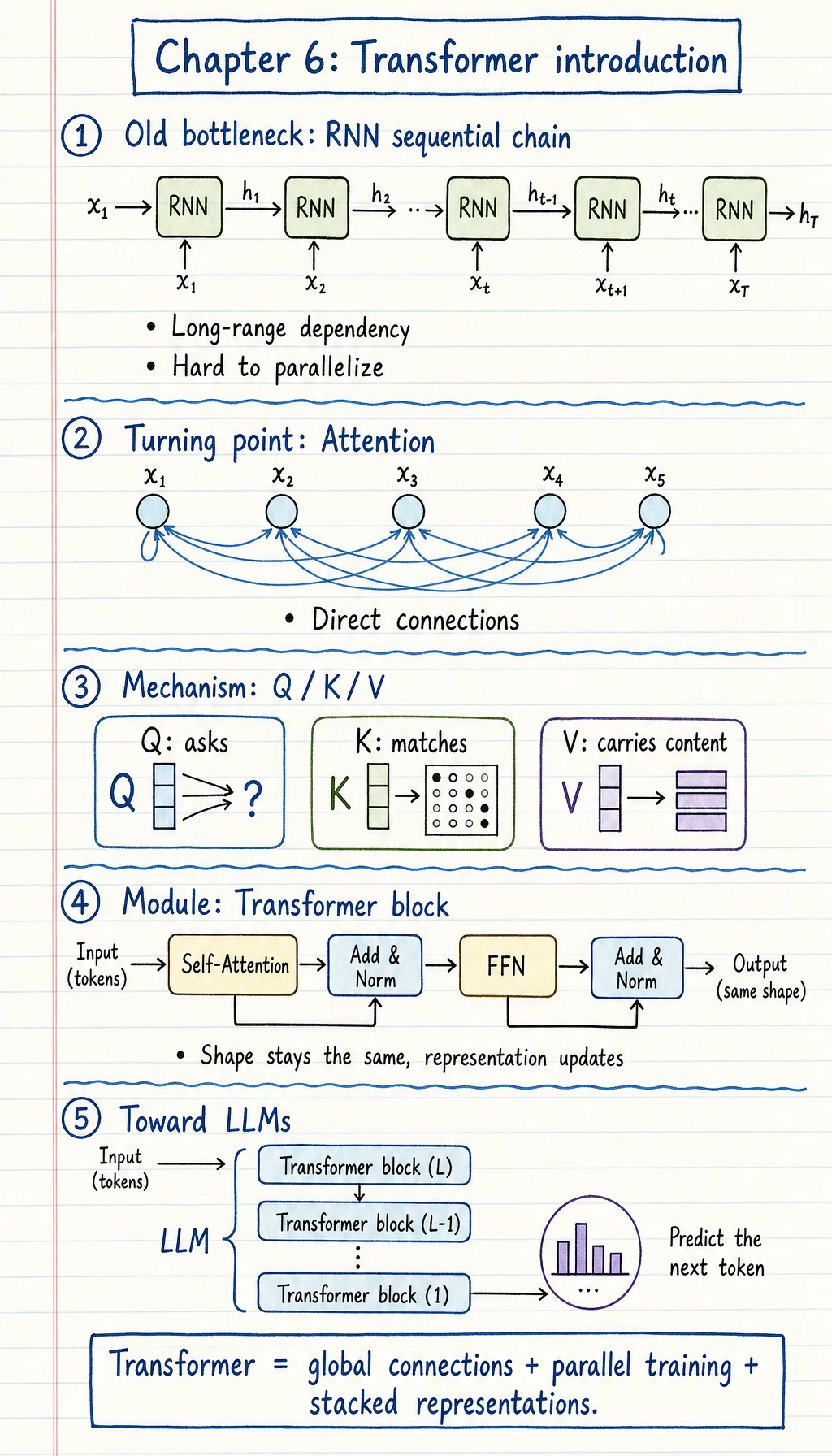
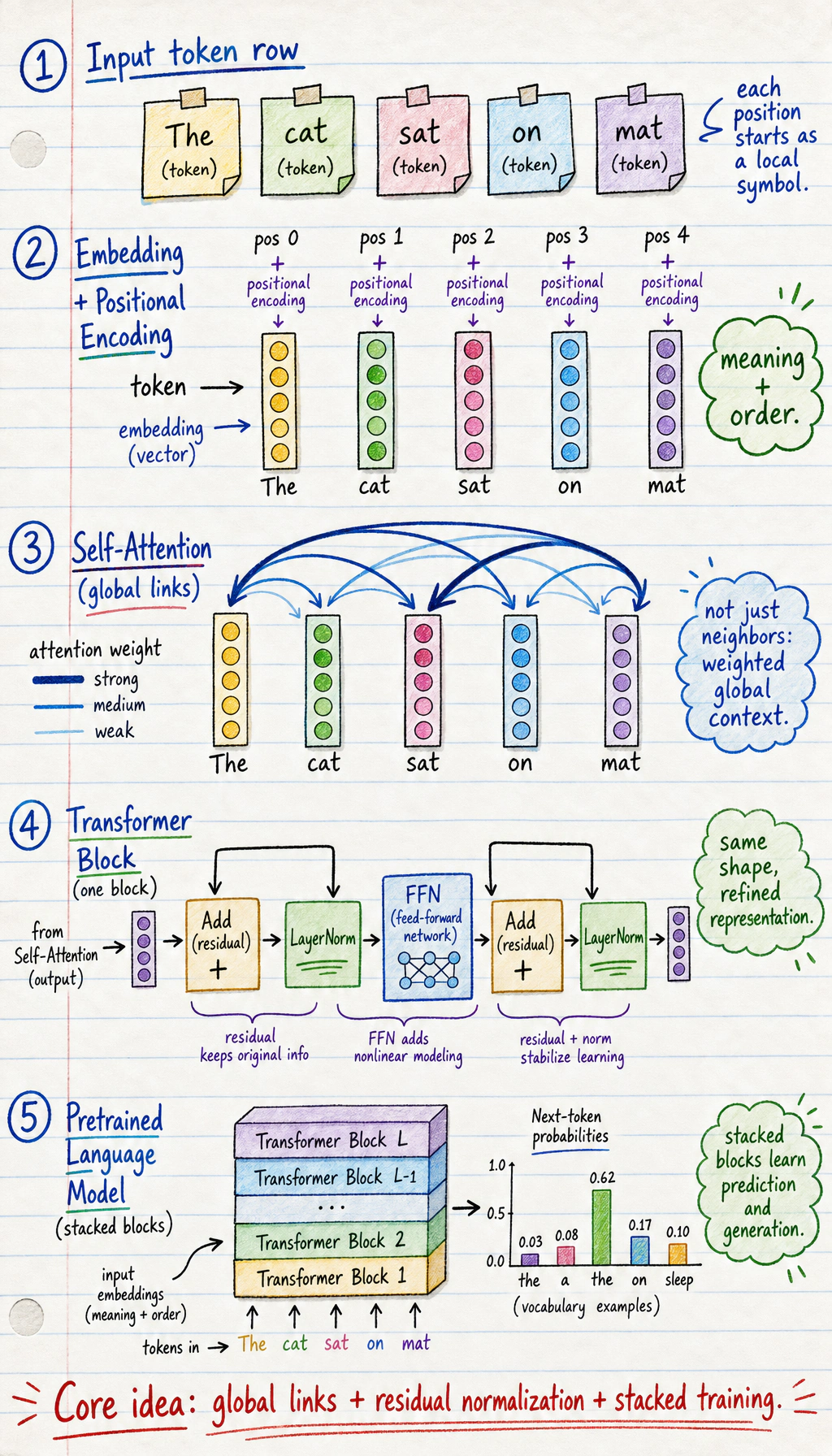
| Concept | First meaning |
|---|---|
| token | one position in the sequence |
| Q / K / V | query, key, value views of tokens |
| attention weight | how much one token looks at another |
| block | attention plus feed-forward refinement |
| mask | prevent seeing future tokens in generation |
Run One Attention Shape Check
Section titled “Run One Attention Shape Check”Create transformer_first_loop.py and run it after installing torch.
import torch
attention = torch.nn.MultiheadAttention(embed_dim=8, num_heads=2, batch_first=True)tokens = torch.randn(1, 4, 8)output, weights = attention(tokens, tokens, tokens)
print("tokens_shape:", tuple(tokens.shape))print("output_shape:", tuple(output.shape))print("attention_shape:", tuple(weights.shape))
Expected output:
tokens_shape: (1, 4, 8)output_shape: (1, 4, 8)attention_shape: (1, 4, 4)attention_shape is [batch, query_position, key_position]: each of 4 positions can look at 4 positions.
Learn in This Order
Section titled “Learn in This Order”| Order | Read | What to focus on |
|---|---|---|
| 1 | 6.5.2 Attention Mechanism | QKV, attention weights, masking |
| 2 | 6.5.3 Transformer Architecture | block structure, residuals, feed-forward layers |
Evidence to Keep
Section titled “Evidence to Keep”Keep one attention bridge note:
- Tokens Shape
- [batch, seq_len, embed_dim]
- Attention Shape
- [batch, query_position, key_position]
- Qkv Meaning
- Q/K match, V carries content
- Mask Reason
- generation cannot see future tokens
- Llm Bridge
- decoder blocks turn token context into next-token logits
Pass Check
Section titled “Pass Check”You pass this roadmap when you can read the attention weight shape, explain why attention gives global context, and connect masks to text generation.
Check reasoning and explanation
- A passing answer connects tensors, model layers, loss,
backward(), and optimizer updates into one training loop. - The evidence should include a runnable mini experiment, tensor-shape checks, and a loss or validation curve you can explain.
- A good self-check names one failure mode such as shape mismatch, no loss decrease, overfitting, data leakage, or using Attention/Transformer words without explaining the data flow.