
9.10.1 Project Roadmap: Build a Traceable Agent
An Agent project portfolio should show a traceable execution loop, not just one final model answer.
See the Project Loop First
Section titled “See the Project Loop First”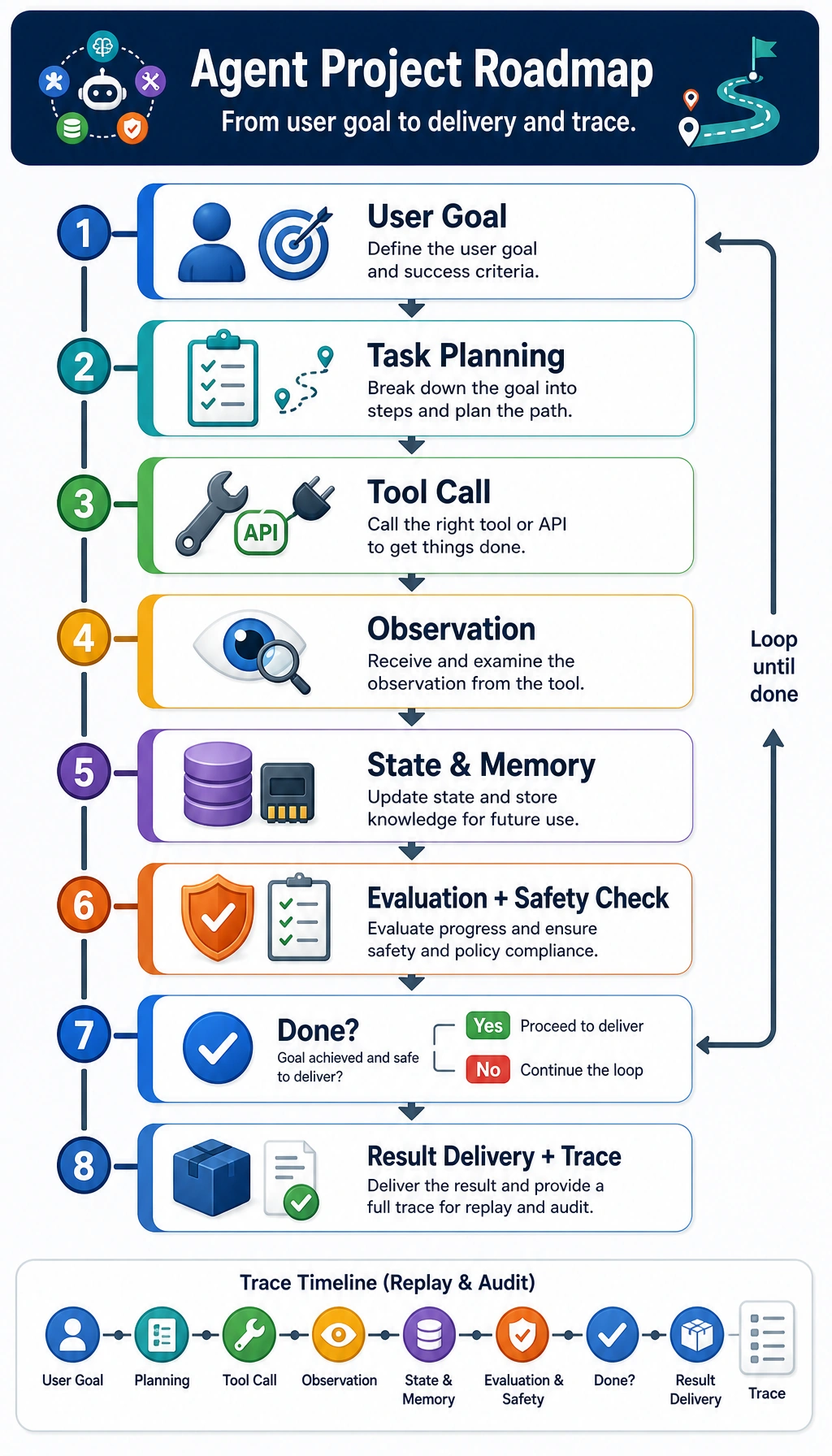
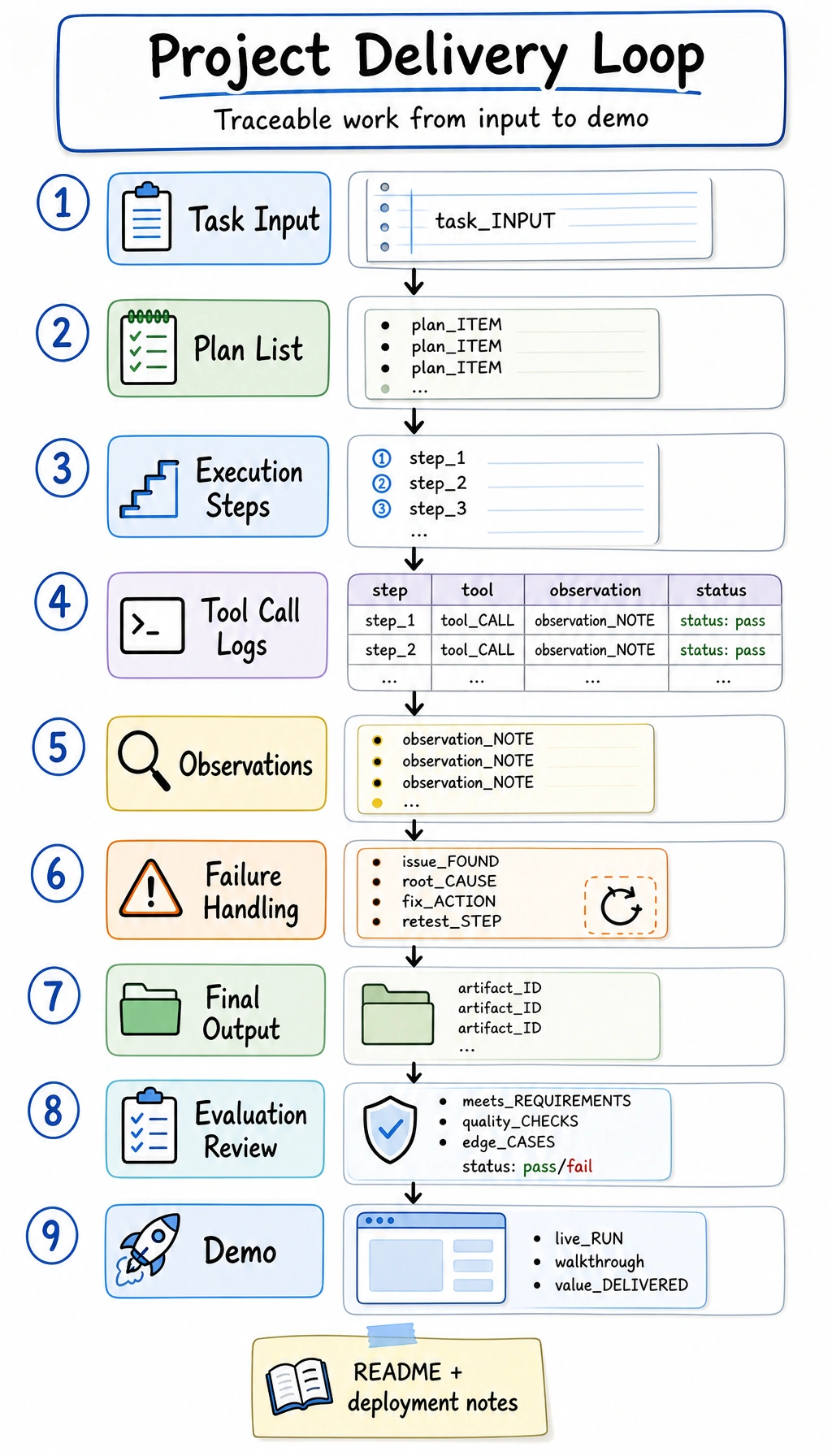
The loop is: goal, plan, tool call, observation, state update, failure handling, stop decision, final output, evaluation.
Run an Agent Evidence Check
Section titled “Run an Agent Evidence Check”Use this before calling the project portfolio-ready.
project = {    "goal_defined": True,    "trace_saved": True,    "tool_logs": True,    "failure_case": True,    "eval_tasks": 10,}
ready = (    project["goal_defined"]    and project["trace_saved"]    and project["tool_logs"]    and project["failure_case"]    and project["eval_tasks"] >= 5)
print("portfolio_ready:", ready)print("evidence:", "goal, trace, tools, failure, eval")
Expected output:
portfolio_ready: Trueevidence: goal, trace, tools, failure, evalIf this says False, improve the evidence before adding more Agent roles.
Learn in This Order
Section titled “Learn in This Order”| Step | Project | What It Trains |
|---|---|---|
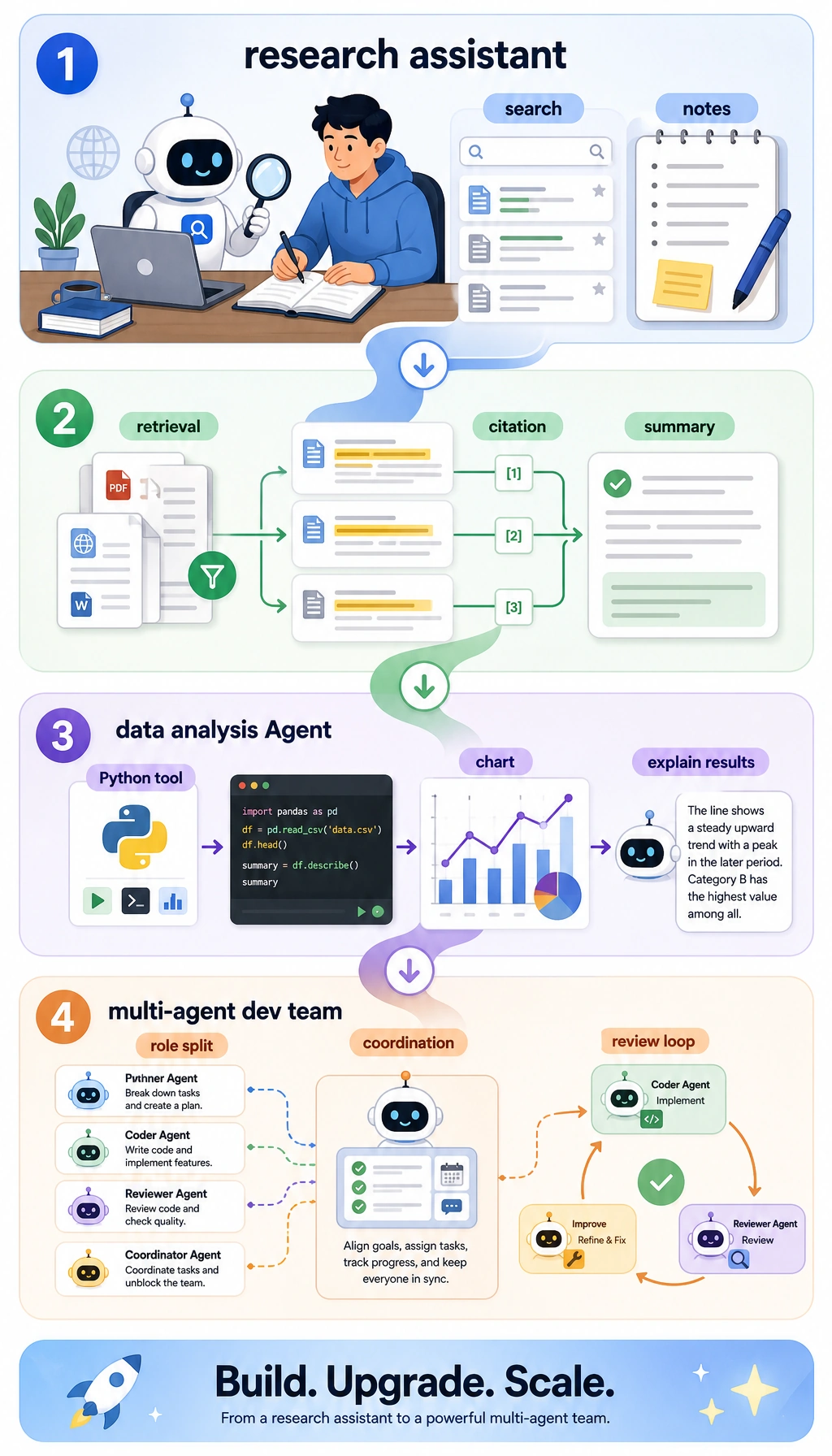
| 1 | Research assistant | Retrieval, citation, summarization, trustworthy output |
| 2 | Data analysis Agent | Python tool calls, table analysis, charts, interpretation |
| 3 | Multi-Agent development team | Role division, handoff, review loop, merge ownership |
| 4 | Hands-on workshop | The smallest traceable single-Agent baseline |
Run 9.10.5 Hands-on: Build a Traceable Single-Agent Assistant before expanding the project.
Evidence to Keep
Section titled “Evidence to Keep”Keep this page’s proof of learning as a small evidence card:
- Project Goal
- what the agent should accomplish and what it must not do
- Baseline
- single-agent loop before adding advanced features
- Trace Pack
- goal, plan, tool calls, observations, memory, evaluation
- Failure Log
- one failed or unsafe run with root cause
- Deliverable
- README, run command, trace screenshot/log, next step
Project Deliverable Standards
Section titled “Project Deliverable Standards”| Deliverable | Minimum Requirement | Stronger Portfolio Version |
|---|---|---|
| README | Goal, run command, dependencies, examples | Add architecture, trade-offs, cost, safety, retrospective |
| Architecture | Model, tools, memory, state, evaluation, safety | Add deployment boundary and human handoff |
| Tool list | Callable tools, input/output schema, failures | Add permission rules and sandbox notes |
| Execution trace | Plan, action, observation, replan, stop | Add replayable JSONL logs |
| Failure case | At least 1 real failure | Add 3 cases with cause, fix, regression check |
| Evaluation set | Fixed tasks and pass/fail rules | Add baseline, metrics, and comparison experiments |
| Deployment note | How to run locally | Add API entry, environment variables, monitoring, rollback |
Pass Check
Section titled “Pass Check”You pass this chapter when another developer can replay your Agent run, inspect each tool call and observation, understand why it stopped, and see at least one failure analysis.
The basic version can be a single-Agent project. Add memory, MCP, multi-Agent collaboration, or deployment only after the trace and evaluation loop are solid.
Check reasoning and explanation
- A passing answer describes the agent loop: goal, plan, tool call, observation, memory or state update, and stop condition.
- The evidence should include a trace that another developer can inspect, not only the final answer.
- A good self-check names one safety or reliability control such as tool schemas, permission boundaries, retries, evaluation cases, or a human-review point.