
9.2.3 Chain-of-Thought Reasoning Strategy
Learning Objectives
Section titled “Learning Objectives”- Understand why Chain-of-Thought reasoning improves multi-step task performance
- Understand what kinds of tasks CoT is suitable for, and what kinds it is not
- Use runnable examples to understand the difference between “answer directly” and “answer step by step”
- Understand how to use structured reasoning in production instead of uncontrolled long-form text
Why does “thinking through the steps first” help?
Section titled “Why does “thinking through the steps first” help?”Because many problems do not reach the end in one jump
Section titled “Because many problems do not reach the end in one jump”For example, consider this problem:
- A support queue has 18 open tickets, 4 are duplicates that should be merged, and then 7 urgent tickets arrive. How many tickets need triage?
If the model generates the answer directly, it may make very typical mistakes:
- Treat duplicate tickets as new tickets instead of removing them
- Forget the urgent tickets that arrive later
- Get the step order wrong
But if it first breaks the process into steps:
18 - 4 = 1414 + 7 = 21
the final answer is usually more stable.
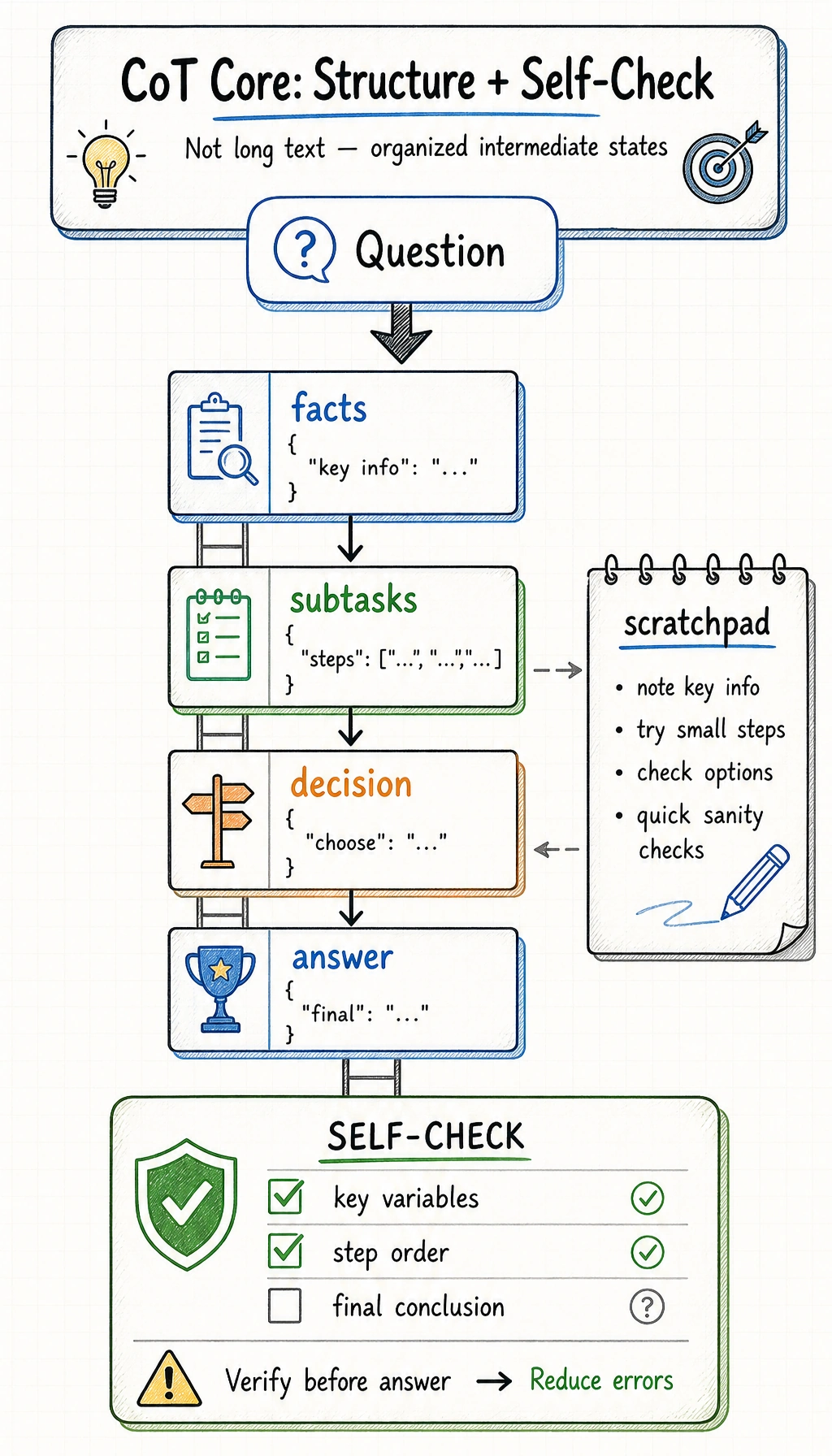
The core of CoT is not “writing more,” but “exposing intermediate structure”
Section titled “The core of CoT is not “writing more,” but “exposing intermediate structure””This point is especially important. The real value of Chain-of-Thought is not:
- Making the output longer
But rather:
- Making local facts
- Intermediate variables
- Step dependencies
explicit.
An analogy: scratch notes are not for looking serious
Section titled “An analogy: scratch notes are not for looking serious”When operations teams review a complex case, they use scratch notes not to make the answer longer, but to:
- prevent the mental state from being lost
- break a complex problem into smaller parts
- make checking easier
CoT plays a similar role for models.
First, let’s compare “direct answer” and “chain reasoning”
Section titled “First, let’s compare “direct answer” and “chain reasoning””The example below does not call an LLM, but it clearly demonstrates:
- Why a “rough direct mapping” is easy to get wrong
- Why “break the steps first, then calculate” is more stable
import re
problem = "A support queue has 18 open tickets, 4 are duplicates to merge, and then 7 urgent tickets arrive. How many tickets need triage?"

def bad_direct_answer(text):    numbers = list(map(int, re.findall(r"\d+", text)))    open_tickets, duplicates, urgent = numbers    # Common mistake: treating duplicates as new tickets instead of removing them    return open_tickets + duplicates + urgent

def chain_reason_answer(text):    open_tickets, duplicates, urgent = map(int, re.findall(r"\d+", text))
    steps = []    unique_tickets = open_tickets - duplicates    steps.append(f"First remove duplicate tickets: {open_tickets} - {duplicates} = {unique_tickets}")
    final_count = unique_tickets + urgent    steps.append(f"Then add urgent tickets: {unique_tickets} + {urgent} = {final_count}")
    return final_count, steps

print("problem:", problem)print("bad direct answer:", bad_direct_answer(problem))
answer, steps = chain_reason_answer(problem)print("\nchain reasoning steps:")for step in steps:    print("-", step)print("final answer:", answer)
Expected output:
problem: A support queue has 18 open tickets, 4 are duplicates to merge, and then 7 urgent tickets arrive. How many tickets need triage?bad direct answer: 29
chain reasoning steps:- First remove duplicate tickets: 18 - 4 = 14- Then add urgent tickets: 14 + 7 = 21final answer: 21
What does this code show most clearly?
Section titled “What does this code show most clearly?”It shows that:
- Direct mapping can easily misinterpret the problem
- Explicitly breaking the steps makes errors easier to expose
For example:
- Does “4 duplicates” mean
+4or-4?
As soon as you write that step out, the mistake is much harder to hide.
Why is CoT especially useful for math, logic, and planning tasks?
Section titled “Why is CoT especially useful for math, logic, and planning tasks?”Because these tasks usually have:
- Clear intermediate variables
- Clear step order
- Clear local dependencies
That naturally matches chain reasoning.
Why shouldn’t CoT be used for every task?
Section titled “Why shouldn’t CoT be used for every task?”Because not every problem needs step-by-step reasoning. For example:
- “What is the capital of France?”
This kind of question is more like retrieval, and does not need a long reasoning chain.
So CoT is not about “the more, the better” by default, but rather:
- More valuable for multi-step problems
How is CoT usually used in Agents?
Section titled “How is CoT usually used in Agents?”First decompose, then call tools
Section titled “First decompose, then call tools”In many Agent tasks, CoT is not directly used for arithmetic, but to decide:
- What to do first
- What to do next
- Which step needs a tool
For example:
- Identify the problem type
- Decide whether to check policy first or inventory first
- After getting observations, organize the conclusion
It can also become more structured “reasoning slots”
Section titled “It can also become more structured “reasoning slots””In production, we do not always need the model to output a long natural-language thought process. Many systems instead switch to a shorter, more structured format, such as:
factssubtasksdecisionnext_action
This kind of structure is often easier to:
- validate
- log
- debug
CoT is also often combined with self-checking
Section titled “CoT is also often combined with self-checking”A very common enhancement is:
- Reason first
- Check key steps
- Output the final answer
This can reduce some careless mistakes.
When is CoT most helpful?
Section titled “When is CoT most helpful?”Problems that require step-by-step decomposition
Section titled “Problems that require step-by-step decomposition”For example:
- Multi-step calculation
- Conditional filtering
- Combined decision-making
- Complex rule checking
Problems that require explaining the process
Section titled “Problems that require explaining the process”For example:
- Why recommend this solution
- Why can’t this request be executed
- Why does this answer follow the rules
When the system must provide not only a conclusion but also a reason, explicit intermediate steps are very valuable.
Problems with high error cost
Section titled “Problems with high error cost”If a mistake in calculation or judgment can lead to serious consequences, then explicit steps are usually more worthwhile.
When might CoT actually hurt performance?
Section titled “When might CoT actually hurt performance?”Simple retrieval questions
Section titled “Simple retrieval questions”If the problem itself does not require step-by-step reasoning, forcing the model to output a long process usually just means:
- slower
- longer
- more expensive
A reasoning chain that is too long can confuse itself
Section titled “A reasoning chain that is too long can confuse itself”When the chain gets too long, the model may:
- Have correct early steps but drift later
- Repeat explanations
- Become inconsistent in intermediate states
In other words, longer CoT is not automatically better.
It may not be suitable to expose the full chain to users
Section titled “It may not be suitable to expose the full chain to users”In many products, a more reasonable approach is:
- Keep the reasoning structure internal
- Show users only a concise explanation
Because what users usually need is:
- A clear conclusion
- Necessary reasons
Not a long scratchpad.
A more practical structured CoT pattern
Section titled “A more practical structured CoT pattern”The following example shows a style that is more suitable for Agents:
- Do not output a large block of free-form text
- Instead, split it into fixed slots
ticket = {    "question": "The refund queue has 18 open tickets, 4 are duplicates to merge, and then 7 urgent tickets arrive. How many tickets need triage?",    "policy": "Duplicate support tickets should be merged before triage.",}

def structured_reasoning(ticket):    facts = [        "Duplicate support tickets should be merged before triage",        "The queue starts with 18 open tickets, removes 4 duplicates, then receives 7 urgent tickets",    ]    calculation = ["18 - 4 = 14", "14 + 7 = 21"]    decision = "The team should triage 21 tickets."
    return {        "facts": facts,        "calculation": calculation,        "decision": decision,    }

result = structured_reasoning(ticket)print(result)
Expected output:
{'facts': ['Duplicate support tickets should be merged before triage', 'The queue starts with 18 open tickets, removes 4 duplicates, then receives 7 urgent tickets'], 'calculation': ['18 - 4 = 14', '14 + 7 = 21'], 'decision': 'The team should triage 21 tickets.'}The advantages of this format are:
- Easier to read
- Easier to test
- Easier to post-process
Common misconceptions
Section titled “Common misconceptions”Misconception 1: CoT just means making the model more verbose
Section titled “Misconception 1: CoT just means making the model more verbose”No. The core is:
- Making intermediate structure explicit
Misconception 2: All tasks should use CoT by default
Section titled “Misconception 2: All tasks should use CoT by default”Not true. Whether to enable it depends on whether the problem is truly multi-step.
Misconception 3: With CoT, the answer is always reliable
Section titled “Misconception 3: With CoT, the answer is always reliable”Also not true. Chain reasoning can improve stability, but it does not automatically eliminate all errors.
Evidence to Keep
Section titled “Evidence to Keep”Keep this page’s proof of learning as a small evidence card:
- Task Goal
- what the agent is trying to solve
- Plan Or Trace
- reasoning steps, plan, ReAct trace, or execution graph
- Observation
- what changed after each action
- Failure Check
- hallucinated step, stale observation, loop, or unverified conclusion
- Eval Action
- compare against expected result and revise the plan
Summary
Section titled “Summary”The most important thing in this section is not remembering the English name Chain-of-Thought,
but building a practical judgment:
When a problem depends on multi-step intermediate states, letting the model explicitly break down the steps often improves stability; but the value of CoT lies in structured intermediate process, not in endlessly lengthening the output.
Once you understand that clearly, the next time you see:
- ReAct
- Plan-and-Execute
- Self-checking and evaluation
it will be much easier to understand that they are continuing to organize reasoning on top of CoT.
Exercises
Section titled “Exercises”- Replace the ticket-queue problem in the example with your own multi-step operations problem, and compare
bad_direct_answerandchain_reason_answer. - Why do we say the core value of CoT lies in “explicit intermediate structure” rather than “longer output”?
- Think of a simple question that is not suitable for CoT, and explain why.
- If you were using CoT in a product, would you prefer free-form text or structured slots? Why?
Reference implementation and walkthrough
- The chain answer should expose sub-results, while the bad direct answer often hides assumptions or arithmetic mistakes.
- CoT is valuable when the task has dependencies that need to be tracked; long text without structure is just verbosity.
- Simple lookup questions such as “What is the capital of Japan?” do not need CoT because intermediate reasoning adds noise and cost.
- For products, structured slots are usually better because they are easier to validate, log, evaluate, and hide from users when needed.