
10.0 Learning Checklist: Computer Vision
Use this page as a printable checklist. If you need the full explanation, return to the Chapter 10 entry page.
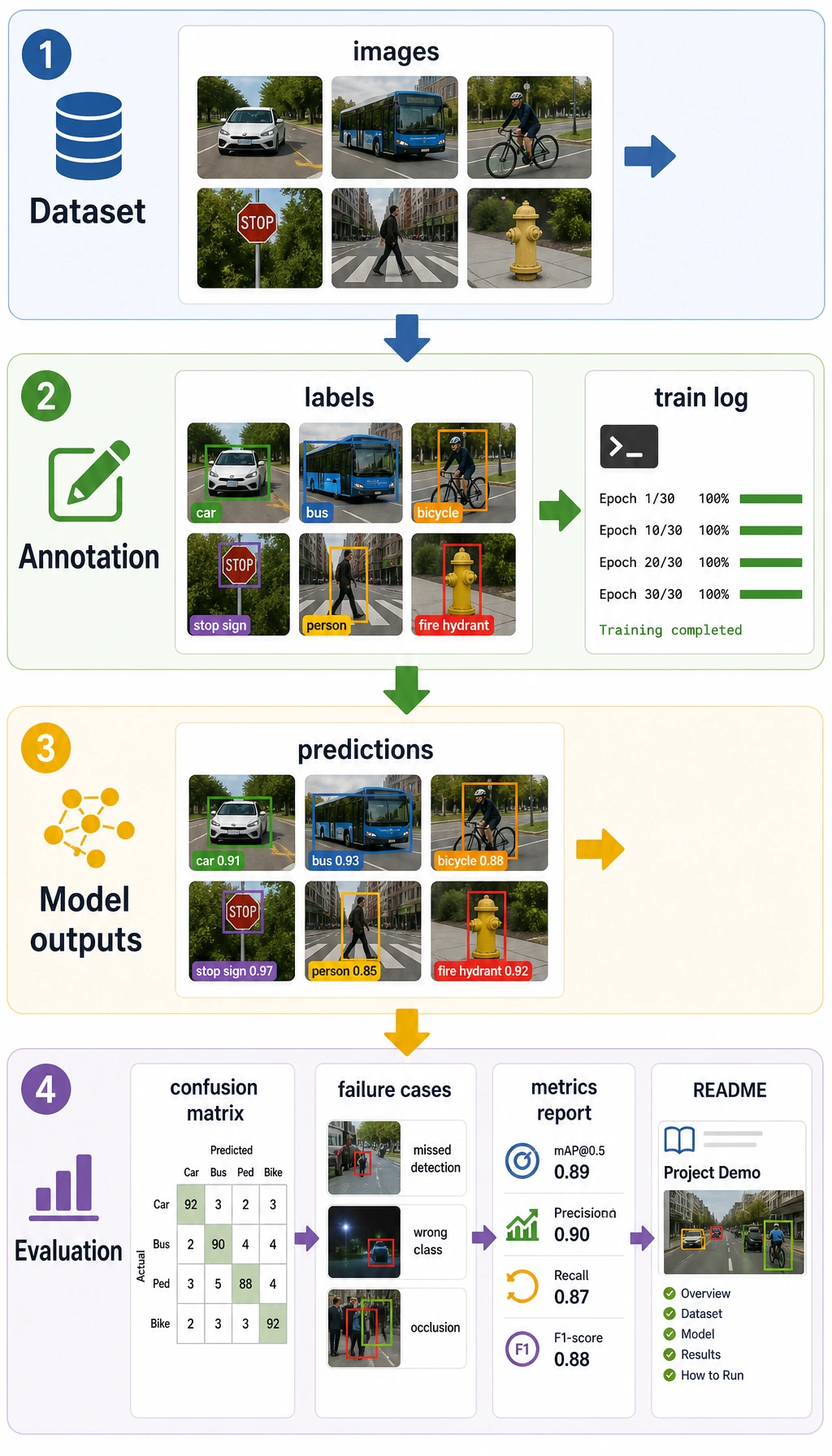
Two-Hour First Pass
Section titled “Two-Hour First Pass”| Time box | Do this | Stop when you can say |
|---|---|---|
| 20 min | Read the output-granularity ladder | ”Classification, detection, and segmentation differ by output.” |
| 25 min | Run the pixel lab | ”I can inspect size, channels, RGB, and grayscale.” |
| 25 min | Skim 10.1 image basics | ”Preprocessing changes the data the model sees.” |
| 25 min | Skim classification, detection, segmentation roadmaps | ”I know which metric belongs to which task.” |
| 25 min | Read the debugging loop | ”I should inspect data and labels before blaming architecture.” |
Required Evidence
Section titled “Required Evidence”| Evidence | Minimum version |
|---|---|
opencv_demo.py or pixel_lab.py | image load or generated image, preprocessing, saved output |
vision_dataset.md | data source, classes, sample count, annotation method, limitations |
eval_results.md | accuracy/F1, mAP, IoU/Dice, OCR hit rate, or chosen metric |
failure_cases.md | failed images, possible cause, fix direction |
README.md | task goal, run command, input/output examples, scenario boundary |
Quality Gates
Section titled “Quality Gates”| Gate | Pass condition |
|---|---|
| Visual trace | Original, processed, prediction, and failure images are saved with matching filenames. |
| Annotation | Dataset notes define classes, boxes or masks, source, split, and known label uncertainty. |
| Metric fit | Accuracy/F1, mAP, IoU/Dice, or OCR hit rate matches the task output. |
| Real-world boundary | Report names lighting, angle, camera or source, latency, image size, and device limits. |
Exit Questions
Section titled “Exit Questions”- Can you explain classification, detection, segmentation, and OCR by output shape?
- Can you show the original image, processed image, and prediction visualization?
- Can you explain why annotation quality affects metrics?
- Can you choose accuracy/F1, mAP, IoU, or Dice for the right task?
- Can you explain why a demo may fail on real images?
If the answer is yes, you can connect vision to multimodal work in Chapter 12.
Check reasoning and explanation
- A passing answer maps the task to the right visual output: class label, bounding box, mask, OCR text, embedding, or video event.
- The evidence should include a rendered visual artifact and one metric or qualitative error note.
- A good self-check names one visual failure mode such as class confusion, missed objects, bad masks, lighting shift, domain shift, or weak annotation quality.
Evidence to Keep
Section titled “Evidence to Keep”Keep this page’s proof of learning as a small evidence card:
- Task Output
- classification label, detection box, segmentation mask, OCR text, or video event
- Artifacts
- original image, processed image, prediction overlay, metrics file, and failure samples
- Metric
- accuracy/F1, mAP, IoU, Dice, latency, or scenario-specific review score
- Failure Check
- data quality, label error, preprocessing mismatch, threshold, or deployment constraint
- Expected Output
- a reproducible run folder with visual outputs and a short failure report