
5.0 Study Guide and Task Sheet: Machine Learning
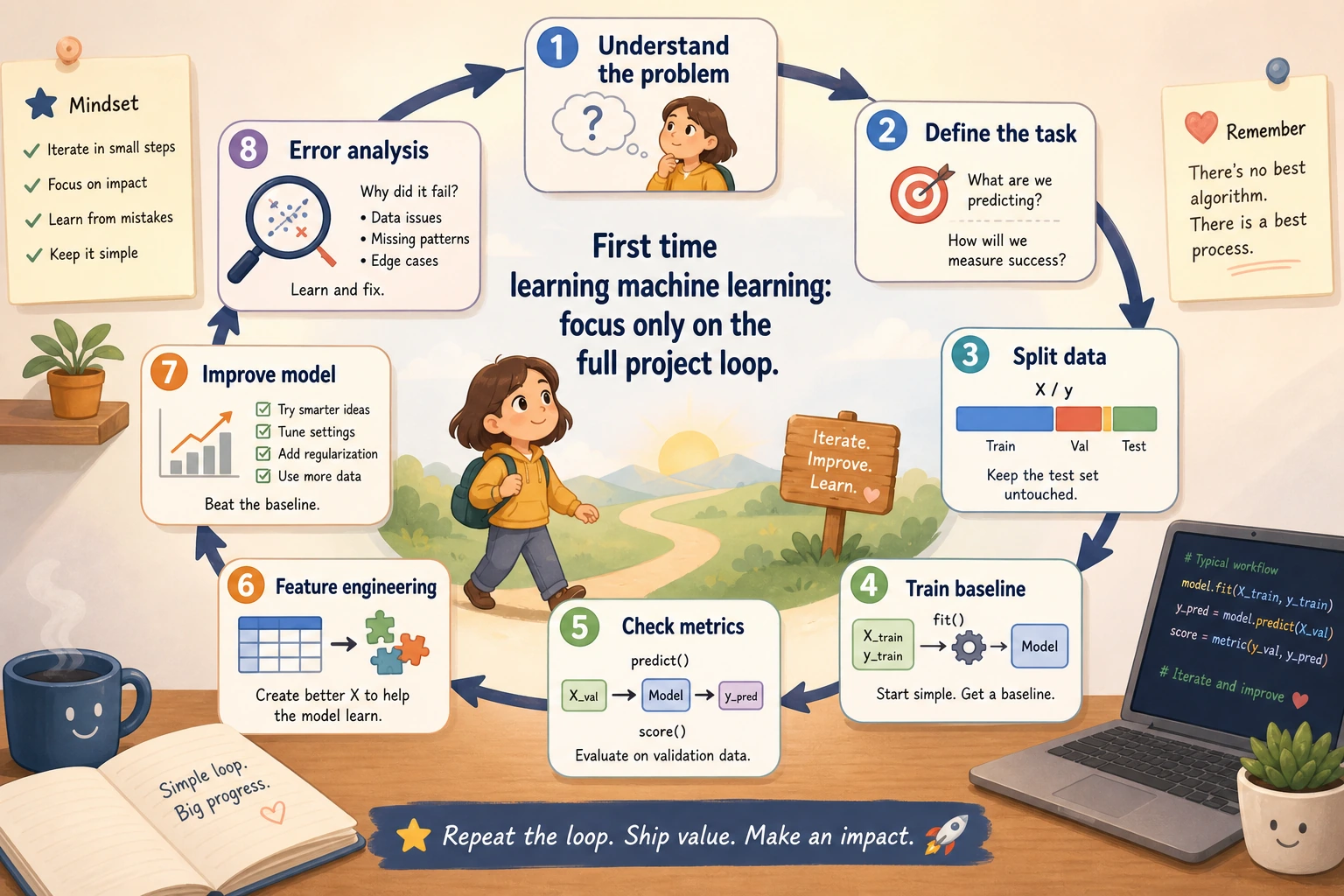
The main study route is now in Chapter 5 entry. Use this page only as a quick checklist while you practice.
One-Line Mental Model
Section titled “One-Line Mental Model”define tasksplit datatrain baselineevaluateinspect errorsimprove
If you do not know which model to use, start with a baseline.
Practice Checklist
Section titled “Practice Checklist”| Check | Evidence |
|---|---|
| I can define the task type | problem note |
| I can split data without leakage | train/test split note |
| I can train a dummy baseline and one real model | baseline comparison |
| I can choose a metric for the task | metric note |
| I can inspect errors | error samples |
| I can finish the evidence-pack workshop | ml_workshop_run/ |
Check reasoning and explanation
- A task note should say whether the problem is regression, classification, clustering, evaluation, or feature engineering, and what success means.
- A safe split note explains when the data is split and which preprocessing steps are fitted only on training data.
- A baseline comparison should include a dummy or simple model and one stronger model under the same evaluation protocol.
- A metric note should justify the metric using the task goal. Accuracy alone is not enough for imbalanced classification.
- Error samples should become a next action, not just a screenshot. Good next actions are controlled feature, data, threshold, or model changes.
- You are ready for Chapter 6 when another person can rerun your evidence pack and understand the modeling decisions.
Evidence Rubric
Section titled “Evidence Rubric”| Artifact | It should answer |
|---|---|
| Problem note | What is the task type, and what counts as success? |
| Split note | How did you keep test data away from training? |
| Baseline comparison | What is the minimum score to beat? |
| Metric note | Why does this metric match the goal better than plain accuracy? |
| Error note | Which mistakes matter most, and what feature or label issue might explain them? |
Ready To Continue
Section titled “Ready To Continue”Continue to Chapter 6 when one tabular project includes a baseline, a real model, metrics, error analysis, and a README that another person can rerun.
Evidence to Keep
Section titled “Evidence to Keep”Keep this page’s proof of learning as a small evidence card:
- Modeling Loop
- data, features, model, metric, error review, and next experiment
- Artifact
- code, score, chart, pipeline, or project README
- Failure Check
- leakage, metric mismatch, unstable split, overfitting, or unclear business target
- Next Action
- one controlled experiment rather than many parameter changes
- Expected Output
- reproducible ML evidence that prepares for deep learning