
11.3.1 Text Classification Roadmap: Text In, Label Out
Text classification takes one piece of text and predicts one label, such as sentiment, topic, intent, or risk type.
See the Classification Pipeline First
Section titled “See the Classification Pipeline First”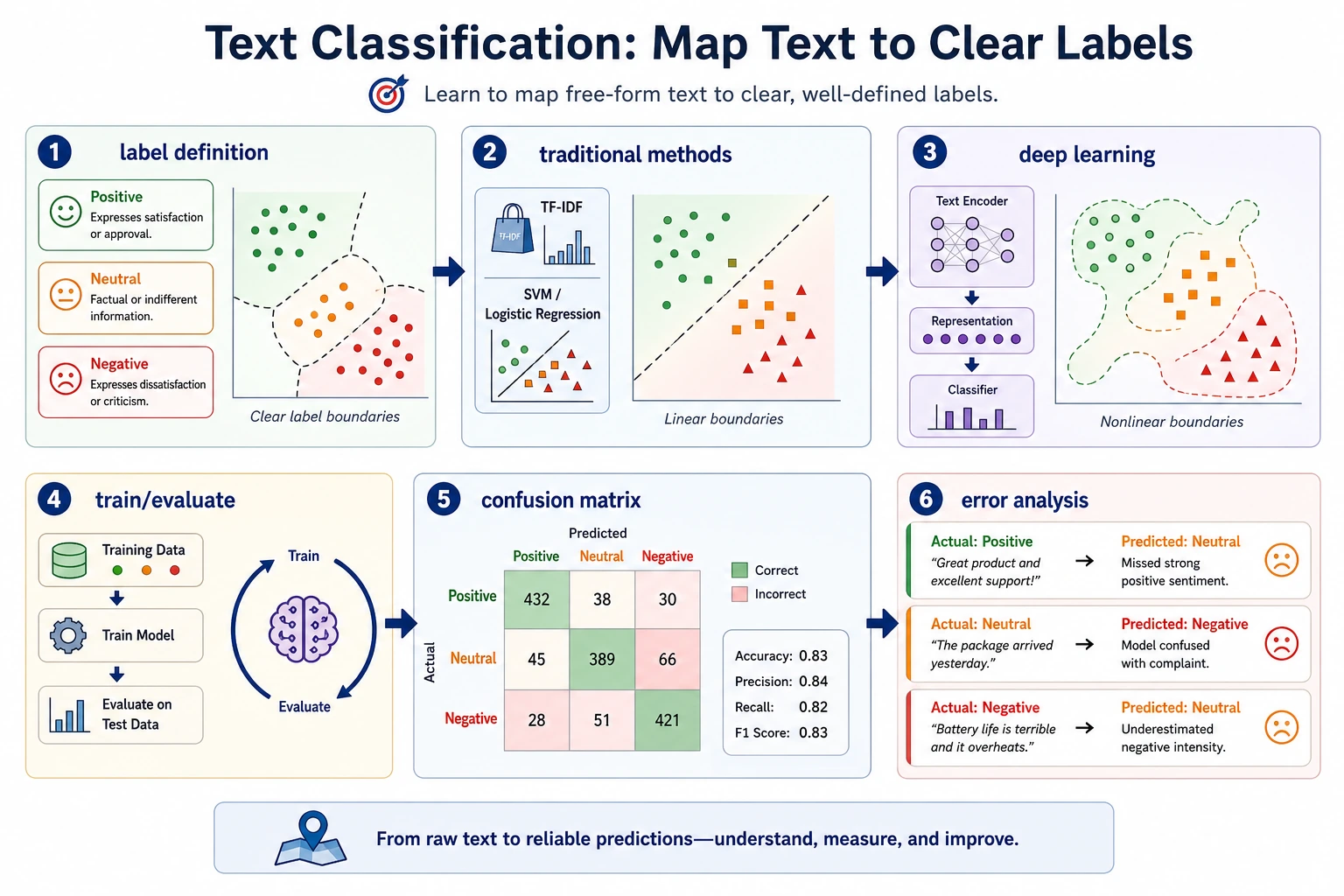
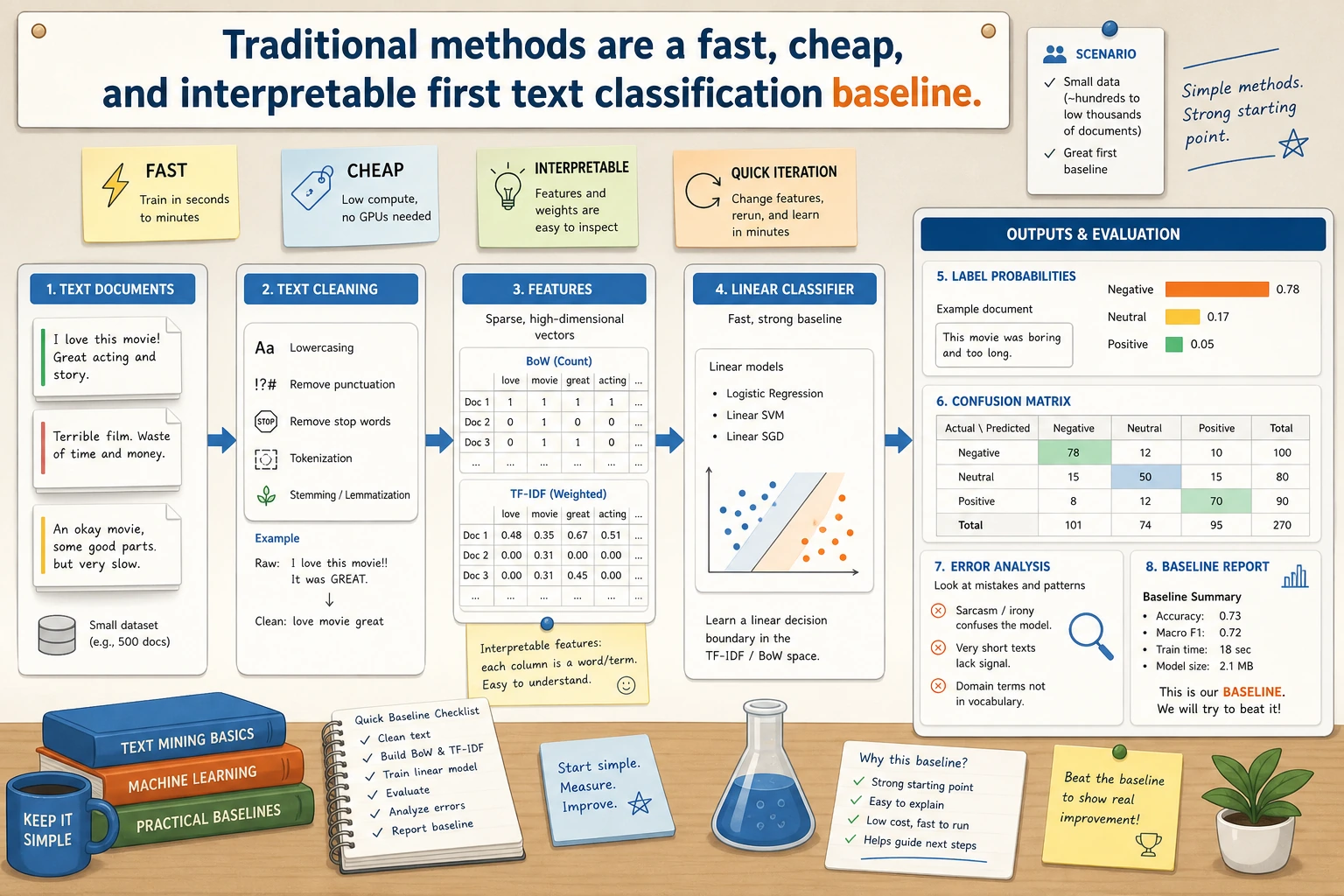
Always build a baseline before a complex model. Most classification problems fail because labels are vague or examples are skewed.
Run a Keyword Baseline
Section titled “Run a Keyword Baseline”texts = ["great course and clear examples", "confusing setup error"]positive_words = {"great", "clear", "good", "useful"}
for text in texts: score = sum(word in positive_words for word in text.split()) label = "positive" if score > 0 else "needs_review" print(label, "-", text)Expected output:
positive - great course and clear examplesneeds_review - confusing setup errorSimple baselines are not the final model, but they expose label rules and failure cases quickly.
Learn in This Order
Section titled “Learn in This Order”| Step | Read | Practice Output |
|---|---|---|
| 1 | Traditional methods | Build TF-IDF or keyword baseline |
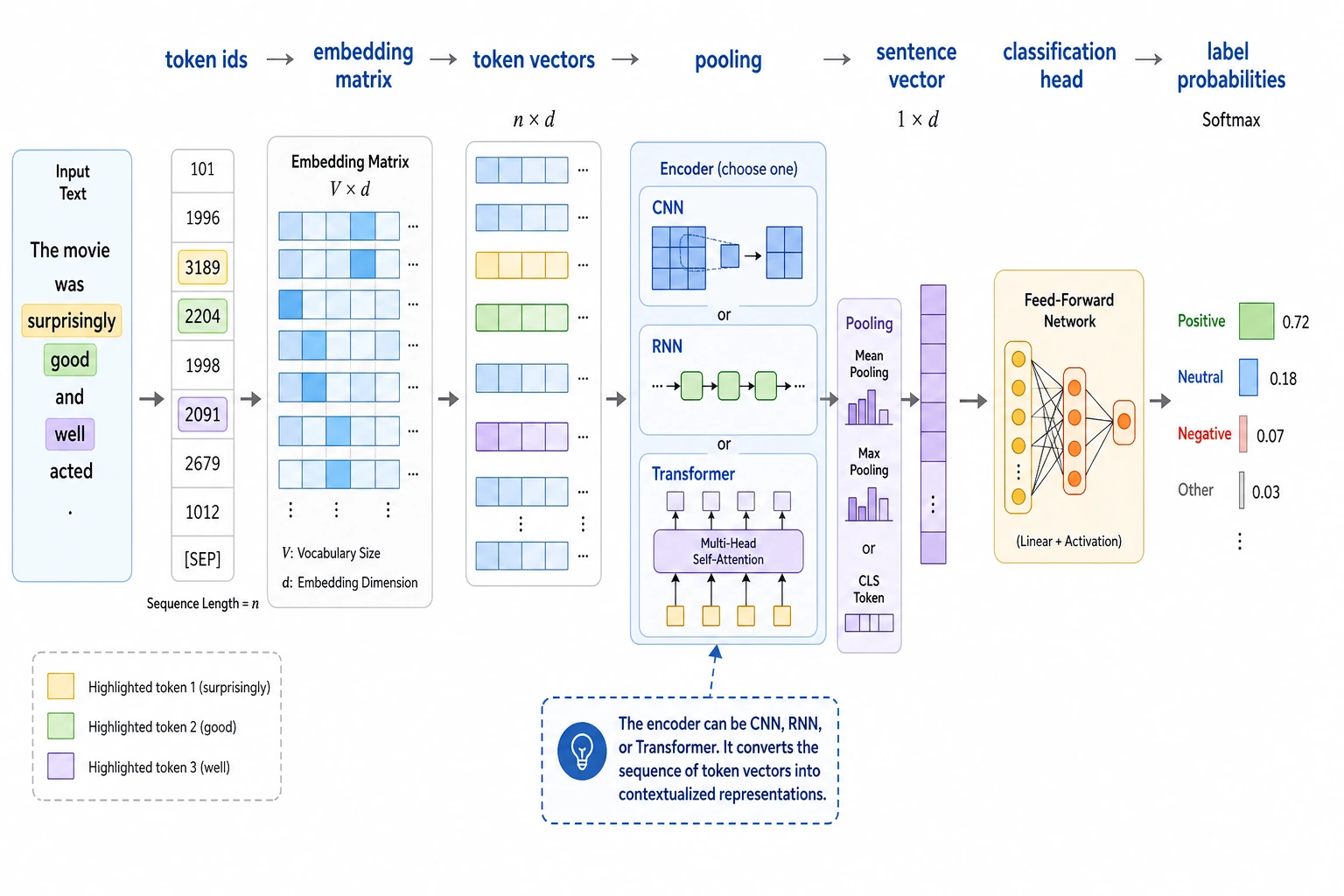
| 2 | Deep learning methods | Compare embeddings, pooling, CNN/RNN/Transformer features |
| 3 | Project practice | Track split, metrics, label ambiguity, and error samples |
Evidence to Keep
Section titled “Evidence to Keep”Keep this page’s proof of learning as a small evidence card:
- Label Schema
- label definitions and boundary examples
- Dataset Split
- fixed train/test examples or evaluation set
- Prediction
- predicted label, expected label, and confidence or score
- Failure Check
- class imbalance, label overlap, leakage, or confusing wording
- Expected Output
- metrics plus error samples grouped by failure reason
Pass Check
Section titled “Pass Check”You pass this chapter when you can train or simulate a classifier, report accuracy/F1, and explain at least one ambiguous label case.
Check reasoning and explanation
- A passing answer starts from the text unit and output type: token, span, sentence label, sequence, embedding, or generated text.
- The evidence should include a small dataset example, model or pipeline choice, metric, and at least one inspected error case.
- A good self-check distinguishes preprocessing issues from model issues, such as tokenization mistakes, label ambiguity, data imbalance, or hallucinated generation.