
9.6.8 Low-Code Platforms [Optional]
Learning Objectives
Section titled “Learning Objectives”- Understand why low-code platforms are so popular in Agent scenarios
- Understand which kinds of tasks they are best suited for
- Understand their real advantages and trade-offs compared with code-based frameworks
- Build the judgment to know when to use low-code and when to fall back to code
What Is the Most Core Value of a Low-Code Platform?
Section titled “What Is the Most Core Value of a Low-Code Platform?”It Is Not Meant to “Replace Engineers”
Section titled “It Is Not Meant to “Replace Engineers””More precisely, it is usually doing this:
- lowering the barrier to prototype building
- enabling non-engineering teammates to join process discussions
- making workflows more visual and easier to modify
So its real value is not:
“No code needed.”
But rather:
“Process expression and collaboration become lighter.”
An Analogy
Section titled “An Analogy”A low-code platform is a bit like:
- turning system logic from source code into a process whiteboard
A whiteboard cannot replace every engineering detail, of course, but it is very well suited for:
- quick experiments
- quick changes
- quick discussions
Why Are Agent Scenarios Especially Likely to Use Low-Code?
Section titled “Why Are Agent Scenarios Especially Likely to Use Low-Code?”Because many Agent systems naturally look like:
- input
- decision
- tool calling
- retrieval
- answer generation
Once this kind of “nodes + flow” structure is visualized, it becomes very suitable for:
- product
- operations
- analysis
- engineering
to discuss together.
In other words, Agent systems are naturally easy to express as workflows.
A Minimal Workflow Example
Section titled “A Minimal Workflow Example”workflow = { "trigger": "user_message", "steps": [ "classify_intent", "retrieve_docs", "generate_answer" ]}
print(workflow)Expected output:
{'trigger': 'user_message', 'steps': ['classify_intent', 'retrieve_docs', 'generate_answer']}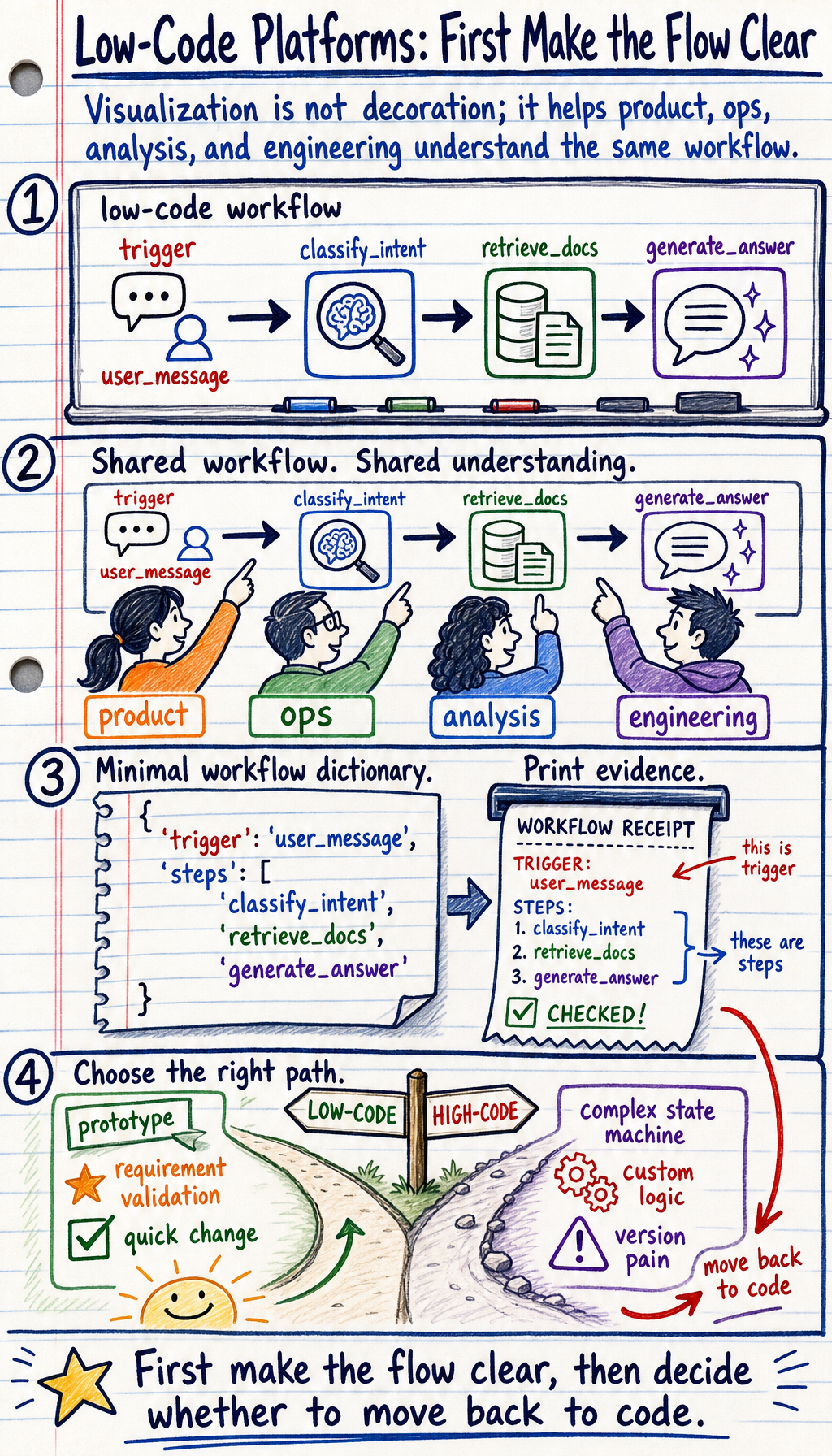
What Does This Example Really Show?
Section titled “What Does This Example Really Show?”It shows the core of low-code thinking:
First, treat the system as a set of nodes and connections, not as a pile of scattered code.
That is also why low-code platforms are often especially good for prototyping.
What Types of Tasks Are Low-Code Platforms Best Suited For?
Section titled “What Types of Tasks Are Low-Code Platforms Best Suited For?”Especially Suitable For
Section titled “Especially Suitable For”- FAQ workflows
- approval flows
- retrieval QA prototypes
- simple content generation chains
These usually have the following characteristics:
- clear process flow
- well-defined node responsibilities
- frequent changes
Not Always Suitable For
Section titled “Not Always Suitable For”If your system needs:
- complex state machines
- lots of custom logic
- highly optimized low-level control
then a low-code platform may eventually become insufficient.
Where Is the Biggest Advantage of Low-Code Platforms?
Section titled “Where Is the Biggest Advantage of Low-Code Platforms?”Visual Communication
Section titled “Visual Communication”In many cases, being able to “let others understand the flow” is already a huge benefit.
Prototype Speed
Section titled “Prototype Speed”It is especially valuable in these stages:
- requirement validation
- solution testing
- cross-role collaboration
Lower Cost of Workflow Changes
Section titled “Lower Cost of Workflow Changes”If business logic changes frequently, a low-code workflow is often more flexible than hard-coding certain processes.
But Why Are Low-Code Platforms Often Overestimated?
Section titled “But Why Are Low-Code Platforms Often Overestimated?”They Do Not Automatically Eliminate Complexity
Section titled “They Do Not Automatically Eliminate Complexity”Once a workflow truly becomes complex, the visual diagram can also become messy.
Many “Low-Code Systems” Still End Up Returning to Code
Section titled “Many “Low-Code Systems” Still End Up Returning to Code”For example:
- custom tools
- special state logic
- complex permission control
So low-code is more like:
a fast way to build the system first.
Rather than the final form of every system.
A Very Important Question: Who Is Using the Platform?
Section titled “A Very Important Question: Who Is Using the Platform?”If It Is Mainly Used by the Engineering Team
Section titled “If It Is Mainly Used by the Engineering Team”Often, using a code-based framework directly is perfectly fine.
If You Want These Roles to Participate Too
Section titled “If You Want These Roles to Participate Too”- product
- operations
- analysis
then the value of low-code increases significantly, because:
- it is easier to discuss together
- it is easier to build process consensus
So low-code platforms are often not just a technical decision, but also a collaboration decision.
When Should You Move Back from Low-Code to Code?
Section titled “When Should You Move Back from Low-Code to Code?”This usually happens at these moments:
- the node graph gets more and more complex
- custom logic keeps increasing
- debugging starts to hurt
- version management becomes harder
At that point, it often means:
Your system has moved from a “visual prototype” stage into an “engineering system” stage.
In other words, low-code is often better suited for:
- 0 to 1
and not necessarily for:
- 1 to 100
Common Pitfalls for Beginners
Section titled “Common Pitfalls for Beginners”Thinking Low-Code Looks Fast, So It Should Be Used for Everything
Section titled “Thinking Low-Code Looks Fast, So It Should Be Used for Everything”This usually hits a wall once complexity grows.
Only Looking at Build Speed, Not Long-Term Maintenance
Section titled “Only Looking at Build Speed, Not Long-Term Maintenance”This is one of the easiest places to overestimate low-code.
Assuming Low-Code Means You Don’t Need to Understand the System
Section titled “Assuming Low-Code Means You Don’t Need to Understand the System”In fact, the opposite is true. If you do not understand the system principles, you are only hiding the problem inside a visual interface.
Evidence to Keep
Section titled “Evidence to Keep”Keep this page’s proof of learning as a small evidence card:
- Problem Shape
- workflow graph, retrieval app, role team, or experiment
- Framework Choice
- what abstraction it adds and what control it hides
- Trace
- state, node, tool call, message, or run id
- Failure Check
- framework magic hides state, retries, or permissions
- Decision
- choose framework only after the single-agent loop is clear
Summary
Section titled “Summary”The most important thing in this section is not to judge whether low-code is “good” or “bad,” but to understand:
Low-code platforms are best suited for Agent scenarios with clear workflows, a need for quick trials, and a need for multiple people to understand the process together.
They are a very valuable kind of tool, but they should not be treated as the final destination for all systems.
Exercises
Section titled “Exercises”- Think of an Agent workflow of your own and judge whether it is suitable to express in a node-based way.
- Explain in your own words: why are low-code platforms especially suitable for the requirement validation stage?
- Think about it: why do we say “low-code lowers the implementation barrier, but not the understanding barrier”?
- If your system has many state loops, would you still choose a low-code platform first? Why?
Solution approach and explanation
- Node-based expression works well when the workflow has visible stages, simple branches, and stakeholders need to review the shape of the process. It is weaker when state loops and custom logic dominate.
- Low-code is useful for requirement validation because non-engineers can see the workflow, comment on missing steps, and test the idea before the team invests in production engineering.
- Low-code lowers implementation friction, but it does not remove the need to understand retrieval quality, tool permissions, error handling, evaluation, and deployment risk.
- If the system has many state loops, I would be cautious about choosing low-code first. It may still be useful for a prototype, but production logic often needs clearer code-level control and testing.