
6.7.4 Model Compression [Elective]
Learning Objectives
Section titled “Learning Objectives”- Explain quantization, pruning, and distillation by what they change.
- Estimate model size from parameter count and numeric precision.
- Measure quantization error in a tiny example.
- Choose a compression path from a deployment bottleneck.
- Avoid judging compression by size alone.
Start from the Deployment Bottleneck
Section titled “Start from the Deployment Bottleneck”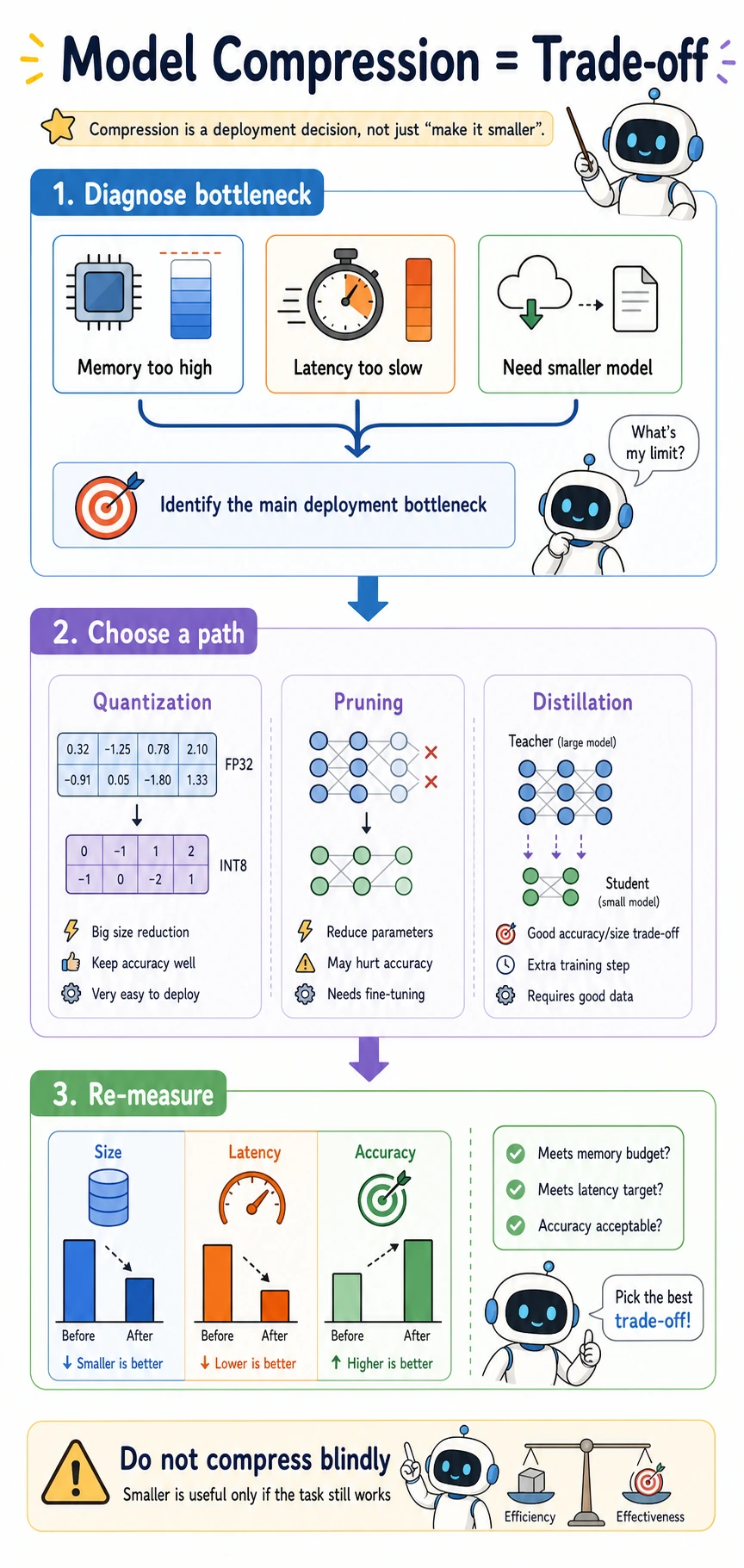
| Bottleneck | First method to consider | Why |
|---|---|---|
| memory too high | quantization | same parameter count, fewer bits per value |
| many redundant weights/channels | pruning | remove structure that contributes little |
| large teacher but retraining is possible | distillation | train a smaller student to imitate behavior |
| latency still high after compression | profiling first | bottleneck may be data transfer or unsupported kernels |
The important habit:
Three Compression Paths
Section titled “Three Compression Paths”| Method | Changes | Typical benefit | Main risk |
|---|---|---|---|
| Quantization | numeric precision | smaller memory, sometimes faster inference | accuracy drop, hardware support issues |
| Pruning | weights, channels, or blocks | less computation if structure is actually removed | sparse speedup may not appear on all hardware |
| Distillation | training objective | smaller model with teacher-like behavior | requires retraining and teacher outputs |
Compression is not complete until the task still works after compression.
Lab 1: Quantization Error
Section titled “Lab 1: Quantization Error”weights = [0.12, -1.87, 3.44, -0.03]
def fake_quantize(values, scale): return [round(v * scale) / scale for v in values]
def mae(a, b): return sum(abs(x - y) for x, y in zip(a, b)) / len(a)
q8_like = fake_quantize(weights, scale=16)q4_like = fake_quantize(weights, scale=4)
print("quant_error_lab")print("original:", weights)print("q8_like:", q8_like)print("q4_like:", q4_like)print("q8_mae:", round(mae(weights, q8_like), 4))print("q4_mae:", round(mae(weights, q4_like), 4))Expected output:
quant_error_laboriginal: [0.12, -1.87, 3.44, -0.03]q8_like: [0.125, -1.875, 3.4375, 0.0]q4_like: [0.0, -1.75, 3.5, 0.0]q8_mae: 0.0106q4_mae: 0.0825More aggressive quantization usually creates more numerical error. The practical question is whether the downstream task metric still stays acceptable.
Lab 2: Estimate Model Size
Section titled “Lab 2: Estimate Model Size”import torchfrom torch import nn
model = nn.Sequential( nn.Linear(128, 64), nn.ReLU(), nn.Linear(64, 10),)
param_count = sum(p.numel() for p in model.parameters())
print("model_size_lab")print("params:", param_count)
for name, bits in [("fp32", 32), ("fp16", 16), ("int8", 8), ("int4", 4)]: mb = param_count * bits / 8 / 1024 / 1024 print(f"{name:>4}: {mb:.4f} MB")Expected output:
model_size_labparams: 8906fp32: 0.0340 MBfp16: 0.0170 MBint8: 0.0085 MBint4: 0.0042 MB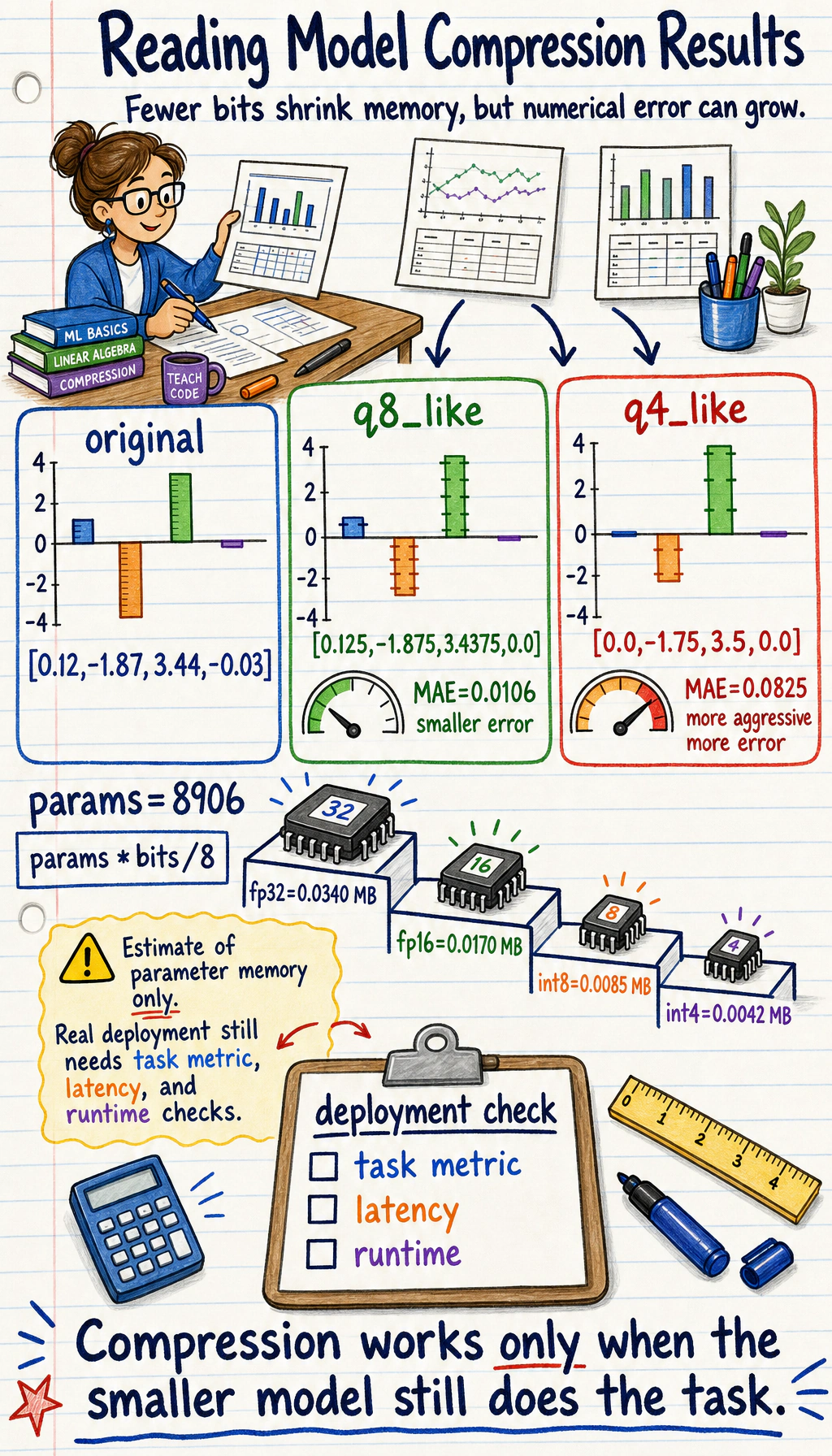
This is an estimate for parameters only. Real deployed size can also include metadata, tokenizer files, runtime overhead, and engine-specific packaging.
Choosing a Path
Section titled “Choosing a Path”| Situation | Good first action |
|---|---|
| model does not fit in memory | try quantization first |
| model fits but latency is high | profile latency before pruning |
| most channels appear redundant | consider structured pruning |
| a smaller model must preserve behavior | distill from a teacher model |
| metric drops too much after compression | reduce compression strength or fine-tune |
For pruning, prefer structured pruning for deployment because removing whole channels or blocks is easier for hardware to exploit than random sparse weights.
For distillation, the common pattern is:
teacher logits or outputs -> student learns labels + teacher behaviorWhat to Report in a Compression Experiment
Section titled “What to Report in a Compression Experiment”| Metric | Before | After | Why it matters |
|---|---|---|---|
| model size | required | required | did memory improve? |
| latency | required | required | did inference actually speed up? |
| throughput | useful | useful | can the service handle more requests? |
| task metric | required | required | did quality remain acceptable? |
| hardware/runtime | required | required | compression depends on deployment stack |
Never report “int8 works” without task metric and latency. Smaller is not automatically better.
Evidence to Keep
Section titled “Evidence to Keep”Save compression results as a before/after report:
- Baseline Size
- To be filled
- Compressed Size
- To be filled
- Baseline Latency
- To be filled
- Compressed Latency
- To be filled
- Baseline Metric
- To be filled
- Compressed Metric
- To be filled
- Runtime Hardware
- To be filled
- Decision
- keep, tune, or reject compression
This protects you from a common mistake: reducing file size while making the actual product slower or less accurate.
Common Mistakes
Section titled “Common Mistakes”| Mistake | Fix |
|---|---|
| compressing before measuring bottlenecks | measure memory, latency, and metric first |
| assuming quantization always speeds things up | verify hardware and runtime support |
| counting only parameter size | include tokenizer, runtime, and packaging where relevant |
| using unstructured pruning and expecting automatic speedup | benchmark on target hardware |
| ignoring accuracy after compression | compare task metric before and after |
Exercises
Section titled “Exercises”- Change
scale=16toscale=32in Lab 1. Does MAE decrease? - Add a third Linear layer to Lab 2 and recompute model size.
- Choose a compression strategy for a model that fits in memory but is too slow.
- Write a before/after report template with size, latency, throughput, and metric.
- Explain why structured pruning is usually easier to deploy than unstructured pruning.
Reference implementation and walkthrough
- Increasing
scaleto32usually reduces quantization error because values are represented with finer steps. Verify with MAE instead of guessing. - A third
Linearlayer adds both weight and bias parameters. Recompute each layer asin_features * out_features + out_features. - If memory is acceptable but latency is too high, start with quantization, batching/runtime optimization, or distillation. Pruning helps only if the deployment runtime can exploit it.
- A useful report compares
model_size,latency_p50/p95,throughput,task_metric, hardware, batch size, and the exact compression method. - Structured pruning removes whole channels, heads, or blocks, so common runtimes can speed it up. Unstructured sparsity often needs special kernels to become faster.
Key Takeaways
Section titled “Key Takeaways”- Compression starts from deployment constraints.
- Quantization changes numeric precision.
- Pruning changes model structure.
- Distillation changes the training process.
- Compression is successful only if the deployed task still meets quality and latency requirements.