
12.0 Learning Checklist: AIGC and Multimodal
Use this page as a printable checklist. If you need the full explanation, return to the Chapter 12 entry page.
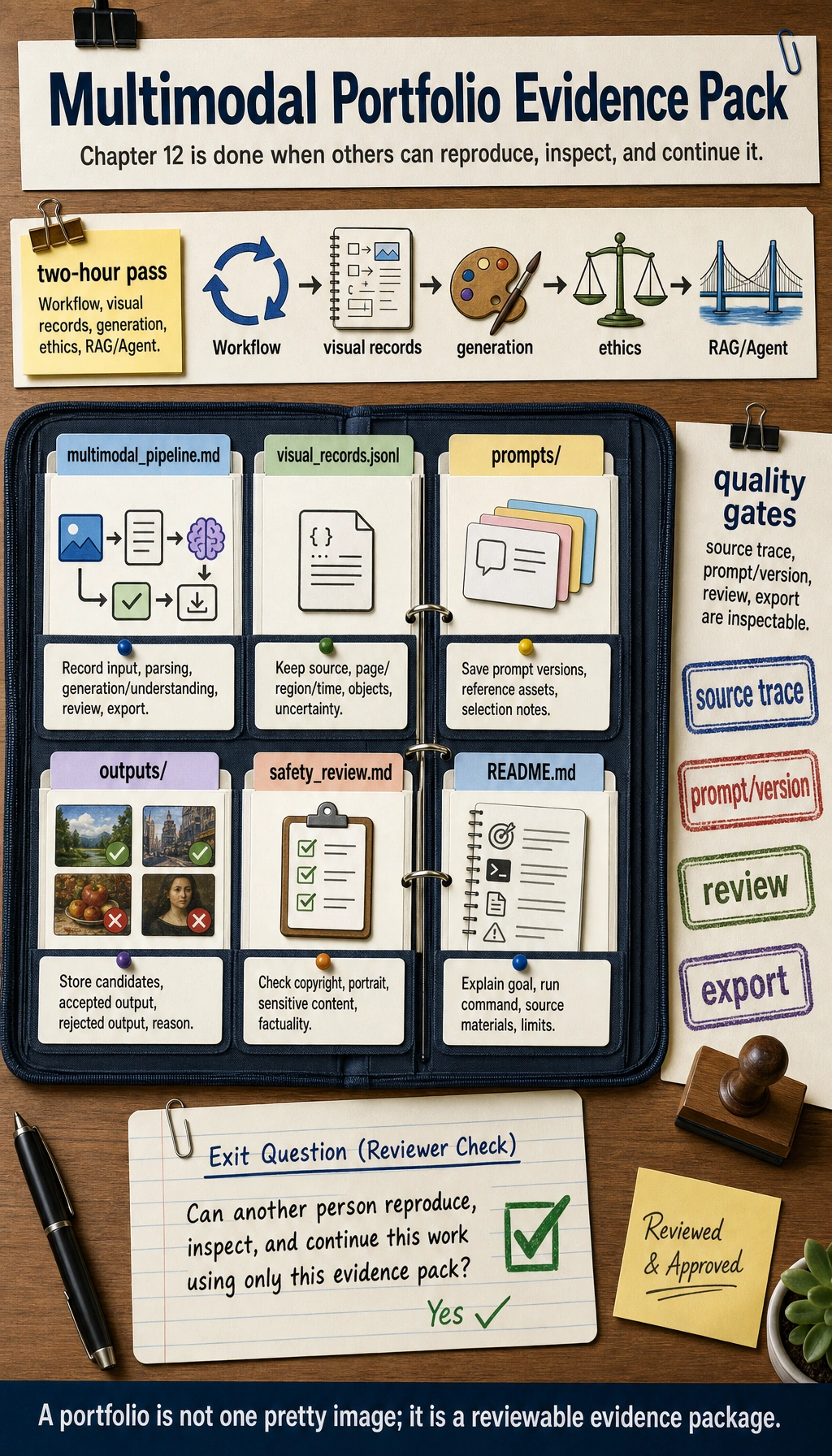
Two-Hour First Pass
Section titled “Two-Hour First Pass”| Time box | Do this | Stop when you can say |
|---|---|---|
| 20 min | Read the workflow loop on the entry page | ”Multimodal work starts with source-preserved inputs.” |
| 25 min | Run the visual record script | ”I can turn visual content into a checkable structured record.” |
| 25 min | Skim multimodal basics and image generation | ”Understanding and generation need prompts, models, outputs, and review.” |
| 25 min | Skim ethics and compliance | ”External use needs copyright, portrait, sensitive, and factual checks.” |
| 25 min | Read the RAG/Agent bridge | ”Multimodal can extend RAG, Agent, and the final capstone.” |
Required Evidence
Section titled “Required Evidence”| Evidence | Minimum version |
|---|---|
multimodal_pipeline.md | input, parsing, generation/understanding, review, export |
visual_records.jsonl | source, page/region/time reference, visible text, objects, uncertainty |
prompts/ | prompt versions, reference assets, negative requirements, selection notes |
outputs/ | candidate outputs, selected output, rejected output, reason |
safety_review.md | copyright, portrait rights, sensitive content, factuality, usage boundary |
README.md | goal, run command, source materials, sample output, limitations |
Quality Gates
Section titled “Quality Gates”| Gate | Pass condition |
|---|---|
| Source trace | Every input and output keeps source, owner or license, version, and page/region/time reference when relevant. |
| Prompt/version | Candidate outputs link back to prompt, model or tool, reference assets, and selection reason. |
| Review | Copyright, portrait or voice, sensitive content, factuality, accessibility, and export scope are checked. |
| Export | README, manifest, selected outputs, rejected outputs, limits, and next fix can be inspected by another person. |
Exit Questions
Section titled “Exit Questions”- Can you preserve source references for screenshots, PDFs, images, audio, or video?
- Can you turn a non-text input into a structured record that RAG or an Agent can use?
- Can you compare generated outputs with prompt versions and review notes?
- Can you explain what must be checked before external release?
- Can you package the result as a final portfolio or capstone demo?
If the answer is yes, you have the multimodal delivery path. Move to Chapter 13 when the project needs open-source model hosting, runtime ownership, or fine-tuning decisions.
Check reasoning and explanation
- Yes means every non-text input has a source, owner, version, and review status, not just a final file.
- A good structured record contains extracted content, modality metadata, confidence or review notes, and a stable link back to the source artifact.
- Generated outputs should be tied to prompt versions, candidate ids, selected/rejected decisions, and reviewer notes so iteration is explainable.
- Before external release, check factual grounding, consent and rights, privacy, sensitive content, safety policy, and whether a human approved high-risk material.
- A portfolio-ready package should include the brief, manifest, prompts, selected assets, rejected cases, review checklist, final export, and a README that explains the workflow.
Keep this page’s proof of learning as a small evidence card:
- Brief
- user goal, audience, assets, constraints, and export format
- Artifacts
- source files, prompts, generated candidates, selected output, and rejected versions
- Review
- factual check, copyright/portrait/sensitive-content check, and human decision
- Integration
- RAG record, Agent trace, creative package, storyboard, or export preview
- Expected Output
- reproducible asset package with README, review checklist, and failure notes