
4.0 Study Guide and Task Sheet: AI Math Foundations
The main study route is now in Chapter 4 entry. Use this page only as a quick checklist while you practice.
One-Line Mental Model
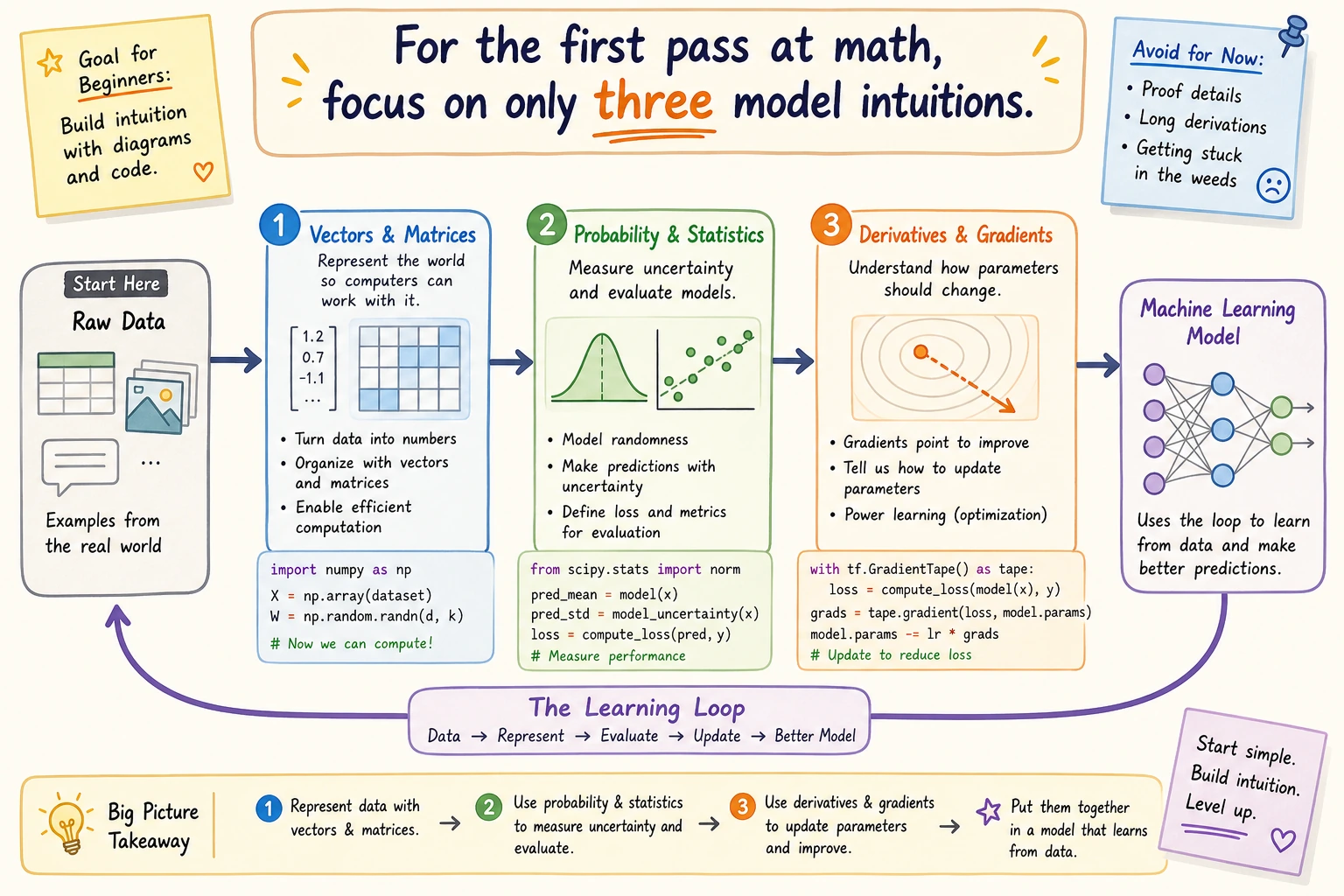
Section titled “One-Line Mental Model”represent datameasure uncertaintymeasure lossupdate parameters
If a formula feels difficult, first ask what model action it supports.
Practice Checklist
Section titled “Practice Checklist”| Check | Evidence |
|---|---|
| I can explain vector similarity | cosine similarity example |
| I can explain a matrix as data or transformation | small matrix note |
| I can simulate probability or uncertainty | probability output |
| I can explain entropy or loss in plain language | one concept card |
| I can trace gradient descent step by step | update table |
| I can finish the final workshop after theory | ch04_math_workshop_evidence/ |
Check reasoning and explanation
- Use the checklist as a translation test: every formula should become a small code operation, and every code output should become a plain-language model interpretation.
- The minimum evidence pack is one vector/matrix output, one probability simulation or Bayes update, one entropy or loss calculation, and one gradient-descent trace.
- If a formula cannot be connected to model training, retrieval, uncertainty, or evaluation, add a one-sentence bridge before moving to Chapter 5.
Formula-To-Code Checks
Section titled “Formula-To-Code Checks”| Idea | Concrete check |
|---|---|
| Vector | Label each dimension before calculating similarity. |
| Probability | Name the random variable, possible outcomes, and one event. |
| Loss | Compute one loss value by hand, then match it with code. |
| Gradient | Show one parameter before and after an update step. |
| Learning rate | Try one smaller and one larger value, then explain the loss curve. |
Ready To Continue
Section titled “Ready To Continue”Continue to Chapter 5 when each math idea maps to a model action: represent data, compare examples, measure uncertainty, measure loss, or update parameters.
Evidence to Keep
Section titled “Evidence to Keep”Keep this page’s proof of learning as a small evidence card:
- Concept Bridge
- which math idea supports model training or AI applications
- Calculation
- small hand/NumPy example that can be checked
- Output
- number, curve, vector, matrix, probability, or gradient trace
- Failure Check
- memorizing formula without knowing the model behavior it explains
- Expected Output
- math note that explains one real AI operation