
13.0 Learning Checklist: Open-Source LLM Deployment
Use this page as a printable checklist. If you need the full explanation, return to the Chapter 13 entry page.
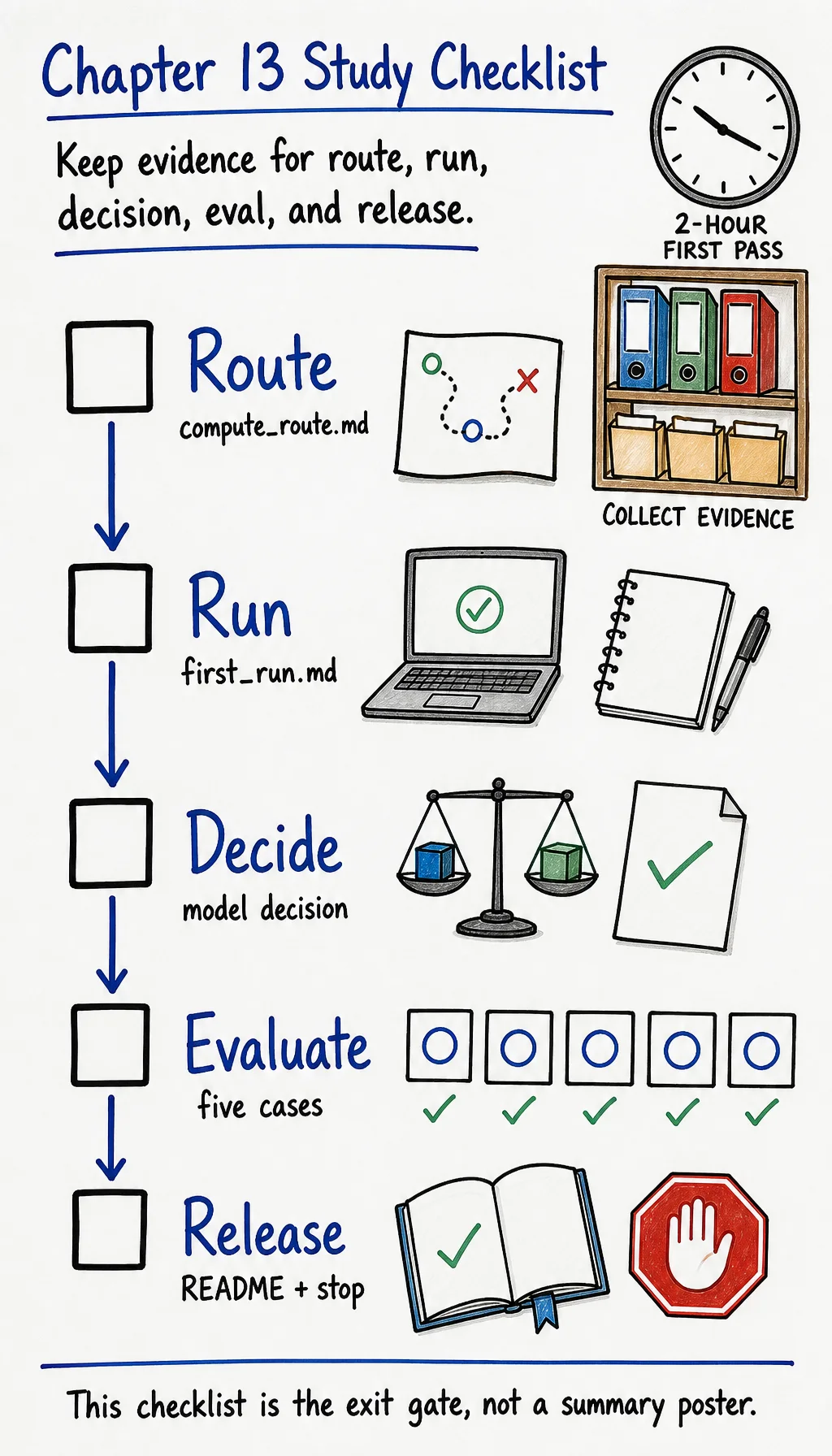
If you have not run the lab yet, first complete 13.1 Compute Routes: Local CPU, Free Colab, Rented GPU, then 13.2 Hands-on: Run, Train, and Serve an Open-Source LLM. Use 13.3 Model and Runtime Decision, 13.4 Serving, Evaluation, and Release Runbook, and 13.5 Open-Weight Model Landscape to finish the deployment evidence.
Two-Hour First Pass
Section titled “Two-Hour First Pass”-
20 min: Choose the compute route Stop when you can say, “This run belongs on local CPU, free Colab, or rented GPU, and I know what that route cannot prove.”
-
20 min: Run the environment check Stop when you can say, “I know whether this machine has usable CUDA or only CPU.”
-
25 min: Run the runbook script Stop when you can say, “I can choose a runtime from hardware and project constraints.”
-
25 min: Run mini GPT-2 training evidence Stop when you can say, “I have a smoke test locally and I know what a CUDA training log must contain.”
-
25 min: Build a five-prompt eval table Stop when you can say, “I can compare model behavior before changing runtime or tuning.”
-
30 min: Write the adaptation decision Stop when you can say, “I can explain why I chose Prompt, RAG, quantization, LoRA, or no tuning.”
-
30 min: Write the release runbook Stop when you can say, “Another engineer can start, test, stop, and roll back this service.”
Required Evidence
Section titled “Required Evidence”environment_report.txt: Python, torch, CUDA/device, platform, disk or instance note.compute_route.md: local CPU, free Colab, or rented GPU choice with fallback and stop rule.model_decision.md: model, size, license, source, reason, rejected alternatives.open_weight_route.json: route, candidate family, runtime fit, adaptation choice, required evidence.model_runtime_decision.json: route-specific local CPU, free Colab, or rented GPU runtime recommendation.open_llm_runbook.json: runtime choice, adaptation choice, required evidence.api_smoke_test.json: health check and sample request/response proof for the local OpenAI-compatible API.first_run.md: exact command, prompt, output, latency or memory note.eval_cases.csv: at least five prompts, expected behavior, pass/fail, notes.openllm_gpu_training_run/:environment_report.json,training_log.csv,mini_gpt2_checkpoint.pt,sample.txt, and a note if the run was CPU/MPS smoke test or CUDA acceptance.gpu_train_log.txt: terminal trace with device, at least three loss rows, checkpoint path, and sample output.README.md: setup, run, evaluate, stop server, rollback or shutdown.
Quality Gates
Section titled “Quality Gates”- Reproducibility: another engineer can identify model version, runtime, command, and environment.
- Safety: license, privacy, auth, logging, and shutdown are checked before sharing.
- Evaluation: runtime or tuning changes are compared on the same eval cases.
- Training evidence: CPU/MPS is labeled as smoke test; CUDA run is required before claiming GPU training completion.
- Cost control: free notebook limits or GPU rental time, memory, latency, and stop procedure are recorded.
- Adaptation: fine-tuning is justified by repeated evidence, not one disappointing answer.
Exit Questions
Section titled “Exit Questions”- Can you explain why you chose this model size and license?
- Can you explain why this open-weight family fits the compute route and runtime?
- Can you explain why this run belongs on local CPU, free Colab, or rented GPU?
- Can you say why this runtime is enough for the current project?
- Can you run or reproduce the environment check?
- Can you explain what the mini GPT-2 training log proves and what it does not prove?
- Can you compare outputs with the same five prompts after a change?
- Can you defend the adaptation choice: Prompt, RAG, quantization, LoRA, or full fine-tune?
If the answer is yes, you can treat open-source LLMs as an engineering option instead of a collection of random model demos.
Evidence to Keep
Section titled “Evidence to Keep”Keep this page’s proof of learning as a small evidence card:
- Environment Report
- Python, torch, CUDA/device, platform, and hardware/cost note
- Compute Route
- local CPU / free Colab / rented GPU, fallback, stop rule
- Model Decision
- selected model, license, size, source, and rejected alternatives
- Runtime Contract
- command or endpoint, request format, response format, and error path
- Training Evidence
- mini GPT-2 device, loss log, checkpoint, sample, and shutdown proof
- Evaluation
- fixed prompts, outputs, pass/fail notes, latency or memory note
- Adaptation Choice
- Prompt/RAG/quantization/LoRA/full fine-tune decision with reason