
6.8.2 Project: Image Classification System
Learning Objectives
Section titled “Learning Objectives”- Define a classification task with clear class boundaries.
- Organize train/validation/test evidence.
- Run a tiny baseline that produces predictions.
- Build a confusion matrix and extract error cases.
- Know what to show in a real CNN or transfer-learning project.
See the Project Loop First
Section titled “See the Project Loop First”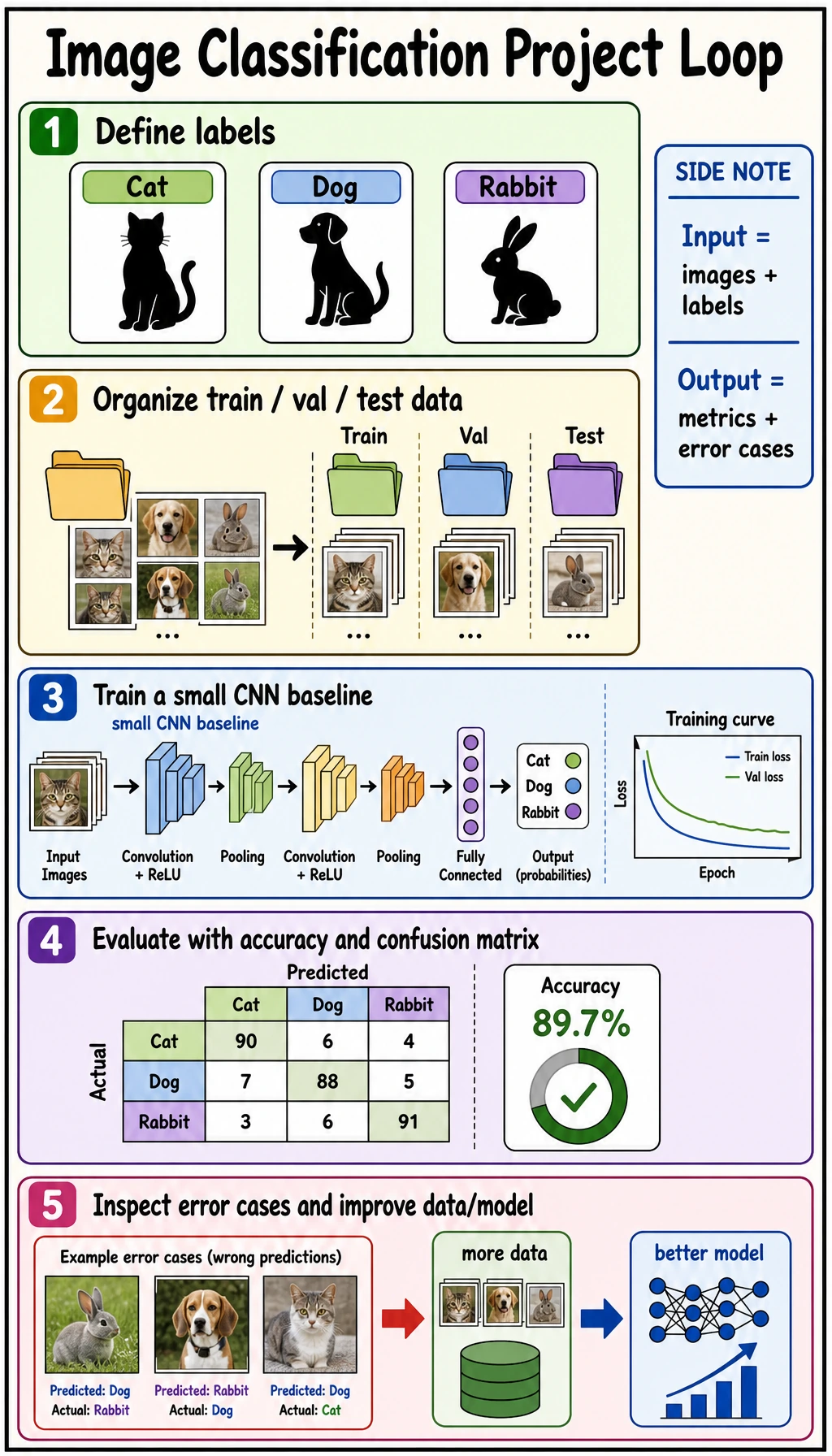
labelsdata splitbaselinemetricserror casesnext data/model action
Choose topics with:
- clear class boundaries;
- data you can actually collect;
- mistakes you can explain.
Avoid starting with hundreds of fine-grained classes or labels that even humans disagree on.
Project Plan Template
Section titled “Project Plan Template”from dataclasses import dataclass, field
@dataclassclass CVProjectPlan: name: str classes: list[str] dataset_split: dict[str, int] baseline: str metrics: list[str] risks: list[str] = field(default_factory=list)
plan = CVProjectPlan( name="pet_image_classifier", classes=["cat", "dog", "rabbit"], dataset_split={"train": 900, "val": 180, "test": 180}, baseline="small_cnn_then_transfer_learning", metrics=["accuracy", "confusion_matrix", "error_cases"], risks=["class imbalance", "background leakage", "label noise"],)
print(plan)This object is a project boundary. If you cannot fill it in, the model choice is still premature.
Lab: Prototype Baseline and Confusion Matrix
Section titled “Lab: Prototype Baseline and Confusion Matrix”This toy example uses three pseudo-features instead of real images. It teaches the same evaluation loop you will use with a CNN later.
Create image_project_baseline.py:
from collections import defaultdict
train_data = [    ("cat", [0.9, 0.8, 0.4]),    ("cat", [0.8, 0.7, 0.5]),    ("dog", [0.7, 0.5, 0.8]),    ("dog", [0.6, 0.4, 0.9]),    ("rabbit", [0.5, 0.9, 0.3]),    ("rabbit", [0.4, 0.8, 0.2]),]
val_data = [    ("cat", [0.85, 0.75, 0.45]),    ("dog", [0.65, 0.45, 0.85]),    ("rabbit", [0.45, 0.85, 0.25]),    ("dog", [0.82, 0.72, 0.42]),]
labels = ["cat", "dog", "rabbit"]

def prototypes(data):    groups = defaultdict(list)    for label, features in data:        groups[label].append(features)
    result = {}    for label, rows in groups.items():        result[label] = [            round(sum(row[i] for row in rows) / len(rows), 3)            for i in range(len(rows[0]))        ]    return result

def l1(a, b):    return sum(abs(x - y) for x, y in zip(a, b))

def predict(features, protos):    distances = {label: round(l1(features, proto), 3) for label, proto in protos.items()}    pred = min(distances, key=distances.get)    return pred, distances

protos = prototypes(train_data)print("prototypes")for label in labels:    print(label, protos[label])
rows = []for gold, features in val_data:    pred, distances = predict(features, protos)    rows.append({"gold": gold, "pred": pred})    print("prediction", gold, "->", pred, distances)
cm = {g: {p: 0 for p in labels} for g in labels}for row in rows:    cm[row["gold"]][row["pred"]] += 1
print("confusion_matrix")for gold in labels:    print(gold, [cm[gold][p] for p in labels])
errors = [row for row in rows if row["gold"] != row["pred"]]print("accuracy:", round((len(rows) - len(errors)) / len(rows), 3))print("errors:", errors)
Run it:
python image_project_baseline.pyExpected output:
prototypescat [0.85, 0.75, 0.45]dog [0.65, 0.45, 0.85]rabbit [0.45, 0.85, 0.25]prediction cat -> cat {'cat': 0.0, 'dog': 0.9, 'rabbit': 0.7}prediction dog -> dog {'cat': 0.9, 'dog': 0.0, 'rabbit': 1.2}prediction rabbit -> rabbit {'cat': 0.7, 'dog': 1.2, 'rabbit': 0.0}prediction dog -> cat {'cat': 0.09, 'dog': 0.87, 'rabbit': 0.67}confusion_matrixcat [1, 0, 0]dog [1, 1, 0]rabbit [0, 0, 1]accuracy: 0.75errors: [{'gold': 'dog', 'pred': 'cat'}]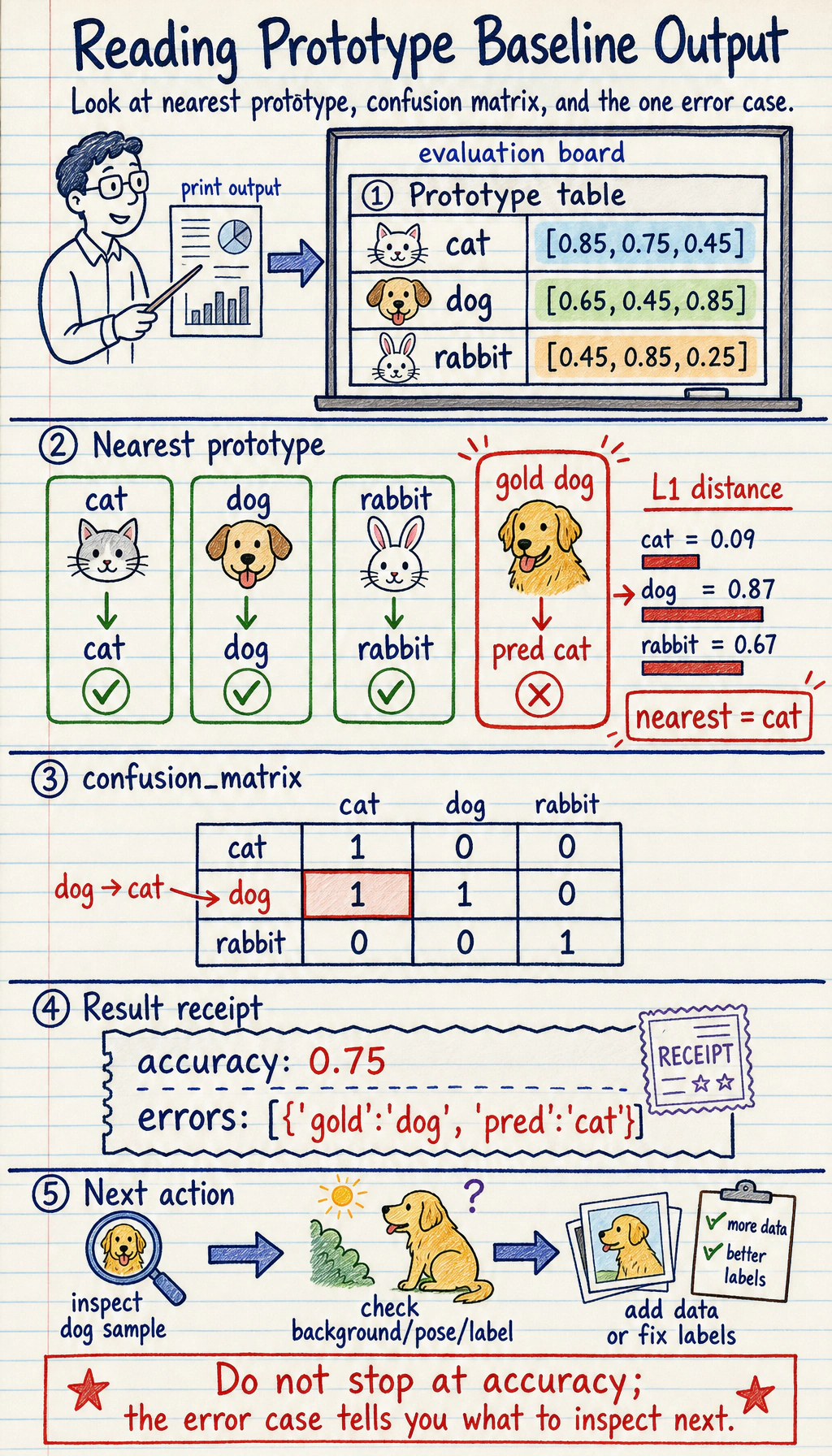
Read the error:
- the last
dogsample is closer to thecatprototype; - the confusion matrix shows
dog -> cat; - the next action is not “try a bigger model” first. Inspect whether dog images share cat-like backgrounds, poses, or labels.
Real Project Upgrade Path
Section titled “Real Project Upgrade Path”| Version | What to add | Evidence to show |
|---|---|---|
| baseline | small CNN or transfer-learning baseline | train/val curves, accuracy |
| evaluation | confusion matrix and error samples | class-level mistakes |
| robustness | augmentation and leakage checks | before/after comparison |
| portfolio | README and demo command | reproducible run |
For a real CNN project, keep:
- dataset directory screenshot or class count table;
- train/validation/test split rule;
- baseline model summary;
- metric table;
- confusion matrix;
- 6 to 12 correct and wrong examples;
- next-step plan.
Evidence to Keep
Section titled “Evidence to Keep”An image classification project should leave this minimum evidence:
- Label Rules
- how classes are defined
- Split Rule
- train/val/test and leakage prevention
- Baseline
- simple CNN or transfer-learning baseline
- Metric
- accuracy plus confusion matrix
- Error Case
- one wrong prediction with likely cause
- Next Action
- data, augmentation, model, or split change
Common Mistakes
Section titled “Common Mistakes”| Mistake | Fix |
|---|---|
| only reporting accuracy | show confusion matrix and error cases |
| choosing fuzzy classes | define label boundaries before collecting data |
| leaking similar images into train and test | split by source or subject when needed |
| starting with a huge model | build a small baseline first |
| hiding failures | use failures to justify the next improvement |
Exercises
Section titled “Exercises”- Add two more
dogvalidation samples and rerun the confusion matrix. - Add a new class
hamster. What changes inlabelsand the matrix? - Write one possible data issue for the
dog -> caterror. - Replace the prototype baseline with a small CNN outline in your README.
- Create a project checklist with dataset, command, metric, and failure cases.
Project reference and review notes
- The
dogrow in the confusion matrix gets more evidence. If the new samples are difficult, dog recall may drop; if they are clear, the estimate becomes more stable. labelsmust includehamster, and the confusion matrix expands to include a new row and column. Any metric table that averages by class should also include the new class.- A possible issue is that dog images are cropped, blurry, too similar to cat poses, or underrepresented. The point is to connect the error to data evidence, not just blame the model.
- A useful README outline includes input size, convolution/ReLU/pooling blocks, classifier head, loss, metric, command, and expected output.
- The checklist should prove the project is reproducible: dataset split, training command, metric, confusion matrix, known failure cases, and next improvement.
Key Takeaways
Section titled “Key Takeaways”- Image classification projects are judged by the full loop, not only the model name.
- Confusion matrices reveal class-level failures.
- Error cases are project evidence, not embarrassment.
- A strong portfolio project shows what improved and what still fails.