
10.2.1 Image Classification Roadmap: Image In, Label Out
Image classification answers one question: given a whole image, which class best describes it?
See the Classification Loop First
Section titled “See the Classification Loop First”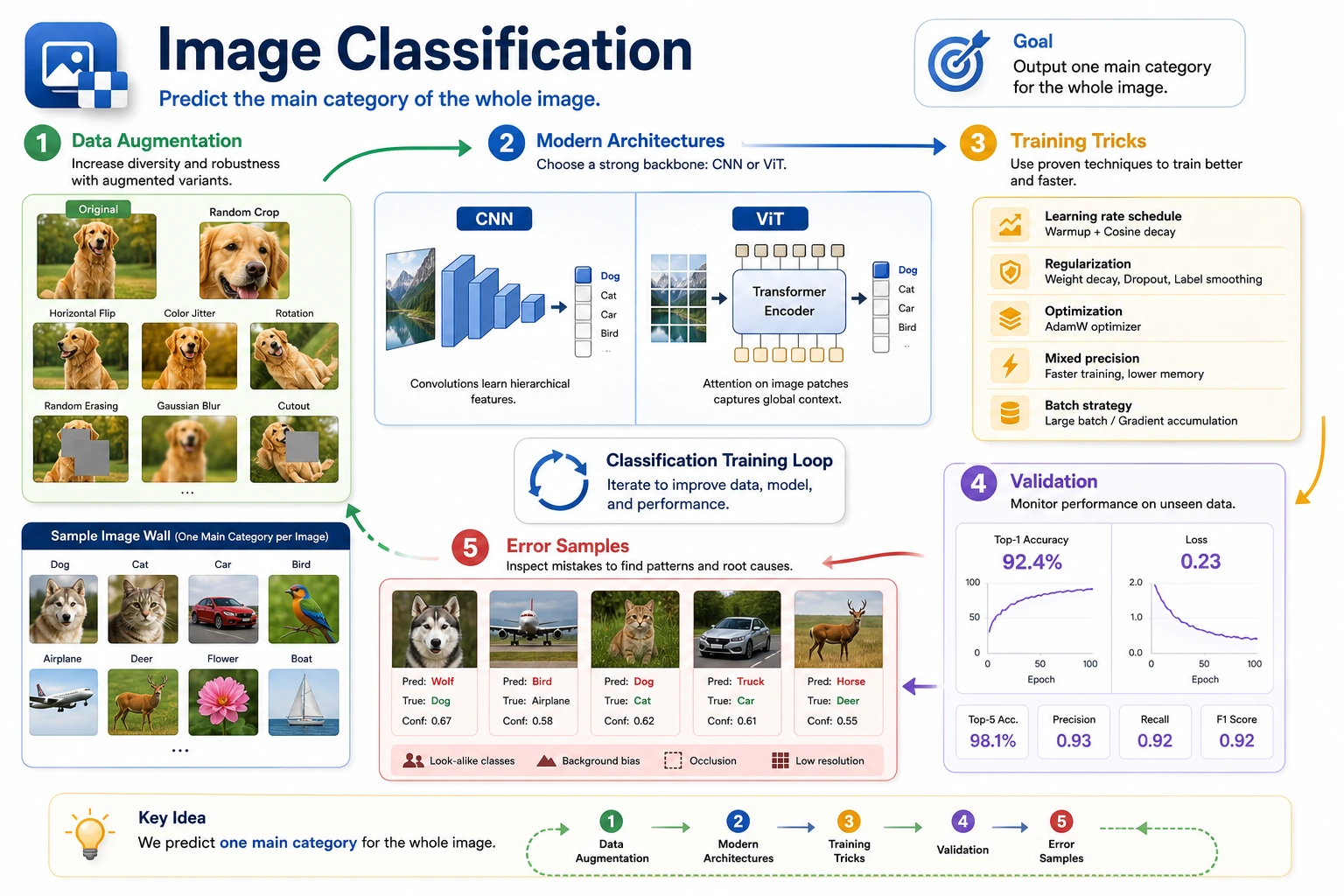
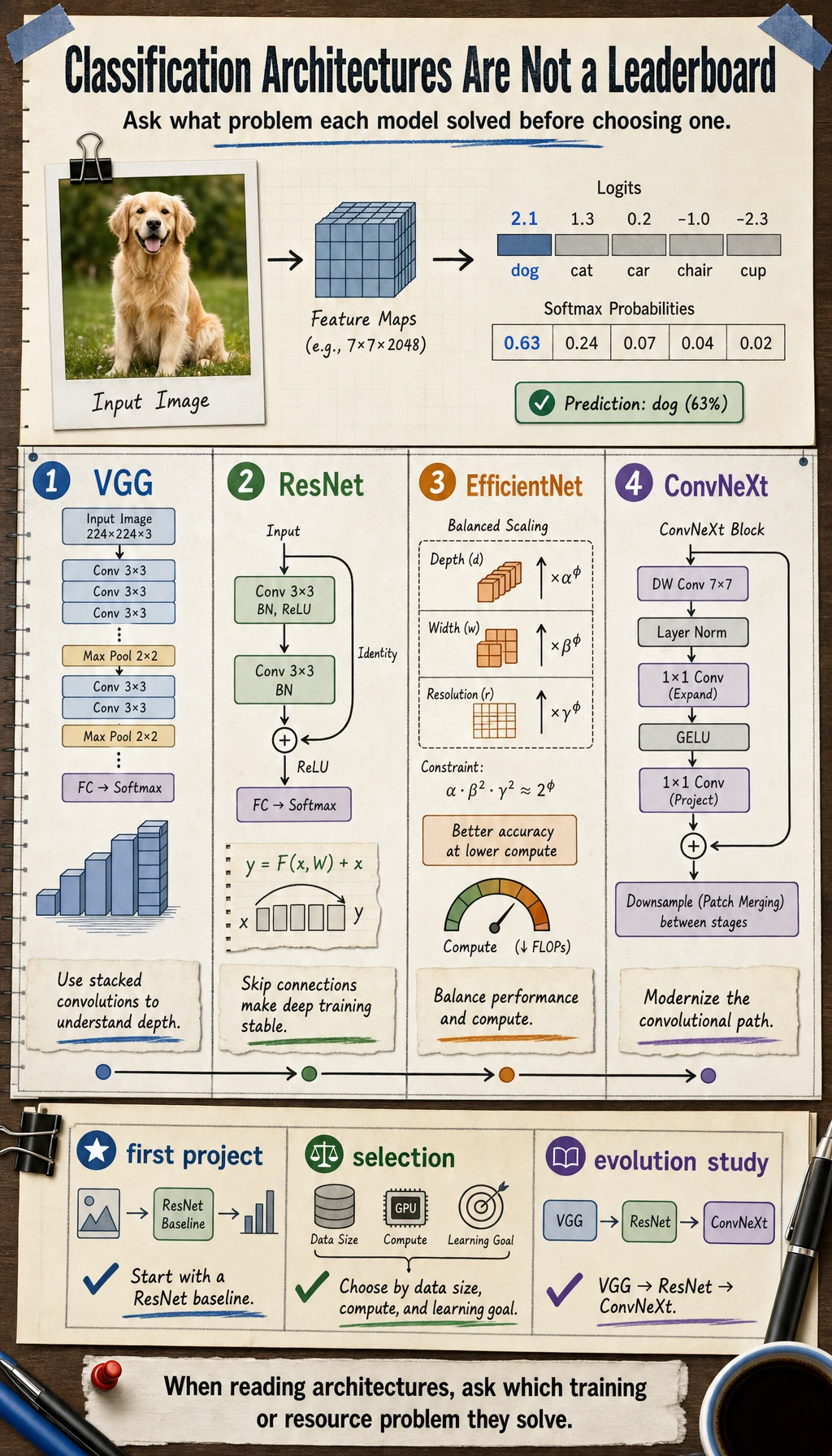

Classification is the simplest vision output, but it still depends on data split, augmentation, architecture, loss, metrics, and error examples.
Run a Prediction Check
Section titled “Run a Prediction Check”This script mimics the last step of a classifier: choose the label with the highest score.
labels = ["cat", "dog", "panda"]scores = [0.12, 0.74, 0.14]
best_index = max(range(len(scores)), key=lambda index: scores[index])
print("prediction:", labels[best_index])print("confidence:", scores[best_index])
Expected output:
prediction: dogconfidence: 0.74In real projects, never show only the top class. Keep confidence, wrong examples, and confusion patterns.
Learn in This Order
Section titled “Learn in This Order”| Step | Read | Practice Output |
|---|---|---|
| 1 | Data augmentation | Explain which changes preserve the class and which create risk |
| 2 | Modern architectures | Compare feature extractor, classifier head, and pretrained backbone |
| 3 | Training techniques | Track split, loss, accuracy, overfitting, and error samples |
Evidence to Keep
Section titled “Evidence to Keep”Keep this page’s proof of learning as a small evidence card:
- Dataset Split
- train/test images, class names, and class balance
- Prediction
- label, confidence, and at least one misclassified image
- Metric
- accuracy, F1, confusion matrix, and class-level errors
- Failure Check
- augmentation changes label meaning, class imbalance, leakage, or overfitting
- Expected Output
- model result table and saved error examples
Pass Check
Section titled “Pass Check”You pass this chapter when you can run a minimal classifier, show train/validation metrics, and explain at least one failure image.
Check reasoning and explanation
- A passing answer maps the task to the right visual output: class label, bounding box, mask, OCR text, embedding, or video event.
- The evidence should include a rendered visual artifact and one metric or qualitative error note.
- A good self-check names one visual failure mode such as class confusion, missed objects, bad masks, lighting shift, domain shift, or weak annotation quality.