
11.6.2 Pretraining Paradigm
Learning Objectives
Section titled “Learning Objectives”- Understand the difference between the pretraining paradigm and “training each task from scratch”
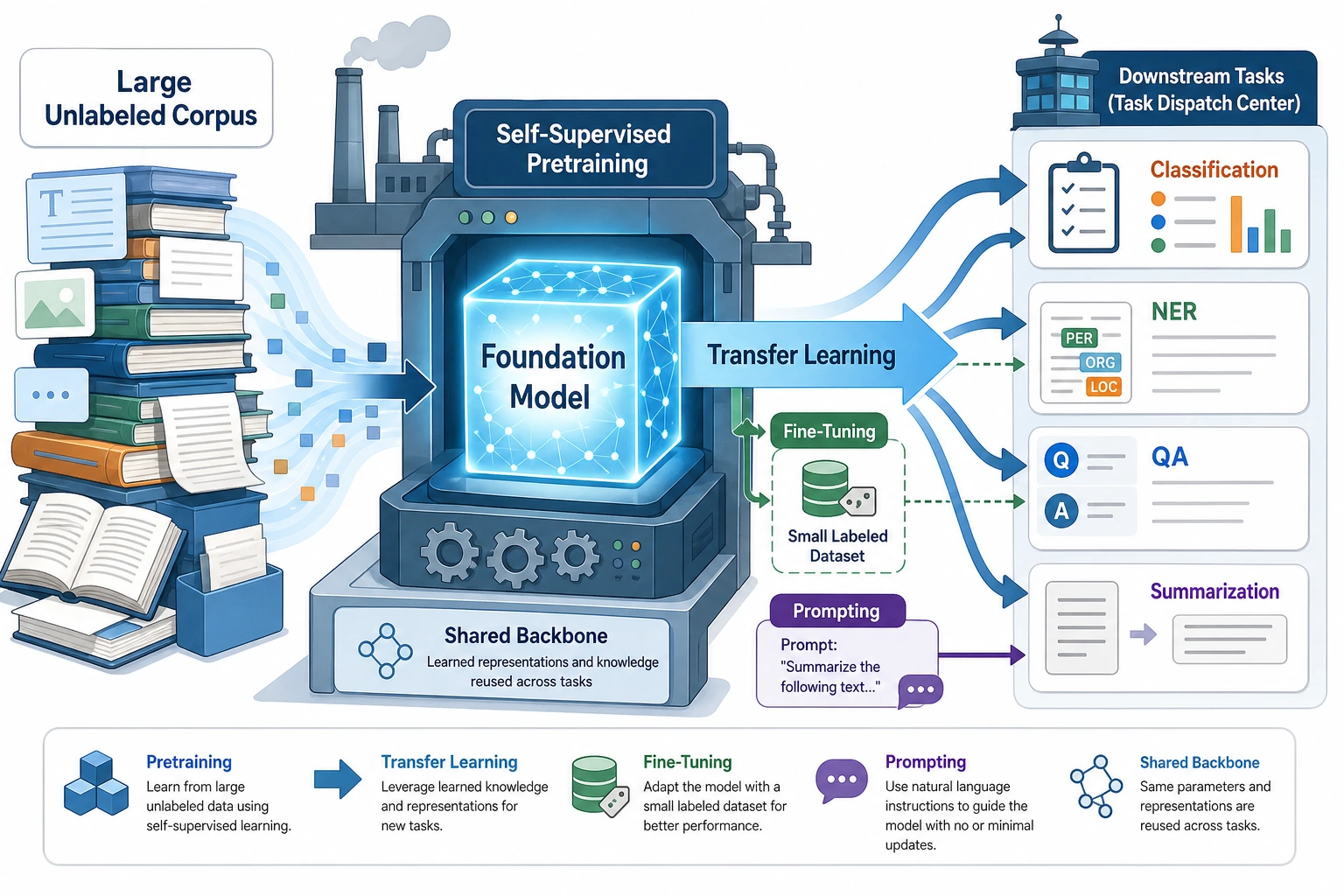
- Understand the main flow of pretraining -> transfer -> fine-tuning
- Build intuition for a “shared foundation” through a runnable example
- Understand why modern NLP is almost entirely organized around this paradigm
First, Build a Map
Section titled “First, Build a Map”If you have already studied word embeddings, contextual representations, and language models, the most natural continuation for this section is:
- You have already seen text representations become stronger
- Now we ask: “Why did the entire field of NLP later start organizing itself around a shared foundation?”
So the pretraining paradigm is not “just one more training step,” but rather:
- The way tasks are organized has changed
The best order for beginners to understand this section is not “memorize model names first,” but to first see clearly:
flowchart LR A["Massive general corpora"] --> B["First learn shared language ability"] B --> C["Form a pretrained foundation"] C --> D["Then transfer to specific tasks"] D --> E["Fine-tuning / feature extraction / Prompt"]So what this section really wants to explain is:
- Why “training each task from scratch” is wasteful
- Why “learn the foundation first, then transfer” changed the main direction of NLP
Why Does Pretraining Change NLP So Much?
Section titled “Why Does Pretraining Change NLP So Much?”Because many tasks share basic language abilities
Section titled “Because many tasks share basic language abilities”Whether it is:
- classification
- NER
- question answering
- translation
they all require some common underlying abilities, such as:
- understanding word meaning
- modeling syntactic structure
- modeling context
Training each task from scratch is wasteful
Section titled “Training each task from scratch is wasteful”It is like:
- learning the language itself from zero every time you do a new problem
Obviously, the cost is high.
The core idea of the pretraining paradigm
Section titled “The core idea of the pretraining paradigm”So a more reasonable approach becomes:
- First learn basic capabilities on massive general text
- Then transfer those capabilities to specific tasks
This is the main thread of modern NLP.
When you first learn the pretraining paradigm, what should you focus on?
Section titled “When you first learn the pretraining paradigm, what should you focus on?”What you should focus on first is not model names, but this sentence:
The core value of pretraining is to learn the language abilities shared by many tasks all at once.
Once this idea is stable, when you later look at:
- BERT
- GPT
- T5
you will naturally ask:
- What role does it play in this shared-foundation main thread?
What Is the Relationship Between Pretraining, Transfer, and Fine-Tuning?
Section titled “What Is the Relationship Between Pretraining, Transfer, and Fine-Tuning?”Pretraining
Section titled “Pretraining”The goal is:
- learn general language representations and patterns
Transfer
Section titled “Transfer”The goal is:
- bring existing capabilities to a new task
Fine-tuning
Section titled “Fine-tuning”The goal is:
- further adapt to a specific task
An Analogy
Section titled “An Analogy”Pretraining is like reading a general education textbook first. Transfer is like moving that foundation to a new subject. Fine-tuning is like doing targeted practice for a specific exam format.
Why Is This Analogy Worth Remembering First?
Section titled “Why Is This Analogy Worth Remembering First?”Because many beginners, when they first encounter pretraining, think:
- pretraining = just train a little longer
But this analogy helps you see more clearly:
- Pretraining learns general capabilities
- Transfer reuses those capabilities
- Fine-tuning adapts them to the task
Let’s Run a “Shared Foundation” Example First
Section titled “Let’s Run a “Shared Foundation” Example First”shared_representation = { "refund": [1.0, 0.2, 0.1], "invoice": [0.3, 1.0, 0.1], "password": [0.1, 0.2, 1.0],}
def sentence_vector(tokens): vectors = [shared_representation[token] for token in tokens if token in shared_representation] dim = len(vectors[0]) return [sum(vec[i] for vec in vectors) / len(vectors) for i in range(dim)]
def classify_intent(tokens): vec = sentence_vector(tokens) scores = { "refund": vec[0], "invoice": vec[1], "password": vec[2], } return max(scores, key=scores.get), scores
for tokens in [["refund"], ["invoice"], ["password"]]: print(tokens, "->", classify_intent(tokens))Expected output:
['refund'] -> ('refund', {'refund': 1.0, 'invoice': 0.2, 'password': 0.1})['invoice'] -> ('invoice', {'refund': 0.3, 'invoice': 1.0, 'password': 0.1})['password'] -> ('password', {'refund': 0.1, 'invoice': 0.2, 'password': 1.0})Read the output from left to right: each input token reuses the same shared representation table, then a small task-specific classifier reads the three score dimensions. This is the miniature version of “shared foundation first, task adaptation second.”
What Is This Example Trying to Show?
Section titled “What Is This Example Trying to Show?”It is not meant to be a real strong model, but to express the most important paradigm:
- first there is a shared representation foundation
- then specific tasks are completed on top of it
Why Is This Similar to the pretraining era?
Section titled “Why Is This Similar to the pretraining era?”Because you are no longer:
- learning all representations separately from scratch for every task
Instead:
- you reuse an existing set of language representations
When Beginners First Learn the Pretraining Paradigm, What Should They Remember Most?
Section titled “When Beginners First Learn the Pretraining Paradigm, What Should They Remember Most?”What is most worth remembering is actually:
- Pretraining is not “just training a bit more,” but a change in task organization
- Shared foundation capabilities are the core asset of modern NLP
- This greatly lowers the barrier for downstream tasks
Why Is the “Shared Foundation” Perspective So Important?
Section titled “Why Is the “Shared Foundation” Perspective So Important?”Because it will directly change how you think later.
You will no longer only ask:
- Does this task need its own separate model?
You will more naturally ask:
- Can this task be built on an existing foundation?
- Do I need fine-tuning, feature extraction, or Prompt?
Why Does This Path Eventually Lead to BERT / GPT / T5?
Section titled “Why Does This Path Eventually Lead to BERT / GPT / T5?”Because It Scales
Section titled “Because It Scales”Once pretraining is established, more data and more compute usually continue to improve the foundation’s capability.
Because It Is More General
Section titled “Because It Is More General”The same foundation can be transferred to many tasks.
Because It Lowers the Barrier for Downstream Tasks
Section titled “Because It Lowers the Barrier for Downstream Tasks”Many tasks no longer need to train a large model from scratch, but instead:
- directly adapt a pretrained model
Evidence to Keep
Section titled “Evidence to Keep”Keep this page’s proof of learning as a small evidence card:
- Model Choice
- BERT, GPT, T5, Transformers pipeline, or other pretrained baseline
- Tokenizer Output
- ids, masks, decoded text, or batch shape
- Task Result
- classification, generation, extraction, or text-to-text output
- Failure Check
- wrong model family, token limit, domain mismatch, cost, or latency
- Expected Output
- model call result plus a short choice rationale
Common Pitfalls
Section titled “Common Pitfalls”Mistake 1: Thinking the pretraining paradigm is just “train first for a while”
Section titled “Mistake 1: Thinking the pretraining paradigm is just “train first for a while””That is not right. It changes the whole way tasks are organized.
Mistake 2: Thinking every task must be fine-tuned
Section titled “Mistake 2: Thinking every task must be fine-tuned”Some tasks only need:
- feature extraction
- Prompt
- retrieval
That may be enough.
Mistake 3: Memorizing model names without understanding the paradigm
Section titled “Mistake 3: Memorizing model names without understanding the paradigm”What really matters is:
- Why does learning general capabilities first and then transferring them work?
Summary
Section titled “Summary”The most important thing in this section is to establish a sense of the era:
The core change in modern NLP is not just that models became larger, but that the training paradigm shifted from “each task handled separately” to “learn a shared foundation first, then transfer and adapt.”
Once this idea is in place, learning BERT, GPT, and T5 will no longer feel like learning only buzzwords.
What You Should Take Away from This Section
Section titled “What You Should Take Away from This Section”- The key change in modern NLP is not only larger models, but a changed paradigm
- Pretraining, transfer, and fine-tuning must be understood as one main thread
- When learning BERT / GPT / T5 later, first think about the role each one plays in this main thread
If we compress it into one sentence, it would be:
What the pretraining paradigm truly changed was not just the training order, but the entire field of NLP, shifting it from “each task done separately” to “sharing a stronger language foundation.”
Exercises
Section titled “Exercises”- Explain in your own words: Why does the pretraining paradigm significantly lower the barrier for many NLP tasks?
- Think about it: Which tasks might only need pretrained features and not full fine-tuning?
- What does this “shared foundation” example correspond to in a real system?
- Why do we say that the pretraining paradigm changes not just the model, but the entire way tasks are organized?
Solution approach and explanation
- Pretraining lowers the barrier because the model has already learned broad language patterns before your small task-specific dataset appears.
- Tasks that may only need pretrained features include similarity search, clustering, simple classification, and retrieval reranking baselines.
- The shared foundation example corresponds to using one pretrained encoder or model family across many downstream heads, prompts, or adapters.
- The paradigm changes task organization because teams now define data, evaluation, adaptation, and deployment around a reusable foundation model.