
7.1.1 NLP Crash Roadmap: Text to Tokens to Vectors
Before LLMs feel understandable, first see how text becomes pieces a model can process: text -> tokens -> IDs -> vectors -> model output.
Look at the Flow First
Section titled “Look at the Flow First”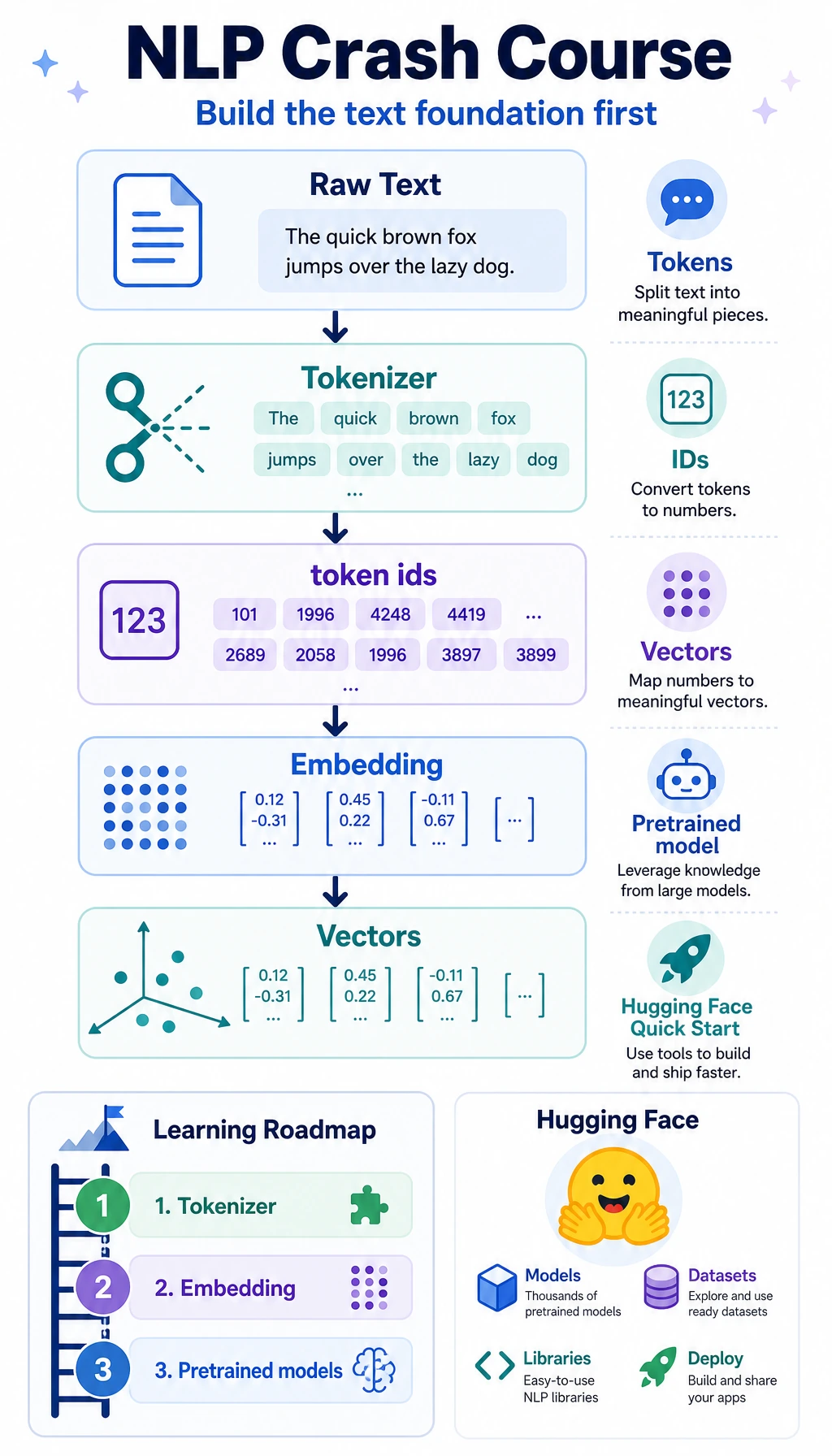
| Word | First meaning |
|---|---|
| token | a piece of text used by the model |
| tokenizer | tool that splits text and maps pieces to IDs |
| embedding | dense vector for a token or text |
| pretrained model | model already trained on broad text |
| Hugging Face | model/dataset/tool ecosystem |
Run One Tiny Token Lab
Section titled “Run One Tiny Token Lab”text = "RAG retrieves evidence before answering"tokens = text.lower().split()vocab = {token: index for index, token in enumerate(sorted(set(tokens)))}ids = [vocab[token] for token in tokens]
print("tokens:", tokens)print("ids:", ids)print("unique_tokens:", len(vocab))Expected output:
tokens: ['rag', 'retrieves', 'evidence', 'before', 'answering']ids: [3, 4, 2, 1, 0]unique_tokens: 5Real tokenizers are smarter, but this shows the main idea: text must become stable pieces and IDs before vectors and models can work.
Learn in This Order
Section titled “Learn in This Order”| Order | Read | What to practice |
|---|---|---|
| 1 | 7.1.2 Tokenizer | text -> tokens -> IDs |
| 2 | 7.1.3 Embeddings | tokens/text -> vectors |
| 3 | 7.1.4 Pretrained Models | load and reuse model capability |
| 4 | 7.1.5 Hugging Face Quickstart | pipeline, model card, local run |
| 5 | 7.1.6 Tokenizer and Embedding Lab | inspect tokens and vectors |
Evidence to Keep
Section titled “Evidence to Keep”Keep this page’s proof of learning as a small evidence card:
- Text Path
- raw text → tokens → ids → embeddings
- Token Risk
- long input can hit context or cost limits
- Embedding Use
- similarity can support retrieval but is not reasoning
- Model Bridge
- pretrained model = shared foundation plus task behavior
- Next Action
- run tokenizer and embedding labs before Prompt work
Pass Check
Section titled “Pass Check”You pass this roadmap when you can explain why raw text needs tokenization, why embeddings are vectors, and why pretrained models are reused instead of trained from zero.
Check reasoning and explanation
- A passing answer explains how tokens, context, attention, prompts, and generation behavior connect in one request-response path.
- The evidence should include at least one reproducible prompt or structured-output test, plus notes on why the output passed or failed.
- A good self-check separates prompt design, RAG, fine-tuning, and alignment: use the lightest method that fixes the observed problem.