
7.5.1 Prompt Engineering Roadmap: Brief, Output, Evaluation
Prompt engineering is the interface between your application and the model. The goal is not to write a clever sentence; the goal is to make one model call predictable, parseable, testable, and easy to improve.
See the Prompt Loop First
Section titled “See the Prompt Loop First”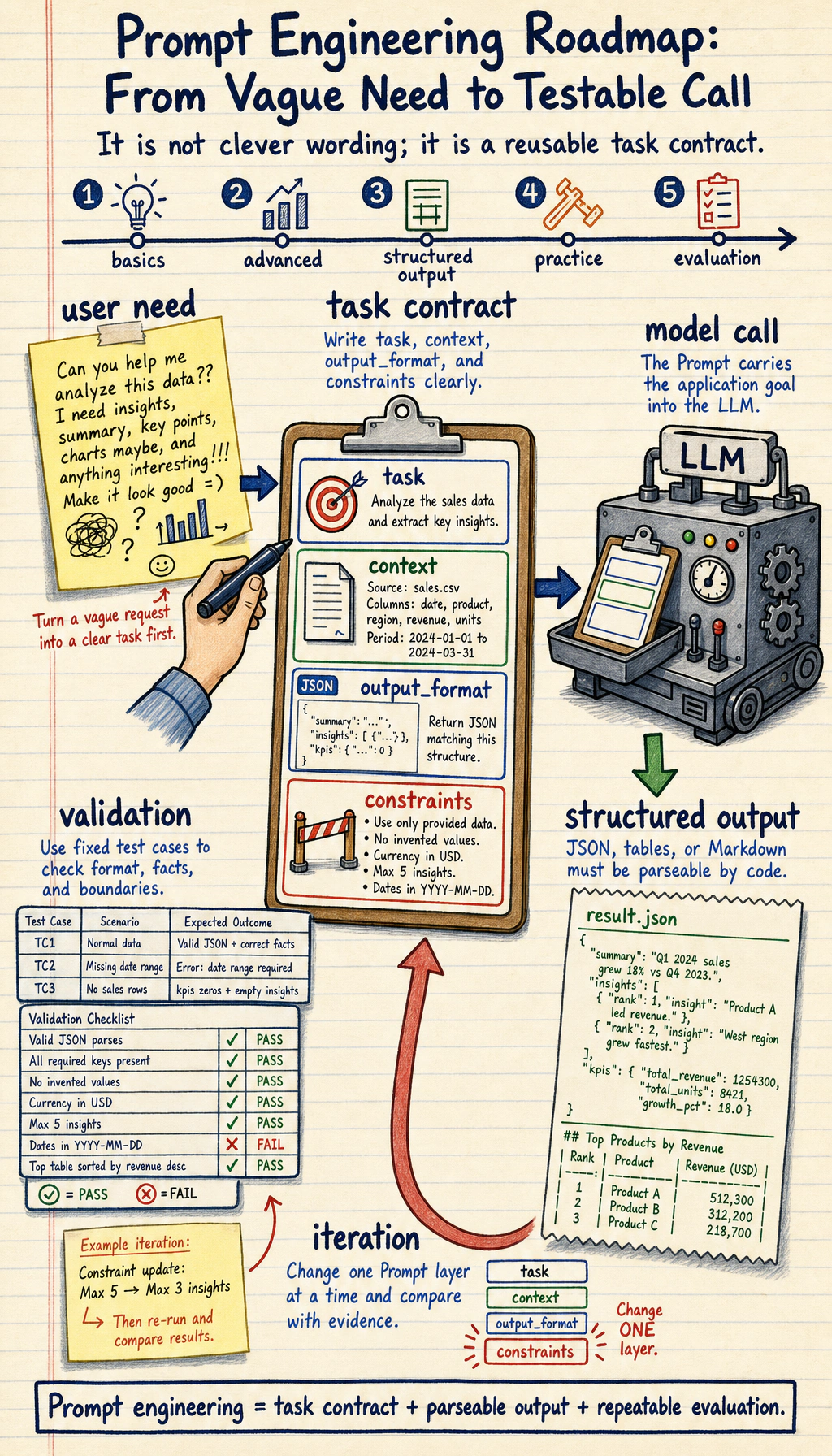
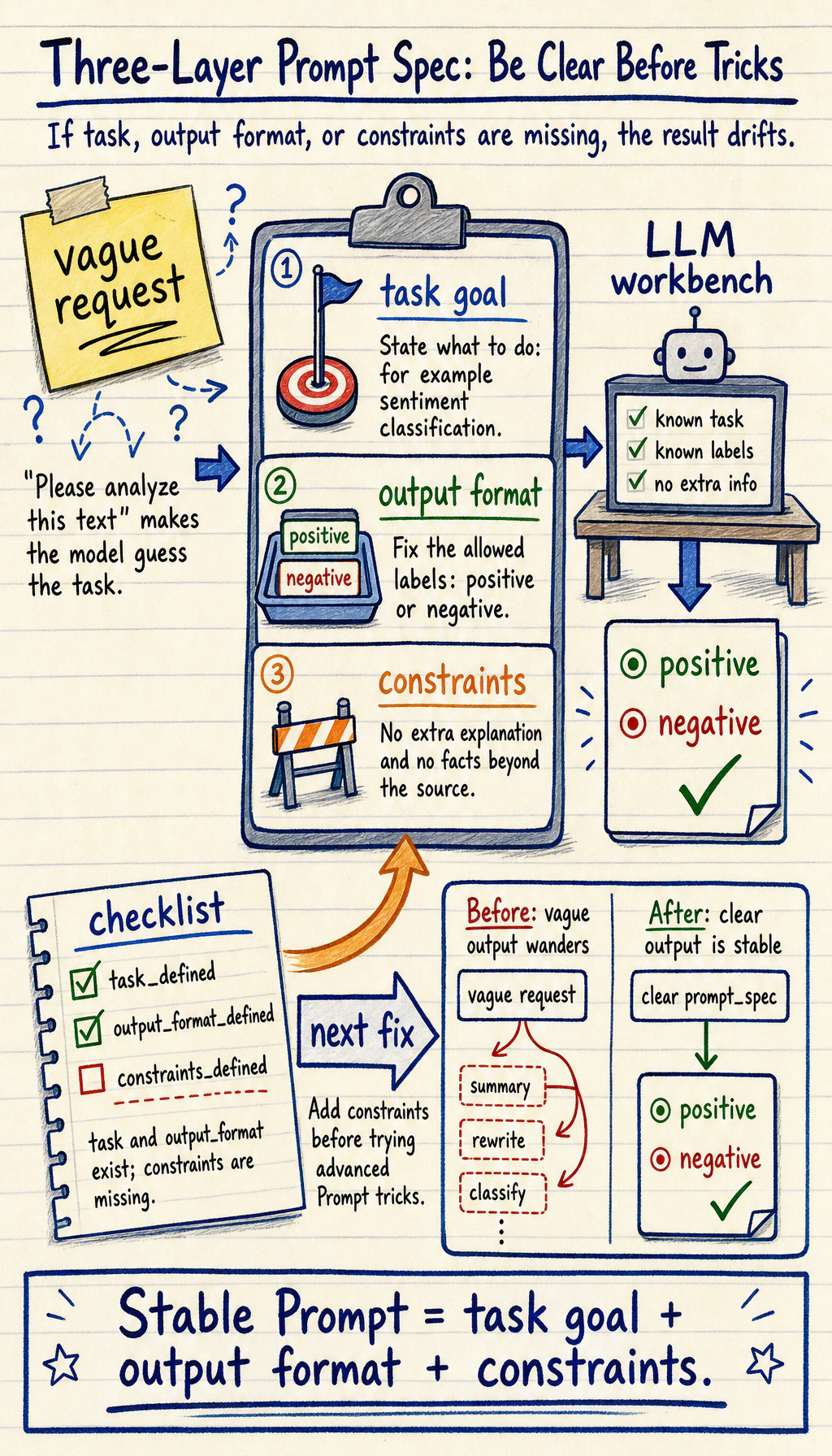
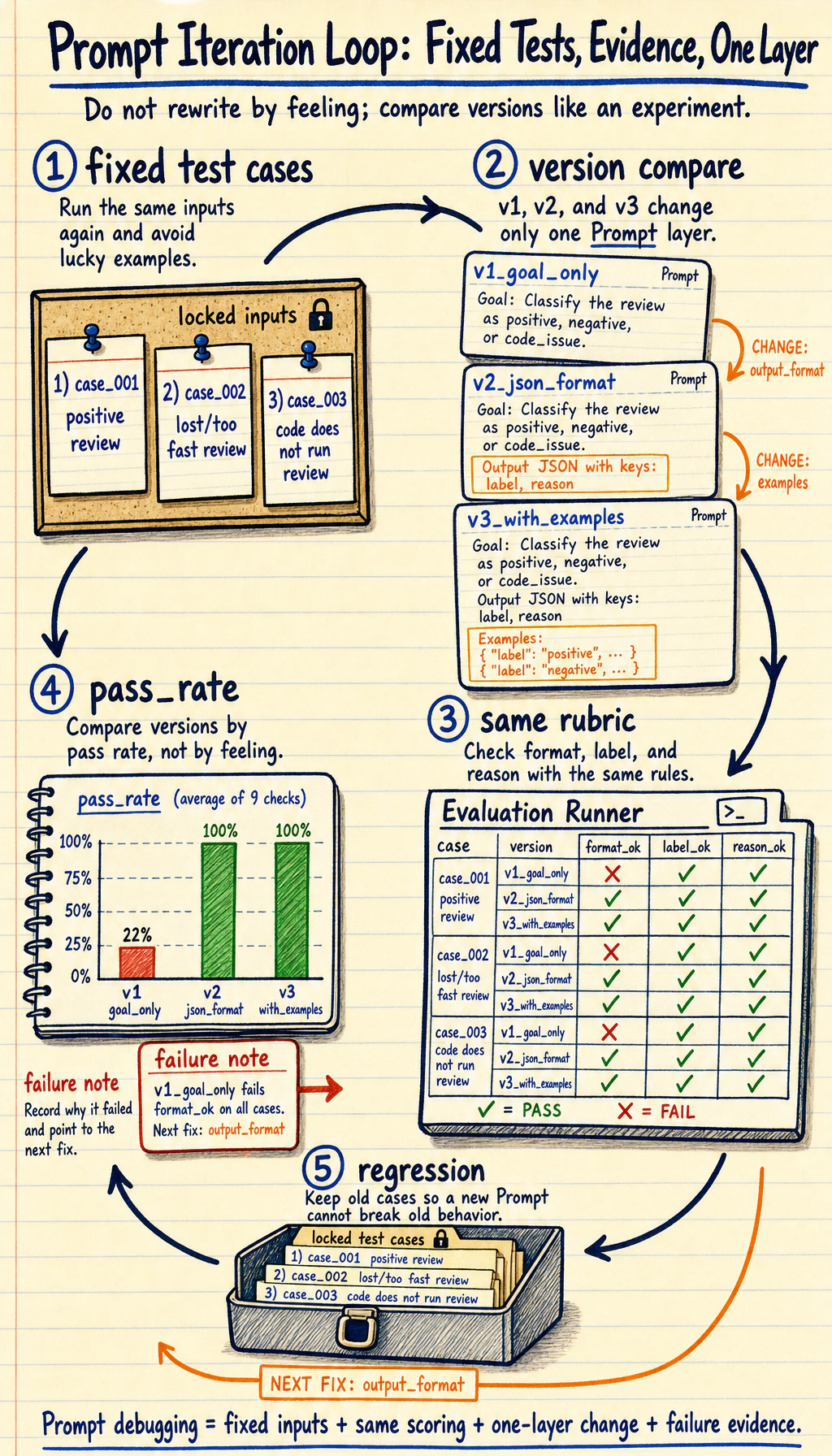
Use this chapter when the model already has the general ability, but the result is vague, unstable, in the wrong format, or hard to evaluate.
Run a Prompt Contract Check
Section titled “Run a Prompt Contract Check”Before calling any LLM, describe the prompt as a contract: task, context, output format, and constraints. This tiny script checks whether the contract is complete enough to test.
prompt_contract = {    "task": "Extract chapter metadata",    "context": "One course markdown file",    "output_format": ["chapter", "goals", "prerequisites", "risks"],    "constraints": ["return JSON only", "mark missing facts as null"],}
required = ["task", "context", "output_format", "constraints"]missing = [field for field in required if not prompt_contract.get(field)]
print("ready:", not missing)print("fields:", ", ".join(required))print("test_case_count:", 3)
Expected output:
ready: Truefields: task, context, output_format, constraintstest_case_count: 3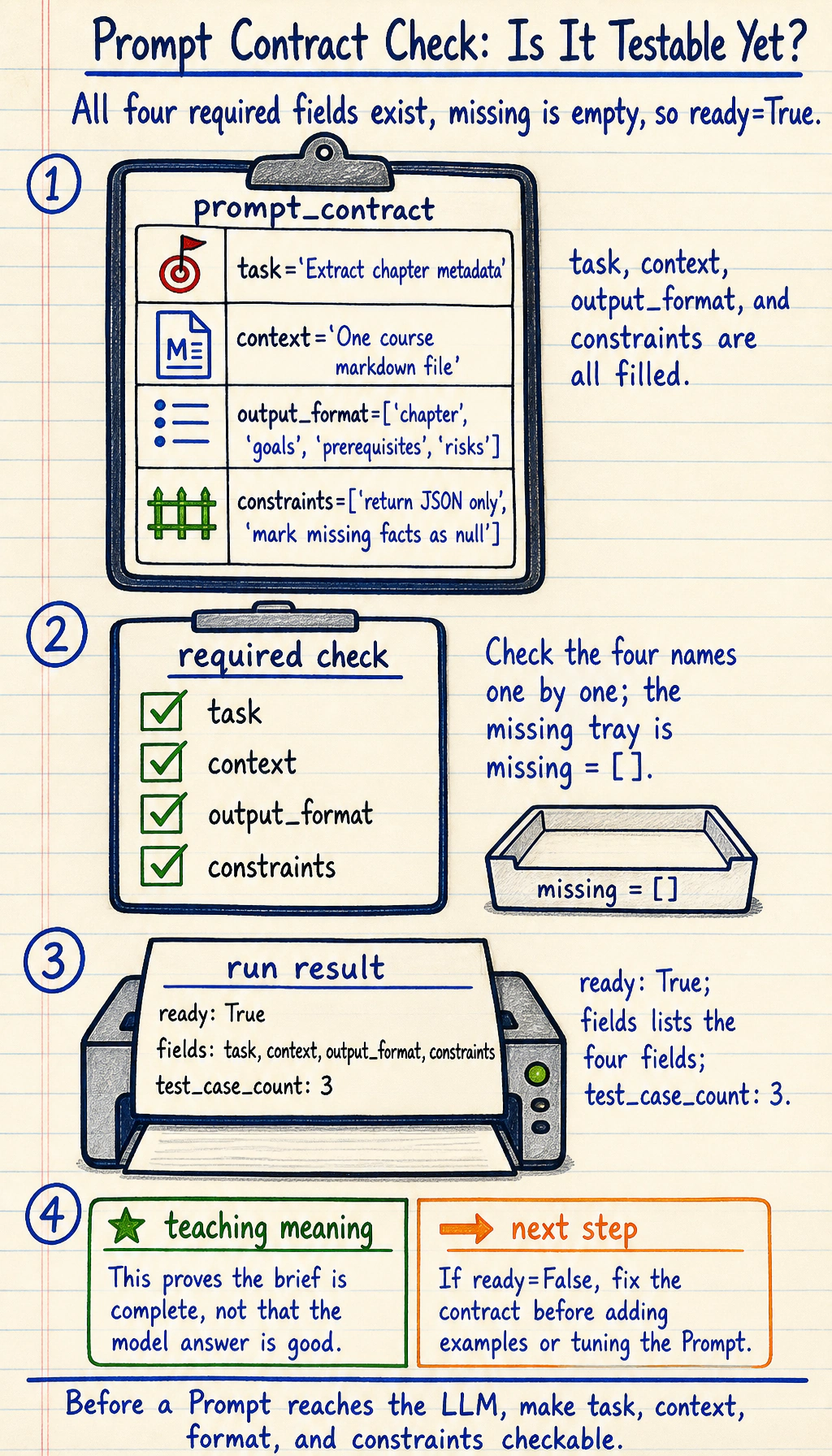
If ready is False, fix the prompt brief before you try more examples. A vague prompt produces vague debugging.
Learn in This Order
Section titled “Learn in This Order”| Step | Read | Practice Output |
|---|---|---|
| 1 | Prompt basics | Rewrite one vague request into task, context, format, constraints |
| 2 | Advanced prompting | Add examples, steps, role, and boundary notes only when they help |
| 3 | Structured output | Make JSON, table, or Markdown output that another program can parse |
| 4 | Prompt practice | Compare prompt versions on the same fixed inputs |
| 5 | Evaluation lab | Record pass rate, failure type, and the next prompt change |
Evidence to Keep
Section titled “Evidence to Keep”Keep this page’s proof of learning as a small evidence card:
- Prompt Contract
- task, context, constraints, output format
- Fixed Cases
- same inputs used across prompt versions
- Schema Check
- structured output validated by parser
- Failure Note
- prompt failure grouped by cause
- Bridge
- Chapter 8 adds retrieved context to this loop
Pass Check
Section titled “Pass Check”You pass this chapter when you can keep the input set fixed, change one prompt layer at a time, and explain why the new version is better with evidence instead of a feeling.
The exit mini project is a course-content extraction prompt: input one course document, output chapter topic, learning goals, prerequisites, key terms, practice suggestions, and risk notes as JSON or a Markdown table.
Check reasoning and explanation
- A passing answer explains how tokens, context, attention, prompts, and generation behavior connect in one request-response path.
- The evidence should include at least one reproducible prompt or structured-output test, plus notes on why the output passed or failed.
- A good self-check separates prompt design, RAG, fine-tuning, and alignment: use the lightest method that fixes the observed problem.