
11.5.1 Seq2Seq Roadmap: Input Sequence to Output Sequence
Seq2Seq handles tasks where both input and output are sequences: translation, summarization, rewriting, dialogue, and error correction.
See the Generation Bridge First
Section titled “See the Generation Bridge First”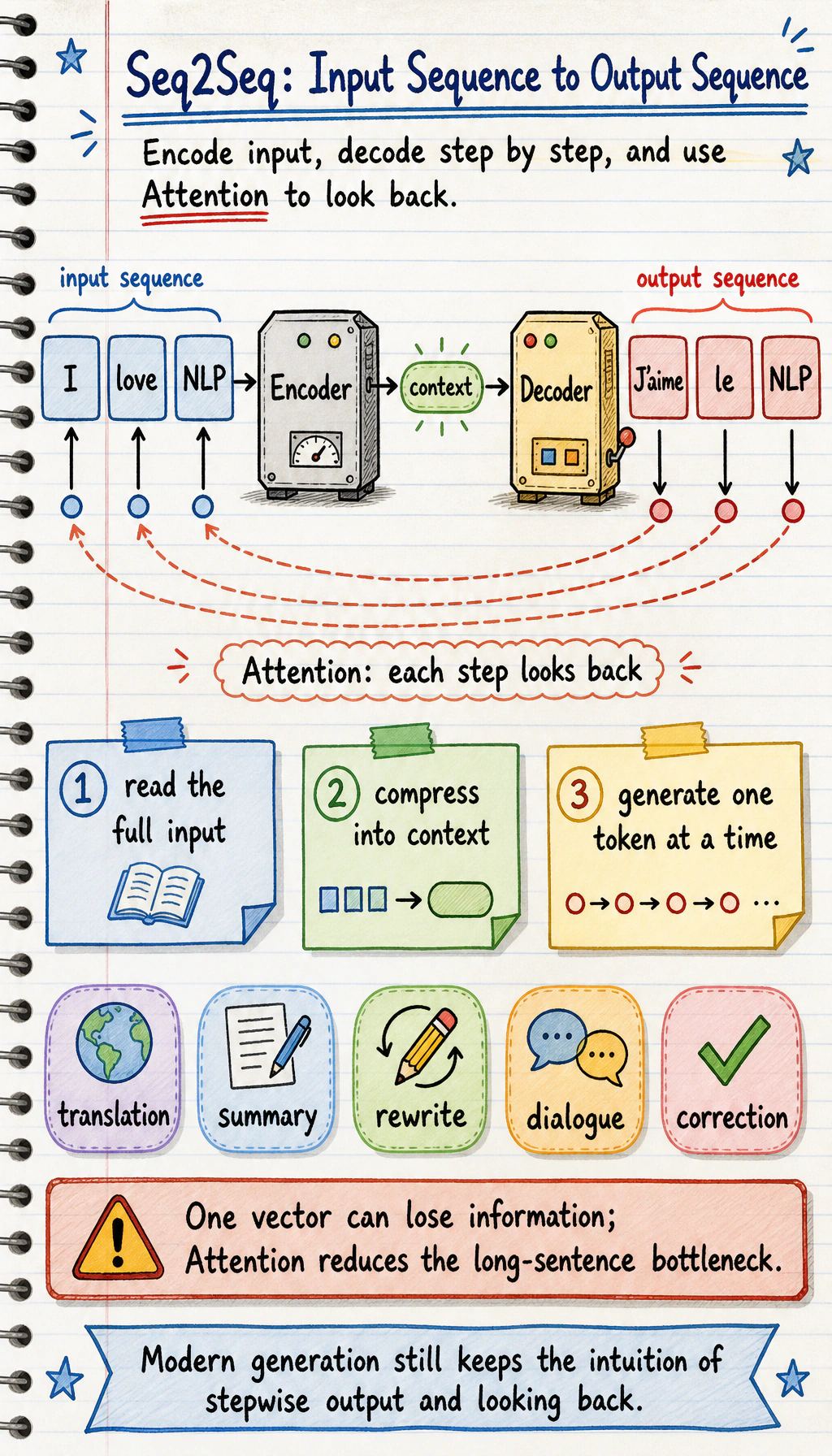
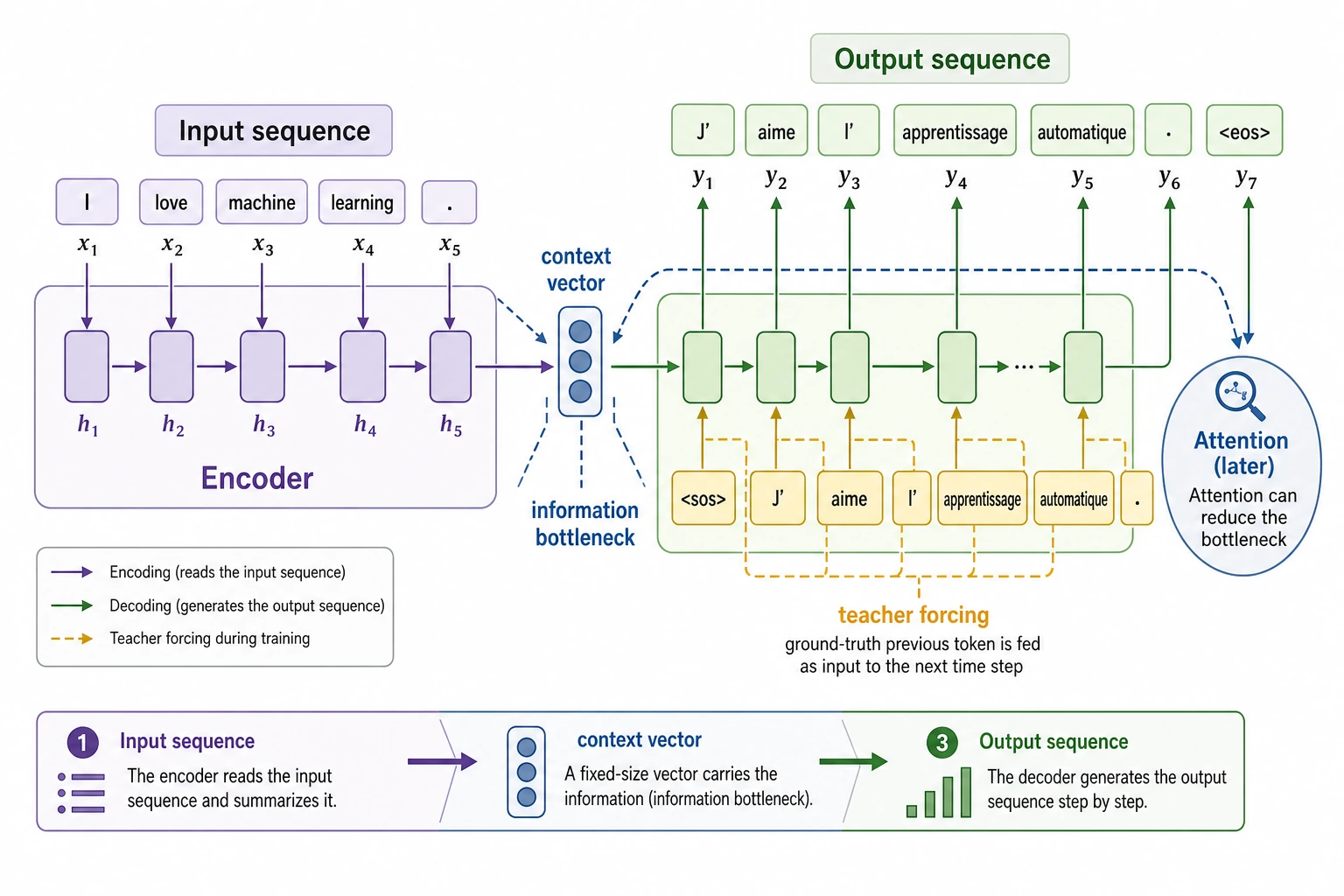
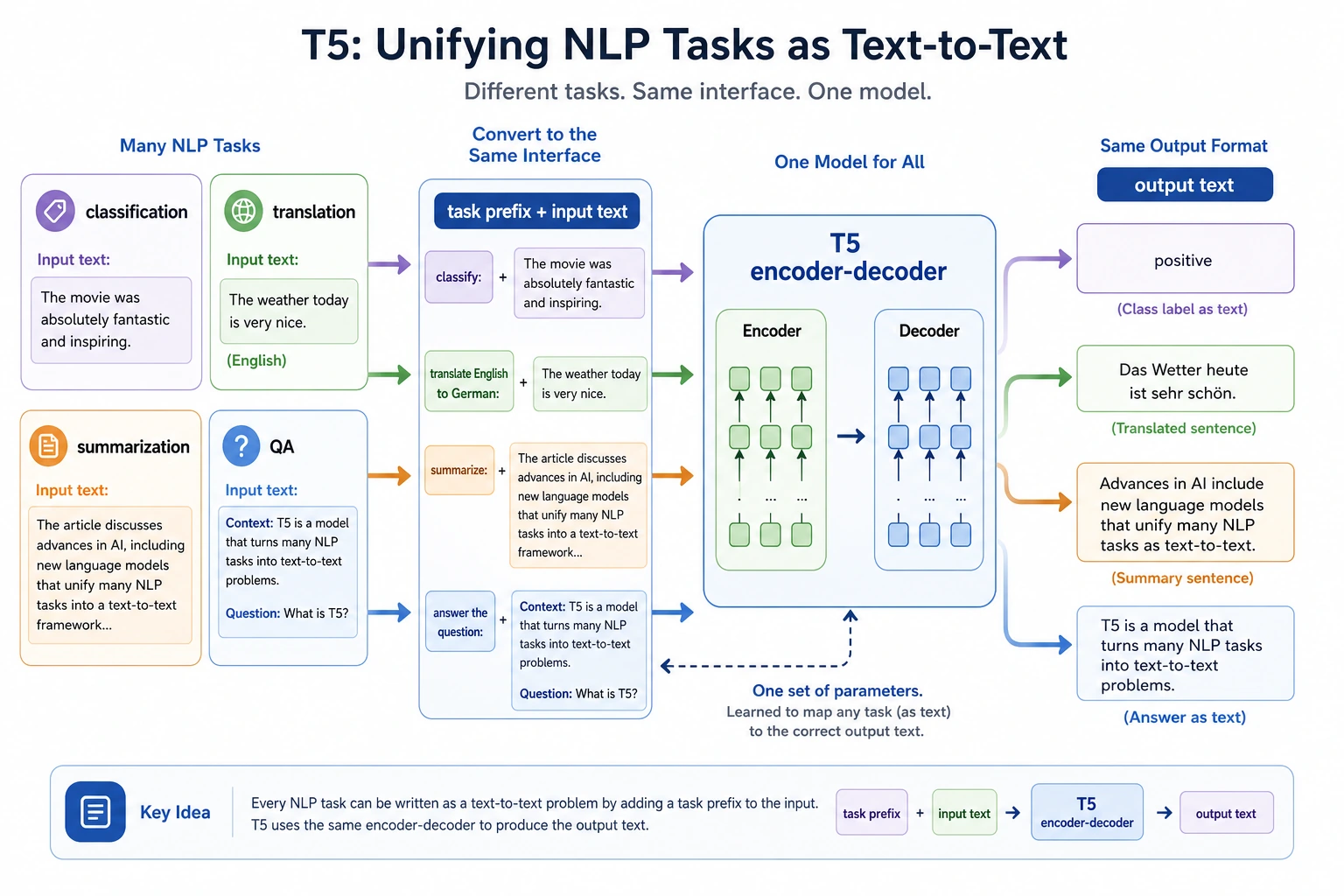
The bridge to modern LLMs is clear: generation happens step by step, and attention helps the decoder look back at useful input positions.
Run an Input-Output Pair Check
Section titled “Run an Input-Output Pair Check”source = ["I", "love", "NLP"]target = ["J'aime", "le", "NLP"]
for step, token in enumerate(target, start=1): print(f"decode_step_{step}:", token)print("source_length:", len(source))print("target_length:", len(target))Expected output:
decode_step_1: J'aimedecode_step_2: ledecode_step_3: NLPsource_length: 3target_length: 3Generation projects should record decoding strategy, failure cases, and whether important input information was lost.
Learn in This Order
Section titled “Learn in This Order”| Step | Read | Practice Output |
|---|---|---|
| 1 | Encoder-Decoder | Explain why input and output can have different lengths |
| 2 | Attention | Explain dynamic alignment during generation |
| 3 | Machine translation | Connect teacher forcing, decoding, BLEU/error analysis |
| 4 | CTC and speech | See what changes when input/output are not frame-aligned |
Evidence to Keep
Section titled “Evidence to Keep”Keep this page’s proof of learning as a small evidence card:
- Source Target
- source text, target text, and task type
- Decoded Output
- generated summary, translation, transcript, or sequence result
- Alignment Note
- attention, CTC path, coverage, or copied source evidence
- Failure Check
- omission, repetition, hallucination, wrong alignment, or weak evaluation
- Expected Output
- generated text with factual or alignment review notes
Pass Check
Section titled “Pass Check”You pass this chapter when you can explain encoder-decoder, attention, greedy/beam decoding, and one generation failure.
Check reasoning and explanation
- A passing answer starts from the text unit and output type: token, span, sentence label, sequence, embedding, or generated text.
- The evidence should include a small dataset example, model or pipeline choice, metric, and at least one inspected error case.
- A good self-check distinguishes preprocessing issues from model issues, such as tokenization mistakes, label ambiguity, data imbalance, or hallucinated generation.