
10.4.4 Segmentation Practice
Learning Objectives
Section titled “Learning Objectives”- Learn how to define a minimal segmentation project
- Understand the basic organization of mask data and metrics
- Build intuition for project evaluation through a runnable example
- Learn how to present the most important results in a segmentation project
First, Build a Map
Section titled “First, Build a Map”If you just finished learning semantic segmentation and instance segmentation, the most natural continuation in this section is:
- You already know what objects like mask and IoU are doing
- Now we ask, “If we turn this into a real project, which parts are most likely to go wrong first?”
So what really matters in this section is not a new network, but:
- mask annotation
- class definition
- evaluation method
- failure sample presentation
For beginners, the best order for understanding this section is not “train a model directly,” but to first understand the project loop:
flowchart LR A["Define the task and classes"] --> B["Prepare mask data"] B --> C["Build a baseline first"] C --> D["Evaluate with IoU"] D --> E["Analyze failure samples"]So what this section really wants to solve is:
- How should a segmentation project move forward?
- Besides the model, where are the places most likely to fail in a project?
A More Beginner-Friendly Overall Analogy
Section titled “A More Beginner-Friendly Overall Analogy”You can think of a segmentation project as:
- carefully coloring a batch of maps
The difficulty is not just “can you color it at all,” but:
- Is each boundary colored accurately?
- Were small regions missed?
- Is everyone following the same standard while coloring?
Once you think about it this way, it becomes much easier to understand why segmentation projects depend so much on:
- mask quality
- boundary standards
- failure sample analysis
How Do You Define the Project Problem?
Section titled “How Do You Define the Project Problem?”A very suitable segmentation project for practice is:
- road scene segmentation
Or:
- medical region segmentation
Shared characteristics:
- clear mask labels
- region boundaries matter
- IoU is meaningful
When a Beginner Does a Segmentation Project for the First Time, How Should They Choose a Task?
Section titled “When a Beginner Does a Segmentation Project for the First Time, How Should They Choose a Task?”A more stable task usually has these characteristics:
- not too many classes
- relatively clear region boundaries
- failure samples that are easy to understand visually
So when you do a project for the first time, “fewer classes, strong boundaries, easy to explain” is usually more important than “the task looks cooler.”
Why Is “Clear Boundaries” So Important?
Section titled “Why Is “Clear Boundaries” So Important?”Because many of the hard parts in segmentation tasks are concentrated in:
- boundaries
- small regions
- places where classes are mixed together
If you start with a task whose boundaries are especially blurry and whose annotation standards are unstable, it will be hard to tell:
- whether the model is poor
- or whether the labels themselves are unstable
First Run a Minimal Segmentation Project Evaluation Example
Section titled “First Run a Minimal Segmentation Project Evaluation Example”pred_masks = [ [[0, 0, 1], [0, 1, 1], [0, 0, 1]], [[1, 1, 0], [1, 0, 0], [1, 0, 0]],]
gt_masks = [ [[0, 0, 1], [0, 1, 1], [0, 1, 1]], [[1, 1, 0], [1, 1, 0], [1, 0, 0]],]
def iou(mask_a, mask_b, target=1): inter = 0 union = 0 for row_a, row_b in zip(mask_a, mask_b): for a, b in zip(row_a, row_b): if a == target and b == target: inter += 1 if a == target or b == target: union += 1 return inter / union if union else 0.0
ious = [iou(pred, gt) for pred, gt in zip(pred_masks, gt_masks)]mean_iou = sum(ious) / len(ious)
print("ious:", [round(x, 4) for x in ious])print("mean_iou:", round(mean_iou, 4))Expected output:
ious: [0.8, 0.8]mean_iou: 0.8This tells you both samples perform similarly in this toy dataset. In a real report, you would keep the per-sample values because the average alone can hide bad edge cases.
What Is This Example Trying to Show?
Section titled “What Is This Example Trying to Show?”The most important thing in a segmentation project is usually not:
- whether one image looks okay
but:
- how the whole set of samples performs
So projects usually need to summarize:
- per-sample IoU
- mean IoU
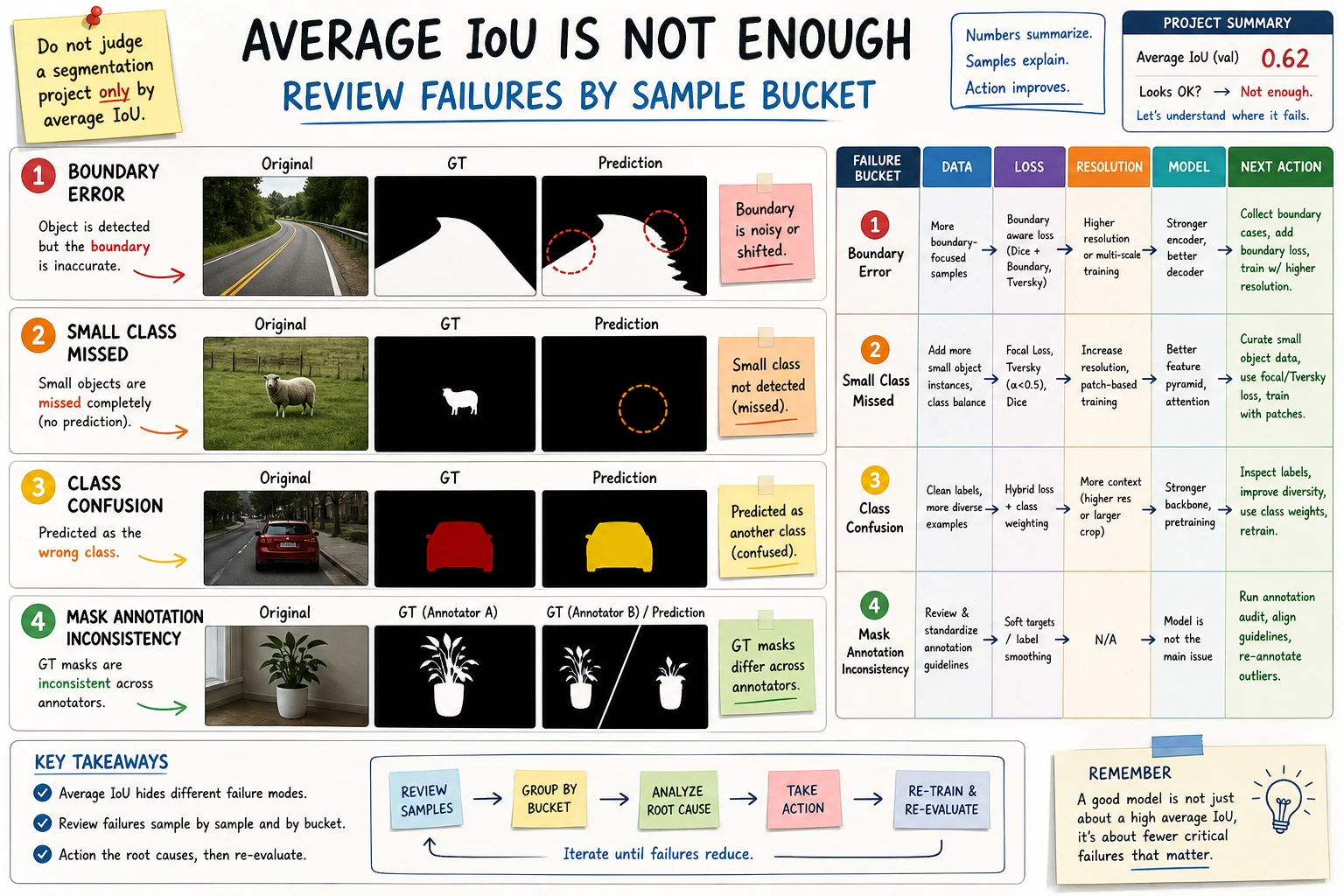
Why Do Segmentation Projects Especially Need to “Review Sample by Sample”?
Section titled “Why Do Segmentation Projects Especially Need to “Review Sample by Sample”?”Because averages can easily hide problems.
For example:
- the large regions are segmented well
- the small target regions are completely wrong
In that case, the average score may still look acceptable, but the project is actually not stable.
When Doing a Segmentation Project for the First Time, Which Types of Failures Are Most Worth Separating First?
Section titled “When Doing a Segmentation Project for the First Time, Which Types of Failures Are Most Worth Separating First?”A very practical failure categorization is:
-
Boundary errors The overall outline is roughly correct, but the edges are rough.
-
Missing small classes The large background is segmented well, but small targets are often missed.
-
Class confusion Two region classes are stuck together.
Once you separate these three types, it becomes much easier to decide:
- whether to add more data
- whether to change the loss function
- or whether to change the model input resolution
Another Minimal Example of a “Project Checklist”
Section titled “Another Minimal Example of a “Project Checklist””checklist = { "classes_defined": True, "mask_quality_checked": True, "baseline_ready": True, "failure_buckets_defined": False,}
def next_step(checklist): if not checklist["classes_defined"]: return "First narrow down the class definitions." if not checklist["mask_quality_checked"]: return "First sample-check the mask annotation quality." if not checklist["baseline_ready"]: return "First build a minimal baseline." if not checklist["failure_buckets_defined"]: return "First bucket the failure samples." return "You can continue with targeted optimization."
print(next_step(checklist))Expected output:
First bucket the failure samples.The baseline and mask checks are ready, so the next useful action is not “try a bigger model” yet. It is to group failure samples so the next change has a clear target.
This example is very small, but it is great for helping beginners understand:
- A project is not just about whether model training runs
- You also need to see whether the project framework is complete
The Most Common Pitfalls in Segmentation Projects
Section titled “The Most Common Pitfalls in Segmentation Projects”Inconsistent Mask Annotation Boundaries
Section titled “Inconsistent Mask Annotation Boundaries”This will contaminate both training and evaluation.
Severe Class Imbalance
Section titled “Severe Class Imbalance”Small-region classes are often overwhelmed by the main background.
Only Looking at the Average, Not the Failure Samples
Section titled “Only Looking at the Average, Not the Failure Samples”The average may hide some especially bad cases.
Only Showing Success Cases, Not Boundary Failures
Section titled “Only Showing Success Cases, Not Boundary Failures”Segmentation projects are especially easy to make “look good,” because colored mask images are visually impressive by themselves. But if you do not show:
- boundary failures
- missed small targets
- class confusion
it becomes hard to tell where the project is still unstable.
A Recommended Workflow for Beginners to Follow
Section titled “A Recommended Workflow for Beginners to Follow”A better approach is:
- First define the classes clearly
- Then sample-check the mask annotations
- Build a minimal baseline first
- Evaluate IoU in a unified way
- Finally, analyze the failure samples separately
This is much more effective than immediately switching models.
If You Turn It into a Portfolio Project, What Is Most Worth Showing?
Section titled “If You Turn It into a Portfolio Project, What Is Most Worth Showing?”Rather than only pasting a colorful mask image, it is more valuable to show:
- original image / ground truth / prediction triplet
- per-class IoU
- several typical failure samples
- how you explain these failures
- what you would improve next
If This Is Your First Time Doing This Kind of Project, What Is the Safest Default Goal?
Section titled “If This Is Your First Time Doing This Kind of Project, What Is the Safest Default Goal?”When doing it for the first time, it is not recommended to chase:
- many classes
- a very complex model
- flashy visualizations
Instead, first aim to achieve:
- Clear class definitions
- Interpretable mask quality
- A baseline that runs stably
- Clear explanations of IoU and failure samples
If you can do these four things, the project already feels much more like a real project.
Evidence to Keep
Section titled “Evidence to Keep”Keep this page’s proof of learning as a small evidence card:
- Input Image
- original image and target mask or class map
- Prediction
- predicted mask, overlay visualization, and boundary examples
- Metric
- IoU, Dice, per-class score, and boundary failure notes
- Failure Check
- annotation quality, thin boundary, small region, or class confusion
- Expected Output
- mask overlay plus segmentation metric summary
Summary
Section titled “Summary”The most important thing in this section is to build a project mindset:
The core of a segmentation project is not just model training, but also mask label quality, IoU evaluation, and failure sample analysis.
What You Should Take Away from This Section
Section titled “What You Should Take Away from This Section”- A segmentation project is first a data and evaluation project, and only then a model project
- Mask annotation quality directly determines the upper bound
- Failure sample analysis is especially important in segmentation projects
If we compress it into one sentence, it is:
The real challenge in a segmentation project is not just making the model draw masks, but making the boundaries, coverage, and errors of each region clearly explainable.
Exercises
Section titled “Exercises”- Build another set of
pred_masksandgt_masks, and observe howmean_iouchanges. - Why is the mask annotation standard especially important in segmentation projects?
- If a certain class covers a very small region, why is IoU especially sensitive?
- How would you turn a segmentation project into a portfolio page?
Project reference and review notes
- When you change
pred_masks,mean_ioushould drop for missing masks, wrong classes, or poor boundaries. Also inspect class-wise IoU so one easy class does not hide another failure. - Mask annotation standards matter because boundary thickness, ignored regions, and ambiguous edges directly define the target and the evaluation.
- For very small regions, a few wrong pixels can change the intersection and union by a large percentage, so IoU becomes sensitive.
- A portfolio page should show the problem definition, mask rules, IoU/Dice metrics, overlay examples, failure cases, limitations, and next steps.