
6.3.6 CNN Practice: Image Classification
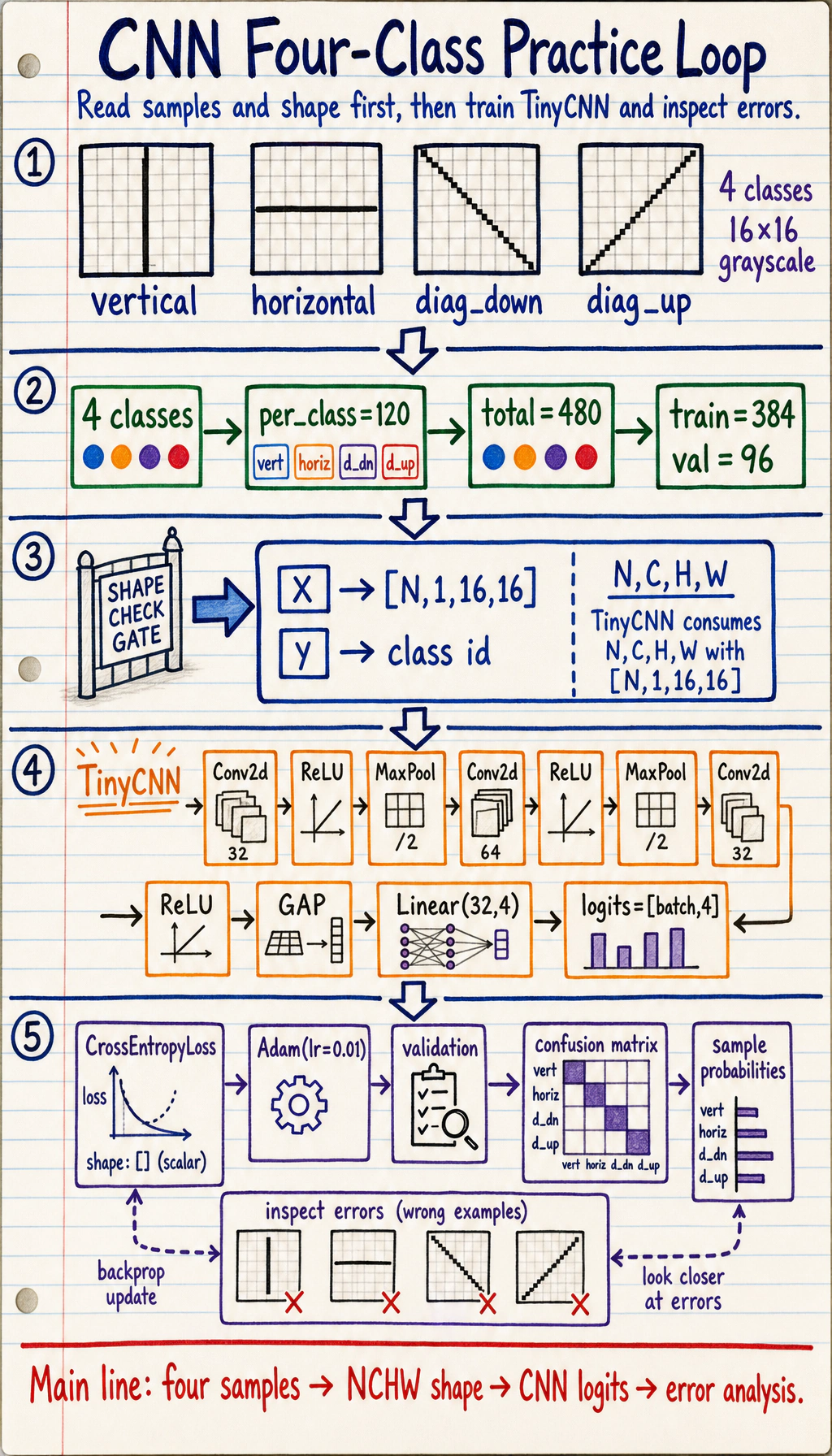
Learning Objectives
Section titled “Learning Objectives”- Build a complete image classification workflow.
- Keep image tensors in
[N, C, H, W]format. - Train and validate a CNN with
CrossEntropyLoss. - Inspect a confusion matrix and single-sample probabilities.
- Understand what changes when you move from this toy task to real images.
The Minimal Closed Loop
Section titled “The Minimal Closed Loop”An image classification project needs:
Do not skip validation or error inspection. A model that “runs” is not the same as a model that learned the right signal.
Full Lab: Train a Four-Class CNN
Section titled “Full Lab: Train a Four-Class CNN”This lab uses four simple classes:
| Label | Pattern |
|---|---|
0 | vertical line |
1 | horizontal line |
2 | diagonal down |
3 | diagonal up |
Run the full script:
import numpy as npimport torchfrom torch import nn
SEED = 42np.random.seed(SEED)torch.manual_seed(SEED)
CLASS_NAMES = ["vertical", "horizontal", "diag_down", "diag_up"]

def make_image(label, size=16, noise=0.08):    img = np.zeros((size, size), dtype=np.float32)    c = size // 2    if label == 0:        img[:, c] = 1.0    elif label == 1:        img[c, :] = 1.0    elif label == 2:        for i in range(size):            img[i, i] = 1.0    elif label == 3:        for i in range(size):            img[i, size - 1 - i] = 1.0
    img += np.random.randn(size, size).astype(np.float32) * noise    return np.clip(img, 0.0, 1.0)

def make_dataset(per_class=120):    X, y = [], []    for label in range(len(CLASS_NAMES)):        for _ in range(per_class):            X.append(make_image(label))            y.append(label)
    X = np.array(X, dtype=np.float32)    y = np.array(y, dtype=np.int64)    idx = np.random.permutation(len(X))    X = torch.tensor(X[idx]).unsqueeze(1)    y = torch.tensor(y[idx])    split = int(len(X) * 0.8)    return X[:split], y[:split], X[split:], y[split:]

class TinyCNNClassifier(nn.Module):    def __init__(self, num_classes=4):        super().__init__()        self.features = nn.Sequential(            nn.Conv2d(1, 8, kernel_size=3, padding=1),            nn.ReLU(),            nn.MaxPool2d(2),            nn.Conv2d(8, 16, kernel_size=3, padding=1),            nn.ReLU(),            nn.MaxPool2d(2),            nn.Conv2d(16, 32, kernel_size=3, padding=1),            nn.ReLU(),            nn.AdaptiveAvgPool2d((1, 1)),        )        self.head = nn.Linear(32, num_classes)
    def forward(self, x):        x = self.features(x)        x = x.flatten(1)        return self.head(x)

def accuracy(logits, y):    return (logits.argmax(dim=1) == y).float().mean().item()

def confusion_matrix(pred, y, num_classes):    matrix = torch.zeros(num_classes, num_classes, dtype=torch.int64)    for true_label, pred_label in zip(y, pred):        matrix[true_label, pred_label] += 1    return matrix

X_train, y_train, X_val, y_val = make_dataset()print("data_lab")print("train:", tuple(X_train.shape), tuple(y_train.shape))print("val  :", tuple(X_val.shape), tuple(y_val.shape))
model = TinyCNNClassifier(num_classes=len(CLASS_NAMES))with torch.no_grad():    z = X_train[:4]    print("shape_lab")    print("input:", tuple(z.shape))    print("features:", tuple(model.features(z).shape))    print("logits:", tuple(model(z).shape))
loss_fn = nn.CrossEntropyLoss()optimizer = torch.optim.Adam(model.parameters(), lr=0.01)
for epoch in range(1, 81):    model.train()    train_logits = model(X_train)    train_loss = loss_fn(train_logits, y_train)
    optimizer.zero_grad()    train_loss.backward()    optimizer.step()
    if epoch == 1 or epoch % 20 == 0:        model.eval()        with torch.no_grad():            val_logits = model(X_val)            val_loss = loss_fn(val_logits, y_val)        print(            f"epoch={epoch:02d} "            f"train_loss={train_loss.item():.4f} "            f"val_loss={val_loss.item():.4f} "            f"train_acc={accuracy(train_logits, y_train):.3f} "            f"val_acc={accuracy(val_logits, y_val):.3f}"        )
model.eval()with torch.no_grad():    val_logits = model(X_val)    val_pred = val_logits.argmax(dim=1)    cm = confusion_matrix(val_pred, y_val, len(CLASS_NAMES))    probs = torch.softmax(val_logits[0], dim=0)
print("confusion_matrix rows=true cols=pred")print(cm)print("sample_prediction")print("true:", CLASS_NAMES[y_val[0].item()])print("pred:", CLASS_NAMES[val_pred[0].item()])print("probs:", [round(v, 3) for v in probs.tolist()])
Expected output:
data_labtrain: (384, 1, 16, 16) (384,)val : (96, 1, 16, 16) (96,)shape_labinput: (4, 1, 16, 16)features: (4, 32, 1, 1)logits: (4, 4)epoch=01 train_loss=1.3883 val_loss=1.3776 train_acc=0.245 val_acc=0.188epoch=20 train_loss=0.0193 val_loss=0.0080 train_acc=1.000 val_acc=1.000epoch=40 train_loss=0.0000 val_loss=0.0000 train_acc=1.000 val_acc=1.000epoch=60 train_loss=0.0000 val_loss=0.0000 train_acc=1.000 val_acc=1.000epoch=80 train_loss=0.0000 val_loss=0.0000 train_acc=1.000 val_acc=1.000confusion_matrix rows=true cols=predtensor([[30, 0, 0, 0], [ 0, 22, 0, 0], [ 0, 0, 18, 0], [ 0, 0, 0, 26]])sample_predictiontrue: verticalpred: verticalprobs: [1.0, 0.0, 0.0, 0.0]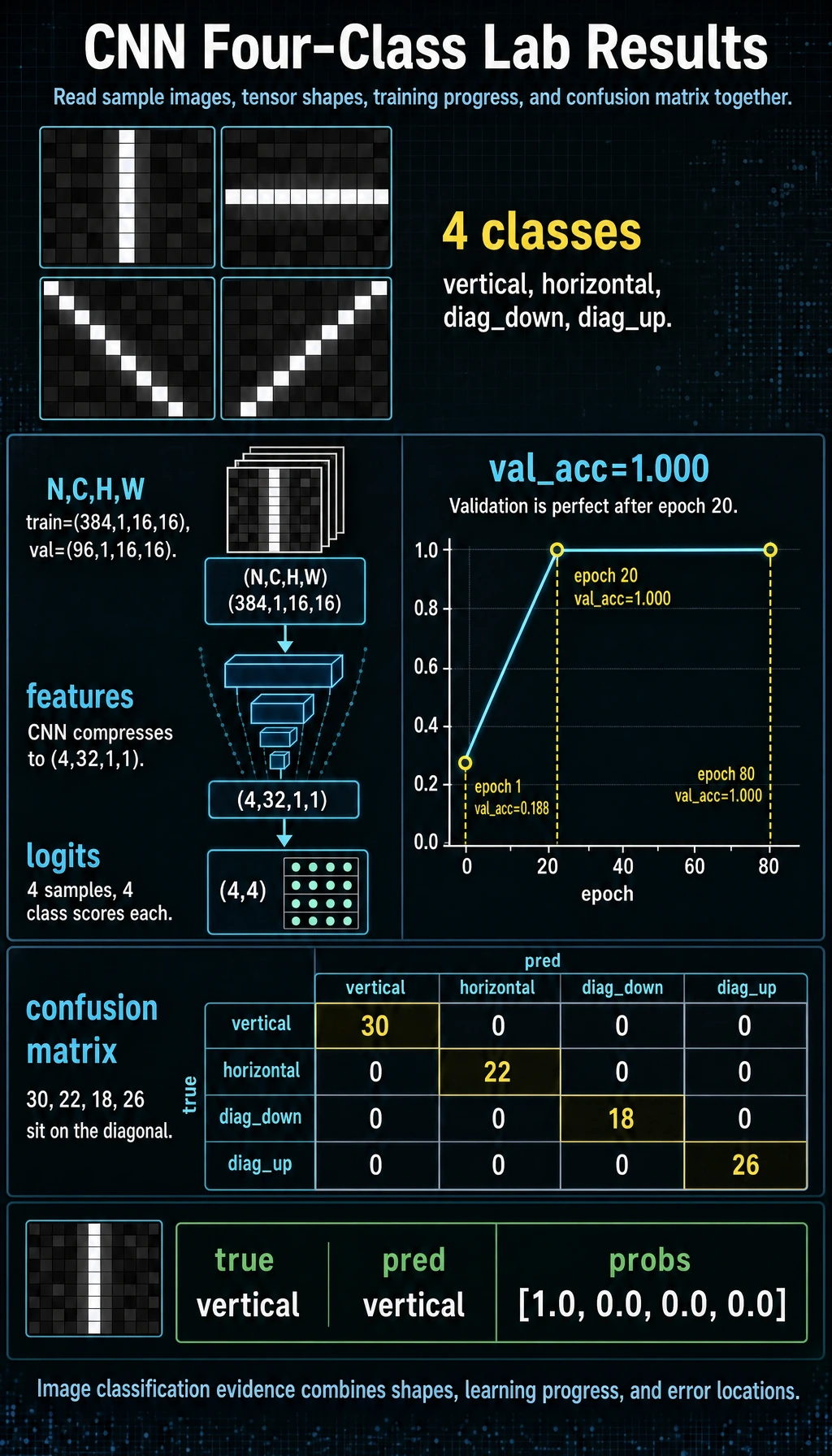
Read the Output
Section titled “Read the Output”| Output | Meaning |
|---|---|
train: (384, 1, 16, 16) | 384 grayscale training images |
features: (4, 32, 1, 1) | CNN has compressed each image into 32 feature values |
logits: (4, 4) | four samples, four class scores each |
val_acc=1.000 | the model learned this simple validation set |
| confusion matrix diagonal | true class and predicted class match |
The confusion matrix is read row by row: rows are true labels, columns are predicted labels. Off-diagonal numbers are mistakes.
Evidence to Keep
Section titled “Evidence to Keep”Save one classification run card:
- Data Shape
- train and validation tensor shapes
- Model Shape
- input → features → logits
- Metric
- validation accuracy and loss
- Confusion Matrix
- rows=true, cols=pred
- Sample Prediction
- true label, predicted label, probabilities
- Next Probe
- more noise, fewer samples, new class, or real image split
Why Use GAP Here?
Section titled “Why Use GAP Here?”The model uses AdaptiveAvgPool2d((1, 1)), also called Global Average Pooling in this context. It turns [N, 32, H, W] into [N, 32, 1, 1].
This keeps the classifier head small:
For this lesson, GAP also avoids fragile manual calculations such as 16 * 3 * 3.
How to Diagnose Results
Section titled “How to Diagnose Results”| Symptom | Likely cause | Next action |
|---|---|---|
| train and val are both poor | model too weak, bad labels, LR issue | print shapes, inspect samples, adjust LR |
| train good but val poor | overfitting or split mismatch | add data, augmentation, regularization |
| loss does not move | wrong labels, no gradients, LR too small | check loss.backward(), labels, trainable params |
| high confidence wrong predictions | biased data or leakage in patterns | inspect examples and class distribution |
| only one class predicted | class imbalance or optimizer issue | print class counts and logits |
From Toy Task to Real Images
Section titled “From Toy Task to Real Images”This lesson intentionally keeps the dataset small and synthetic. Real projects add:
DatasetandDataLoader;- image file reading;
- train/validation/test split by source;
- data augmentation;
- pretrained backbone or transfer learning;
- model checkpointing;
- richer metrics such as precision, recall, and per-class accuracy.
The workflow is the same. The tooling becomes more serious.
Common Mistakes
Section titled “Common Mistakes”| Mistake | Fix |
|---|---|
| checking only training loss | always compute validation metrics |
| forgetting channel dimension | use [N, C, H, W] |
using softmax before CrossEntropyLoss | pass raw logits to CrossEntropyLoss |
| ignoring wrong examples | inspect the confusion matrix and samples |
| making validation too similar to training | split by source when real images share context |
Exercises
Section titled “Exercises”- Increase
noisefrom0.08to0.25. How do validation results change? - Reduce
per_classfrom120to10. Does the model still generalize? - Remove
AdaptiveAvgPool2dand use aFlattenhead. What shape mustLinearexpect? - Add one more class, such as a square border.
- Print the first five wrong validation examples if any exist.
Reference implementation and walkthrough
- Higher noise usually lowers validation accuracy and creates more borderline mistakes. The error examples are more informative than the metric alone.
- With only
10samples per class, the model may still fit training data but validation becomes less reliable. Expect higher variance across seeds. Linearmust receivechannels * height * widthafter the final convolution stack. Print the feature shape once and compute the flattened size from that.- Adding a class requires new data generation, a new label, and changing the final output dimension to the new number of classes.
- Wrong examples should be inspected for pattern overlap, label bugs, or systematic confusion. A useful note says what to try next, not only that the model was wrong.
Key Takeaways
Section titled “Key Takeaways”- A complete image classification loop includes data, labels, split, model, loss, metrics, and error inspection.
- CNN inputs in PyTorch use
[N, C, H, W]. CrossEntropyLossexpects logits, not probabilities.- GAP keeps the classifier head compact and shape-safe.
- Validation and error analysis are part of the model, not an afterthought.