
7.3.6 Model Scale and Computation
Learning Objectives
Section titled “Learning Objectives”- Understand the relationship between parameter scale, context length, and computational cost
- Understand why training and inference have different cost structures
- Learn how to make rough estimates of parameter count and KV cache with a runnable example
- Build a practical judgment of “why models cannot grow without limit”
Parameter Count Is Only the First Layer of the Story
Section titled “Parameter Count Is Only the First Layer of the Story”Why do people like to say 7B / 70B?
Section titled “Why do people like to say 7B / 70B?”Because it is intuitive. Parameter count does roughly reflect a model’s capacity:
- More parameters usually means a higher upper bound on expressive power
But that is only the first layer.
For large models, cost also depends on many other dimensions
Section titled “For large models, cost also depends on many other dimensions”For example, even if two models are both labeled 7B,
they can still differ a lot because of factors like:
- different numbers of layers
- different hidden sizes
- different numbers of heads
- different context lengths
- whether they use GQA / MoE
So parameter count is not useless, but you cannot look at it alone.
An analogy: floor area is not the total cost of a building
Section titled “An analogy: floor area is not the total cost of a building”You can think of parameter count as the total floor area of a house. But what really costs money also includes:
- building structure
- interior complexity
- heating and maintenance costs
Likewise, the real computational cost of a large model is not determined by parameter count alone.
Where Does the Parameter Count Come From?
Section titled “Where Does the Parameter Count Come From?”In a decoder block, the main cost comes from attention and FFN
Section titled “In a decoder block, the main cost comes from attention and FFN”For a rough estimate, it helps to remember two main parts:
- Attention projection
- FFN projection
In many decoder-only models, the FFN can have even more parameters than attention.
A very useful rough formula
Section titled “A very useful rough formula”For a standard decoder block, you can use this approximate intuition:
- Attention-related parameters are about
4 * hidden^2 - FFN-related parameters are about
8 * hidden^2
So one layer can be roughly approximated as:
12 * hidden^2
Then multiply by the number of layers, and you get a very useful first-order estimate.
Why is a rough estimate still valuable?
Section titled “Why is a rough estimate still valuable?”Because engineering decisions do not need exact values down to the last digit at the beginning. What matters more is:
- the approximate order of magnitude
- which part is the main cost driver
- which hyperparameter change will raise cost most noticeably
Run a Truly Useful Estimation Script
Section titled “Run a Truly Useful Estimation Script”The script below estimates two very common real-world things:
- The approximate parameter count of a decoder-only model
- The approximate KV cache usage during inference
def approx_decoder_params(num_layers, hidden_size, ffn_multiplier=4, vocab_size=50000):    attention_params = 4 * hidden_size * hidden_size    ffn_params = 2 * hidden_size * (hidden_size * ffn_multiplier)    norm_params = 4 * hidden_size    block_params = attention_params + ffn_params + norm_params    embedding_params = vocab_size * hidden_size    total = num_layers * block_params + embedding_params    return total

def kv_cache_bytes(    num_layers,    seq_len,    batch_size,    num_kv_heads,    head_dim,    dtype_bytes=2,):    # 2 represents two caches: K and V    return num_layers * batch_size * seq_len * num_kv_heads * head_dim * 2 * dtype_bytes

def human_readable(num_bytes):    units = ["B", "KB", "MB", "GB", "TB"]    value = float(num_bytes)    for unit in units:        if value < 1024 or unit == units[-1]:            return f"{value:.2f} {unit}"        value /= 1024

configs = [    {        "name": "small",        "layers": 24,        "hidden": 2048,        "kv_heads": 16,        "head_dim": 128,        "seq_len": 4096,    },    {        "name": "large",        "layers": 48,        "hidden": 4096,        "kv_heads": 8,        "head_dim": 128,        "seq_len": 8192,    },]
for cfg in configs:    params = approx_decoder_params(cfg["layers"], cfg["hidden"])    kv_bytes = kv_cache_bytes(        num_layers=cfg["layers"],        seq_len=cfg["seq_len"],        batch_size=1,        num_kv_heads=cfg["kv_heads"],        head_dim=cfg["head_dim"],    )    print("-" * 60)    print("model       :", cfg["name"])    print("rough params:", f"{params / 1e9:.2f}B")    print("kv cache    :", human_readable(kv_bytes))
Expected output:
------------------------------------------------------------model : smallrough params: 1.31Bkv cache : 768.00 MB------------------------------------------------------------model : largerough params: 9.87Bkv cache : 1.50 GB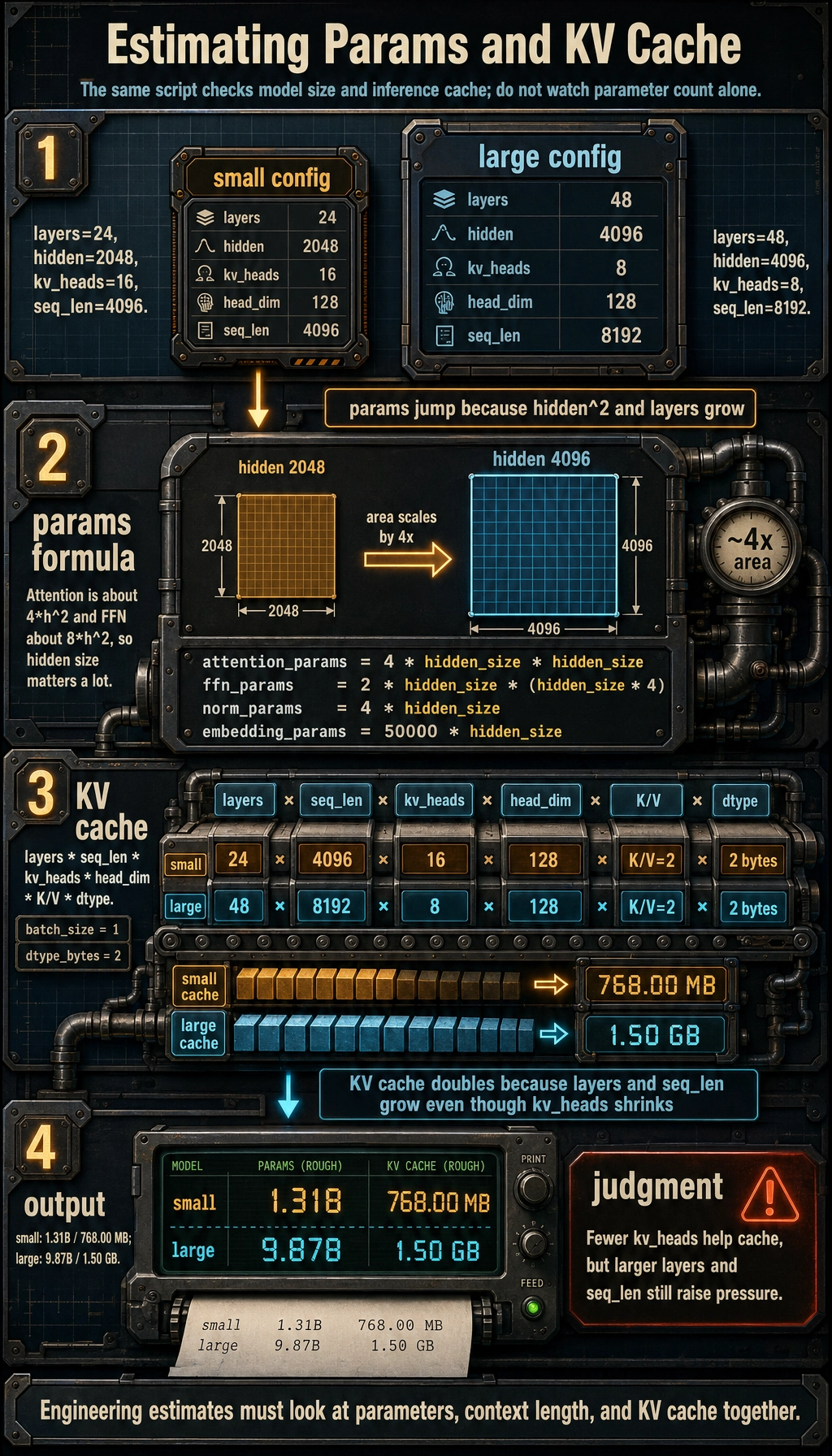
What is the most important takeaway from this code?
Section titled “What is the most important takeaway from this code?”First:
- Parameter count is strongly related to
hidden_size^2
That means once hidden size gets larger, cost increases very quickly.
Second:
- KV cache grows together with
layers * seq_len * kv_heads * head_dim
This is why context length and inference memory affect each other.
Why is the pressure on the large model not just a doubling of parameters?
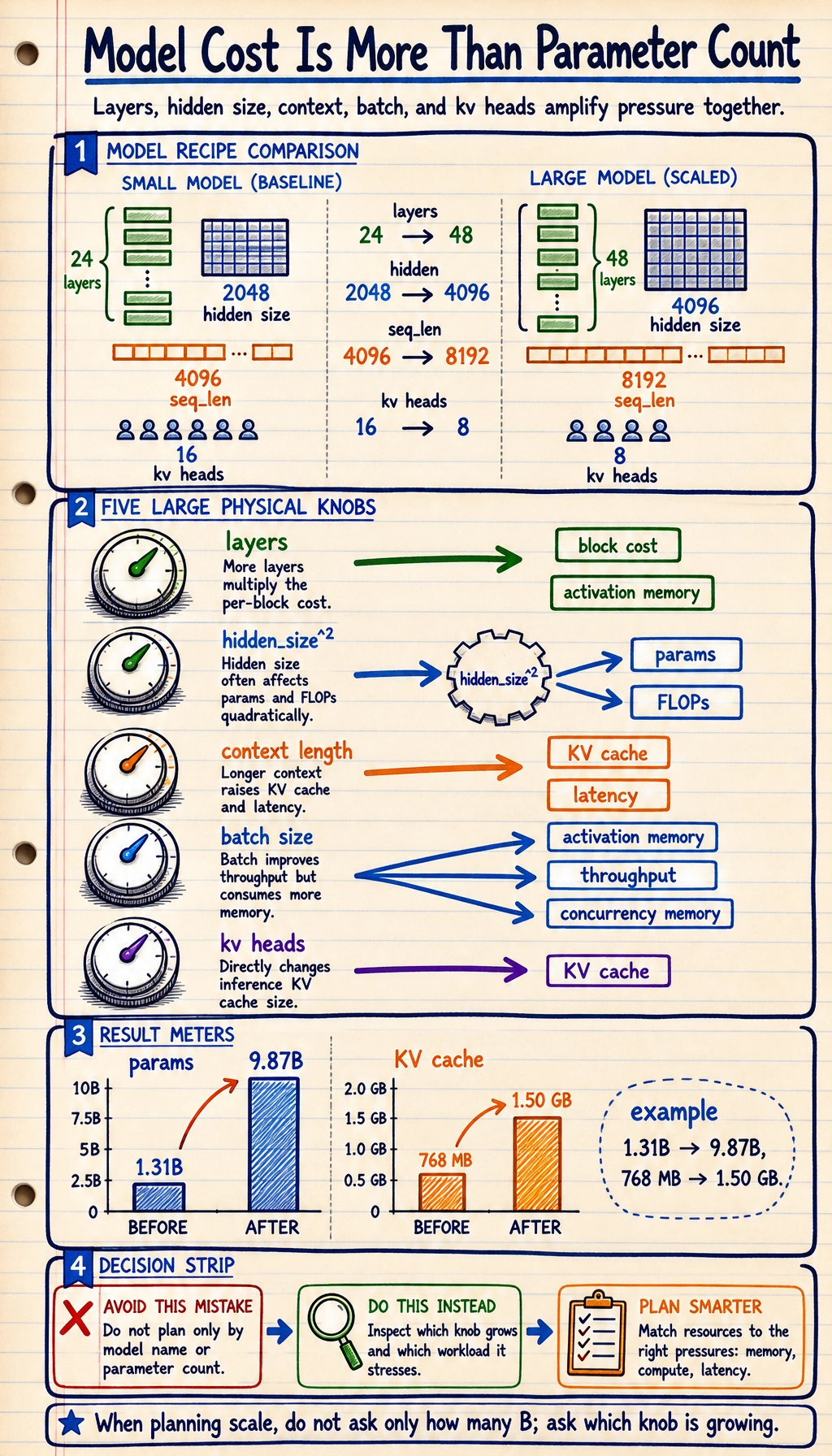
Section titled “Why is the pressure on the large model not just a doubling of parameters?”Because you will find that many factors are growing at the same time:
- more layers
- larger hidden size
- longer seq_len
Once these factors stack together, both training and inference costs rise significantly.
Why can GQA / MQA relieve inference pressure?
Section titled “Why can GQA / MQA relieve inference pressure?”Because they directly reduce:
num_kv_heads
And that is one of the core terms in the KV cache formula.
What Is Actually Different Between Training and Inference?
Section titled “What Is Actually Different Between Training and Inference?”What usually becomes the bottleneck during training?
Section titled “What usually becomes the bottleneck during training?”Common training bottlenecks include:
- model parameters
- gradients
- optimizer states
- intermediate activations
So during training, you will care a lot about:
- mixed precision
- gradient checkpointing
- tensor parallelism / data parallelism
- activation memory
What usually becomes the bottleneck during inference?
Section titled “What usually becomes the bottleneck during inference?”The main pressure during inference more often comes from:
- KV cache
- throughput
- latency per request
- GPU memory under concurrency
So you will care more about:
- how to set batch size
- how long the context is
- how many kv heads there are
- whether the cache can be quantized
Why does “the model can be trained” not mean “it is easy to deploy”?
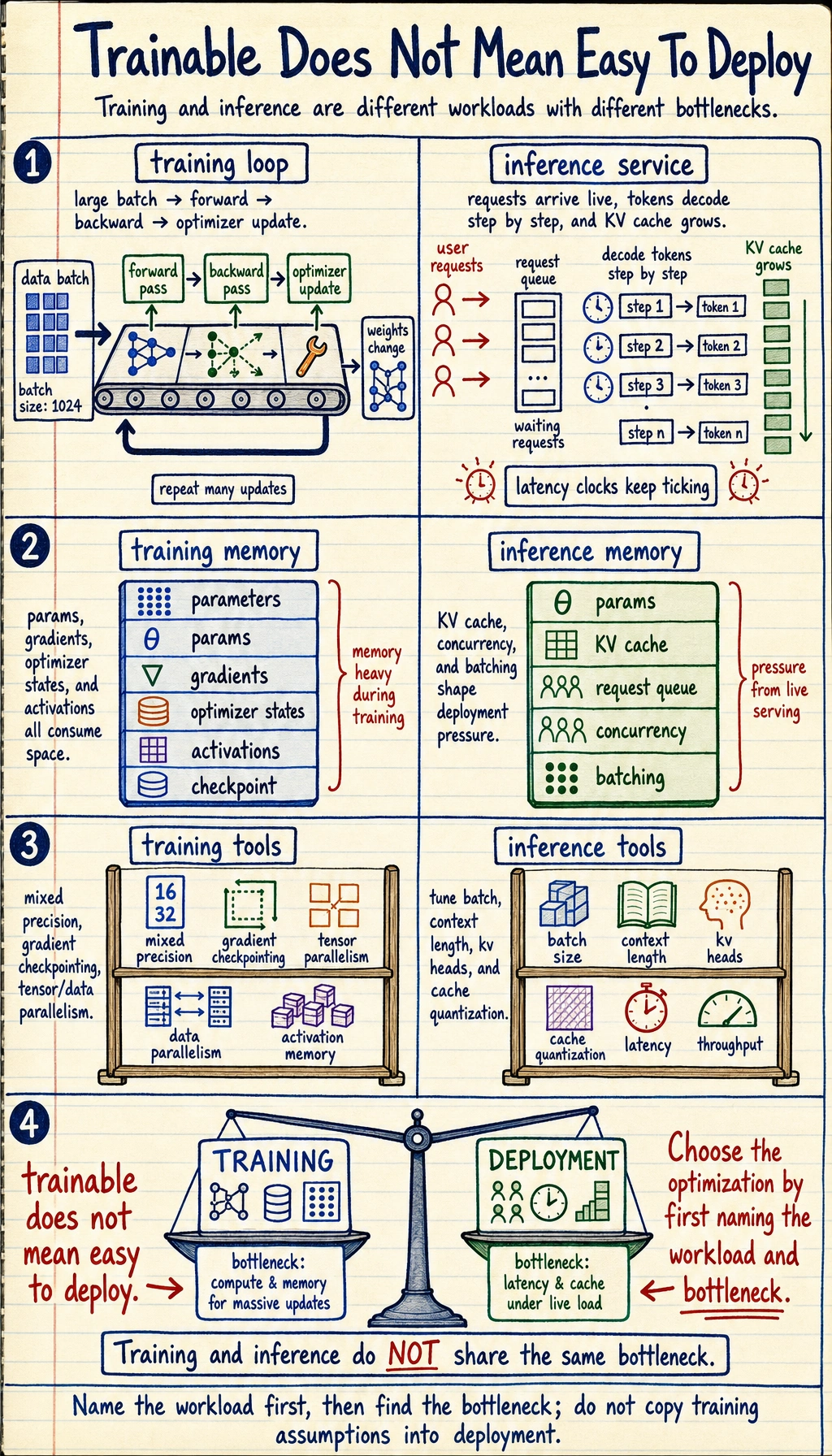
Section titled “Why does “the model can be trained” not mean “it is easy to deploy”?”Because training and inference are fundamentally different workloads.
Training is more like:
- large batches, continuous updates, throughput first
Inference is more like:
- real-time responses, cache accumulation, latency sensitive
That is why some model training setups are feasible, but deployment is still extremely painful.
Scaling Is Not About Bigger Is Better, but About Bigger Is More Expensive
Section titled “Scaling Is Not About Bigger Is Better, but About Bigger Is More Expensive”Parameter growth creates opportunities for capability, not free performance
Section titled “Parameter growth creates opportunities for capability, not free performance”More parameters usually bring a higher expressive ceiling, but only if you also have:
- enough data
- enough training tokens
- enough compute
Otherwise, the model is just “bigger,” not necessarily “more worthwhile.”
Longer context is not free either
Section titled “Longer context is not free either”Increasing context length brings:
- more usable information
But it also brings:
- higher attention cost
- larger KV cache
- harder long-range information utilization
So “supports 128k” does not mean “all 128k are necessarily useful.”
Three common real-world problems when scaling up
Section titled “Three common real-world problems when scaling up”- Training cost rises sharply
- Inference service cost increases at the same time
- If data and training tokens are insufficient, marginal gains decline
So the essence of scaling is:
- finding a balance among capability, cost, and data
A Very Practical Decision Order
Section titled “A Very Practical Decision Order”If you are stuck on the training side
Section titled “If you are stuck on the training side”First check:
- Is hidden size too aggressive?
- Are batch size and seq_len too high?
- Are intermediate activations the main bottleneck?
If you are stuck on the inference side
Section titled “If you are stuck on the inference side”First check:
- context length
- concurrency
- KV cache size
- whether you can use GQA / MQA / cache quantization
If you are planning model scale
Section titled “If you are planning model scale”First ask:
- Can my data scale support it?
- Can my training budget handle it?
- Can I afford the inference cost after launch?
If you do not think about these three together, model planning easily turns into the illusion that “bigger is always better.”
Evidence to Keep
Section titled “Evidence to Keep”Keep this page’s proof of learning as a small evidence card:
- Params
- rough parameter estimate and major contributors
- Training Cost
- forward + backward + optimizer state
- Inference Cost
- prefill, decode, KV cache, output length
- Bottleneck
- memory, latency, throughput, or quality
- Decision
- choose smaller model, quantization, batching, or retrieval by evidence
Common Misconceptions
Section titled “Common Misconceptions”Misconception 1: If the parameter count is large, the result must be good
Section titled “Misconception 1: If the parameter count is large, the result must be good”Not necessarily. Parameter count is only capacity, not automatically realized performance.
Misconception 2: Inference cost depends only on parameter count
Section titled “Misconception 2: Inference cost depends only on parameter count”Wrong. Context length and KV cache are often just as important.
Misconception 3: Training memory and inference memory are the same thing
Section titled “Misconception 3: Training memory and inference memory are the same thing”No. Their memory composition and bottlenecks are different.
Summary
Section titled “Summary”The most important thing in this lesson is not to memorize how many B some model has, but to build a more realistic language:
Model scale = parameter capacity, while computational cost is determined together by parameters, layers, hidden size, context length, KV cache, batch size, and engineering implementation.
Once you can look at all these factors together, you will truly gain an engineering intuition for why large models are expensive, where that expense comes from, and how to control it.
Exercises
Section titled “Exercises”- Change
seq_lenin the example from4096to16384, and observe how KV cache usage changes. - Why is hidden size often more “expensive” than many people expect?
- Explain in your own words: why does a model being trainable not mean deployment will be easy?
- If you want to build a long-context chat service, besides parameter count, what metrics would you care about first?
Reference implementation and walkthrough
- KV cache grows roughly linearly with sequence length, layers, batch size, and key-value head dimensions. Moving from
4096to16384multiplies the sequence-length part by about four. - Hidden size affects projection matrices, FFN width, activation memory, and attention dimensions. Increasing it can raise both parameter count and per-token compute in several places at once.
- Training can be done offline with planned batches and recovery windows. Deployment must handle latency, concurrency, memory limits, context growth, and user traffic spikes.
- First check latency, throughput, KV cache memory per request, maximum concurrent sessions, prefill/decode speed, context retention quality, and cost per useful answer.