
7.4.3 Pretraining Methods
Learning Objectives
Section titled “Learning Objectives”- Understand what abilities different pretraining objectives teach the model
- Distinguish the core differences among Causal LM, Masked LM, and Span Corruption
- Use a runnable example to see how the same text can be turned into different training samples
- Build intuition for why “task objective” and “downstream ability” are so strongly related
First, Build a Map
Section titled “First, Build a Map”Pretraining methods are easier to understand if we think in terms of “what the model practices every day”:
flowchart LR A["Causal LM"] --> B["Practice continuation and generation"] C["Masked LM"] --> D["Practice filling blanks and bidirectional understanding"] E["Span Corruption"] --> F["Practice recovering spans and text transformation"]So what this lesson is really trying to answer is:
- Why does the ability profile differ even though all of them are pretraining?
- Why does how we construct training labels directly affect what the model becomes good at later?
Why Does the Pretraining Objective Decide the Model’s Path?
Section titled “Why Does the Pretraining Objective Decide the Model’s Path?”Because the model will preferentially learn what it is repeatedly asked to do in training
Section titled “Because the model will preferentially learn what it is repeatedly asked to do in training”If training keeps asking the model to:
- predict the next token from the previous text
then it will naturally become better at:
- continuation
- generation
If training keeps asking the model to:
- recover masked tokens from left and right context
then it will more easily learn:
- bidirectional understanding
- semantic completion
So the pretraining objective is not just a surface-level task; it is the steering wheel for the model’s abilities.
An analogy: Training tasks shape system behavior
Section titled “An analogy: Training tasks shape system behavior”Think of the objective as the test harness that keeps exercising the model.
- If the harness always hides tokens, the model practices reconstruction
- If the harness always asks for continuation, the model practices next-token prediction
- If the harness always gives an input and expected output, the model practices input-to-output mapping
Models are the same.
A more beginner-friendly overall analogy
Section titled “A more beginner-friendly overall analogy”You can think of the pretraining objective as:
- deciding what kind of questions the model practices every day
If it practices:
- continuation questions
it will naturally become more like a generative model. If it practices:
- fill-in-the-blank questions
it will more easily become an understanding-oriented model. If it practices:
- recovery questions with an entire missing span
it will more easily learn the mapping from input to output.
The Three Most Important Pretraining Routes
Section titled “The Three Most Important Pretraining Routes”Causal Language Modeling: Predict the Future from the Past
Section titled “Causal Language Modeling: Predict the Future from the Past”This is the classic objective in the GPT family.
The form is simple:
- input the previous tokens
- predict the next token
Its advantage is:
- the training objective is naturally aligned with generation
In other words, during training the model cannot see the future, and during inference the model also cannot see the future, so there is no mismatch.
Masked Language Modeling: Fill in the Blanks from Context
Section titled “Masked Language Modeling: Fill in the Blanks from Context”This is the classic objective in the BERT family.
The method is:
- mask out some tokens in the input
- let the model recover them from left and right context
This objective is very suitable for bidirectional modeling, so it is especially good at:
- understanding
- representation learning
- classification and extraction tasks
But it is not as naturally suited to free-form generation as Causal LM.
Span Corruption / Denoising: Not Masking One Word, but an Entire Span
Section titled “Span Corruption / Denoising: Not Masking One Word, but an Entire Span”T5 / BART-style models often use a more general denoising objective:
- instead of masking a single token
- mask an entire span
- then let the model reconstruct that content
This is closer to:
- summarization
- paraphrasing
- translation
- text-to-text transformation
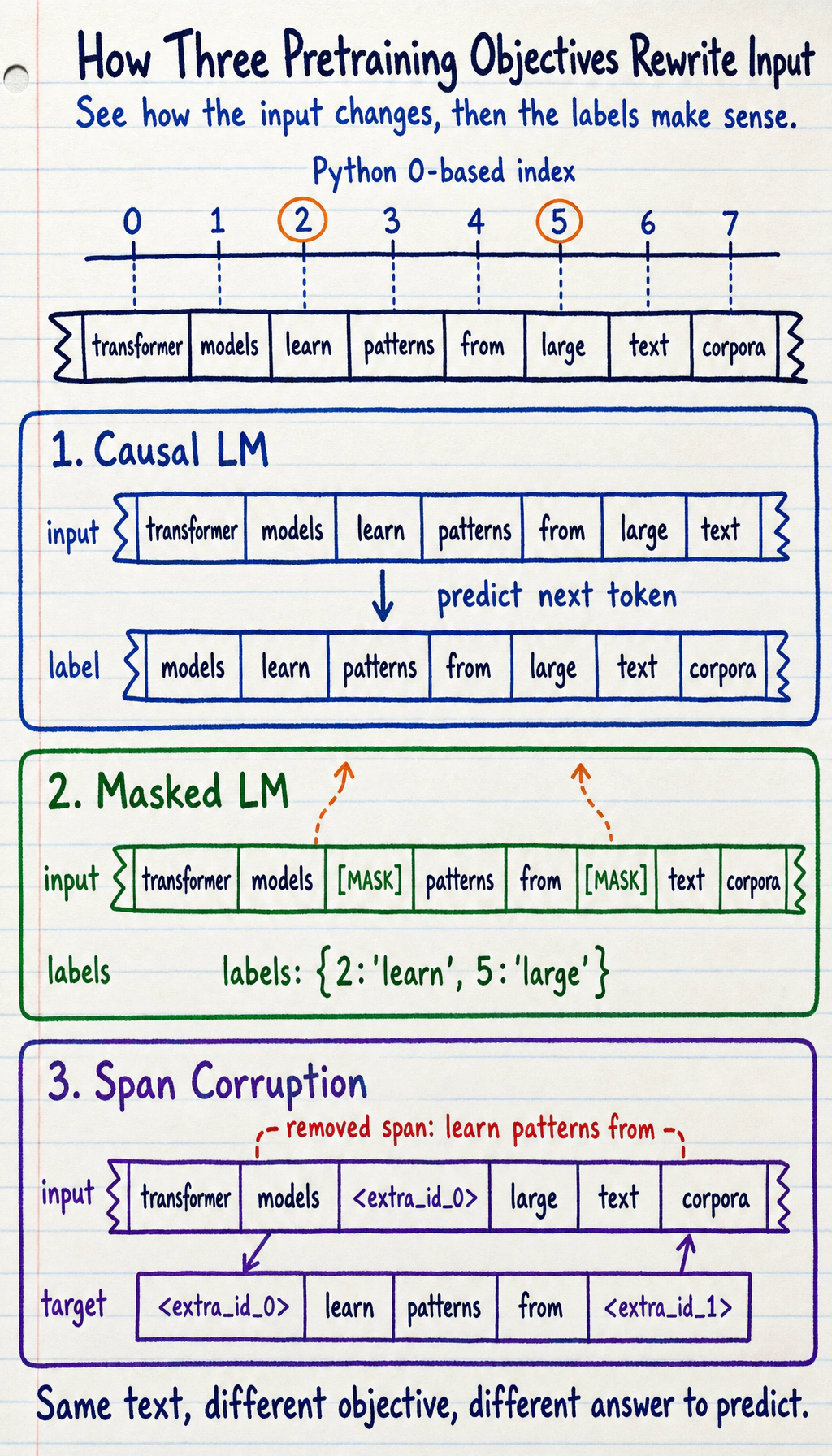
First, Construct Three Training Samples from the Same Text
Section titled “First, Construct Three Training Samples from the Same Text”The goal of this code is very direct:
- take the same sentence
- generate Causal LM, Masked LM, and Span Corruption training samples respectively
This lets you see very clearly:
- what “different objectives” actually means
tokens = "transformer models learn patterns from large text corpora".split()

def build_causal_example(tokens):    inputs = tokens[:-1]    labels = tokens[1:]    return inputs, labels

def build_masked_example(tokens, mask_positions):    masked = tokens[:]    labels = {}    for pos in mask_positions:        labels[pos] = masked[pos]        masked[pos] = "[MASK]"    return masked, labels

def build_span_corruption(tokens, start, end):    corrupted_input = tokens[:start] + ["<extra_id_0>"] + tokens[end:]    target = ["<extra_id_0>"] + tokens[start:end] + ["<extra_id_1>"]    return corrupted_input, target

causal_inputs, causal_labels = build_causal_example(tokens)masked_inputs, masked_labels = build_masked_example(tokens, mask_positions=[2, 5])span_inputs, span_target = build_span_corruption(tokens, start=2, end=5)
print("causal inputs :", causal_inputs)print("causal labels :", causal_labels)print()print("masked inputs :", masked_inputs)print("masked labels :", masked_labels)print()print("span inputs   :", span_inputs)print("span target   :", span_target)
Expected output:
causal inputs : ['transformer', 'models', 'learn', 'patterns', 'from', 'large', 'text']causal labels : ['models', 'learn', 'patterns', 'from', 'large', 'text', 'corpora']
masked inputs : ['transformer', 'models', '[MASK]', 'patterns', 'from', '[MASK]', 'text', 'corpora']masked labels : {2: 'learn', 5: 'large'}
span inputs   : ['transformer', 'models', '<extra_id_0>', 'large', 'text', 'corpora']span target   : ['<extra_id_0>', 'learn', 'patterns', 'from', '<extra_id_1>']
What should you look at most in this code?
Section titled “What should you look at most in this code?”Focus on these three things first:
- What the input has been turned into
- What the labels are asking the model to learn
- Why the same sentence can be organized into completely different training tasks
If you understand this point, you will understand why:
- GPT, BERT, and T5 end up with different capability profiles
Why Are Causal LM Labels Shifted by One Position?
Section titled “Why Are Causal LM Labels Shifted by One Position?”Because what it is doing is:
- given the previous text, guess the next token
So the most natural way to organize the training data is:
- input:
x_1 ... x_{t-1} - labels:
x_2 ... x_t
Why Is Span Corruption Often Considered More “General”?
Section titled “Why Is Span Corruption Often Considered More “General”?”Because it is closer to real text transformation than single-token masking. The model is not just recovering one word, but restoring an entire missing span.
This makes it naturally move toward:
- text-to-text
That is also a very important reason behind the T5 route.
A Minimal Comparison Table for the Same Sentence and Three Training Objectives
Section titled “A Minimal Comparison Table for the Same Sentence and Three Training Objectives”| Method | Input | Label | First intuition |
|---|---|---|---|
| Causal LM | Sees the previous text | Predicts the next token | More like continuation |
| Masked LM | Has blanks in the middle | Restores masked tokens | More like fill-in-the-blank |
| Span Corruption | Deletes an entire span | Restores the whole span | More like text repair / paraphrasing |
This table is especially useful for beginners because it puts:
- the name
- the input format
- the label format
- the final capability tendency
into one view.
What Is Each Objective Better At?
Section titled “What Is Each Objective Better At?”Causal LM: Generation, Continuation, Dialogue
Section titled “Causal LM: Generation, Continuation, Dialogue”This type of objective is highly aligned with downstream generation tasks, so it is especially suitable for:
- chat
- writing
- code completion
- long-text continuation
Masked LM: Representation Learning and Understanding
Section titled “Masked LM: Representation Learning and Understanding”Because the model can see both left and right context, it is very suitable for:
- classification
- retrieval encoding
- semantic matching
- extraction tasks
Span Corruption: Input-to-Output Mapping
Section titled “Span Corruption: Input-to-Output Mapping”If you want the model to naturally do:
- summarization
- paraphrasing
- translation
- question answering generation
then this kind of denoising and seq2seq objective will feel much more natural.
A Safe Default Sequence for First-Time Learners
Section titled “A Safe Default Sequence for First-Time Learners”A good order is usually:
- Don’t rush to memorize the abbreviations
- First look at how the input is transformed
- Then look at what the labels ask the model to learn
- Finally, see how the training objective relates to downstream tasks
This is much easier than memorizing:
- CLM
- MLM
- span corruption
right away.
Pretraining Objectives Do Not Exist Alone; They Are Bound to the Architecture
Section titled “Pretraining Objectives Do Not Exist Alone; They Are Bound to the Architecture”Why Do Decoder-only Models Usually Use Causal LM?
Section titled “Why Do Decoder-only Models Usually Use Causal LM?”Because the two are perfectly aligned:
- a decoder can only look at the past
- Causal LM also requires looking only at the past
Training and generation form a very natural loop.
Why Do Encoder-only Models Usually Use Masked LM?
Section titled “Why Do Encoder-only Models Usually Use Masked LM?”Because encoders are good at bidirectional modeling. Since they can see the whole sentence, they are well suited for:
- recovering masked positions
Why Do Encoder-Decoder Models Usually Use Denoising Objectives?
Section titled “Why Do Encoder-Decoder Models Usually Use Denoising Objectives?”Because this structure is naturally suited to:
- taking one piece of text as input
- producing another piece of text as output
So span corruption, denoising, and text-to-text training all fit very well.
What Other Variants Are There Besides the Classic Objectives?
Section titled “What Other Variants Are There Besides the Classic Objectives?”Prefix LM: Partly Bidirectional, Partly Causal
Section titled “Prefix LM: Partly Bidirectional, Partly Causal”Some methods let the first part of the input be read bidirectionally, while the generated part still follows a causal constraint.
This kind of objective is suitable when you want both:
- understanding of context
- continuation generation
Multimodal Pretraining: The Input Is Not Just a String of Text
Section titled “Multimodal Pretraining: The Input Is Not Just a String of Text”If the input also includes:
- images
- audio
- video
then the objective may become:
- cross-modal alignment
- image-text generation
- multimodal understanding
Even though the form is more complex, the core idea is the same:
- the training objective decides what the model will prioritize learning
Self-Supervised Does Not Mean Completely “Bias-Free”
Section titled “Self-Supervised Does Not Mean Completely “Bias-Free””Even if the labels are automatically constructed, the objective function still imposes preferences on the model.
For example:
- more generation-oriented
- more understanding-oriented
- more structure-recovery-oriented
That is why the pretraining objective itself is a design choice.
The Most Common Mistakes
Section titled “The Most Common Mistakes”Mistake 1: The pretraining objective is just an early-stage detail, and fine-tuning will solve everything later
Section titled “Mistake 1: The pretraining objective is just an early-stage detail, and fine-tuning will solve everything later”Not true. The pretraining objective gives the model a long-term ability bias.
Mistake 2: Masked LM is more advanced than Causal LM, or vice versa
Section titled “Mistake 2: Masked LM is more advanced than Causal LM, or vice versa”There is no ranking relationship between them, only design choices for different paths.
Mistake 3: Remembering only the name without looking at what the labels look like
Section titled “Mistake 3: Remembering only the name without looking at what the labels look like”True understanding means:
- how the input is organized
- how the labels are constructed
- what the model is being asked to learn
If You Turn This into Notes or Slides, What Is Most Worth Showing?
Section titled “If You Turn This into Notes or Slides, What Is Most Worth Showing?”What is most worth showing is usually not:
- just listing the three abbreviations
Instead, show:
- The same sentence transformed into three training samples
- A comparison of the inputs and labels for the three methods
- What ability each objective tends to teach
- Why they correspond to GPT / BERT / T5
That way, people will more easily see:
- you understand how “training objectives shape abilities”
- not just the method names
Evidence to Keep
Section titled “Evidence to Keep”Keep this page’s proof of learning as a small evidence card:
- Objective
- causal LM, masked LM, or seq2seq objective
- Training Sample
- input and target constructed from same text
- Architecture Fit
- objective matched to encoder/decoder pattern
- Behavior Effect
- what the objective teaches the model to do
- Limitation
- pretraining objective is not the same as instruction following
Summary
Section titled “Summary”The most important thing in this section is not memorizing the abbreviations CLM / MLM / Span Corruption,
but grasping one main line:
A pretraining objective is essentially a rule for what the model practices over and over every day, and what the model ends up best at is usually the kind of ability it practiced most often.
Once this line is established, the architectural choices, fine-tuning methods, and task transfer in the following sections will make much more sense.
Exercises
Section titled “Exercises”- Replace the sentence in the example with one of your own, and generate the three training samples again.
- Explain in your own words: why is Causal LM more suitable for open-ended generation?
- Why is Masked LM more like a “fill-in-the-blank” task than a “continuation” task?
- Think about this: if your goal is to build a strong summarization model, which type of pretraining objective would you prefer? Why?
Reference implementation and walkthrough
- A good answer should show that the same text can become different training signals: next-token prediction for Causal LM, masked-token recovery for Masked LM, and input-to-output reconstruction for sequence-to-sequence objectives.
- Causal LM trains the model to continue a prefix token by token. That matches open-ended generation, chat, code completion, and other tasks where the output is produced left to right.
- Masked LM sees surrounding context and predicts hidden pieces inside the sequence. It is therefore closer to solving blanks than to generating an unknown continuation.
- For summarization, sequence-to-sequence denoising or encoder-decoder-style objectives are often a natural fit because they train a model to read an input and produce a compressed output. Causal LM can still summarize, especially after instruction tuning, but the objective is less directly matched.