
8.3.3 LangChain Basics
Learning Objectives
Section titled “Learning Objectives”- Understand why a chain-style abstraction naturally appears
- Read where Prompt, model, parser, and retriever sit in the chain
- Use a minimal example to understand the core idea of “feeding the previous output into the next step”
- Understand why it is especially suitable for prototypes and linear workflows
First, Build a Map
Section titled “First, Build a Map”For beginners, the best way to understand this section is not “learn the framework API first,” but to first see clearly:
flowchart LR A["Real applications do more than one model call"] --> B["Break it into multiple small steps"] B --> C["Each step has clear input and output"] C --> D["Then connect them in order"]So what this section is really trying to explain is:
- Why chain abstractions naturally appear
- What they are actually organizing for you
Why Do We Need a “Chain” Abstraction?
Section titled “Why Do We Need a “Chain” Abstraction?”Because real applications usually need more than one model call
Section titled “Because real applications usually need more than one model call”For example, if you want to build a small question-answering system, you may already need these steps:
- Clean the user query
- Retrieve documents
- Build the prompt
- Call the model
- Format the output
If you write everything by hand in one function, it can still work, but it quickly becomes:
- unclear
- hard to reuse
- hard to debug
What does a chain abstraction actually do?
Section titled “What does a chain abstraction actually do?”It says:
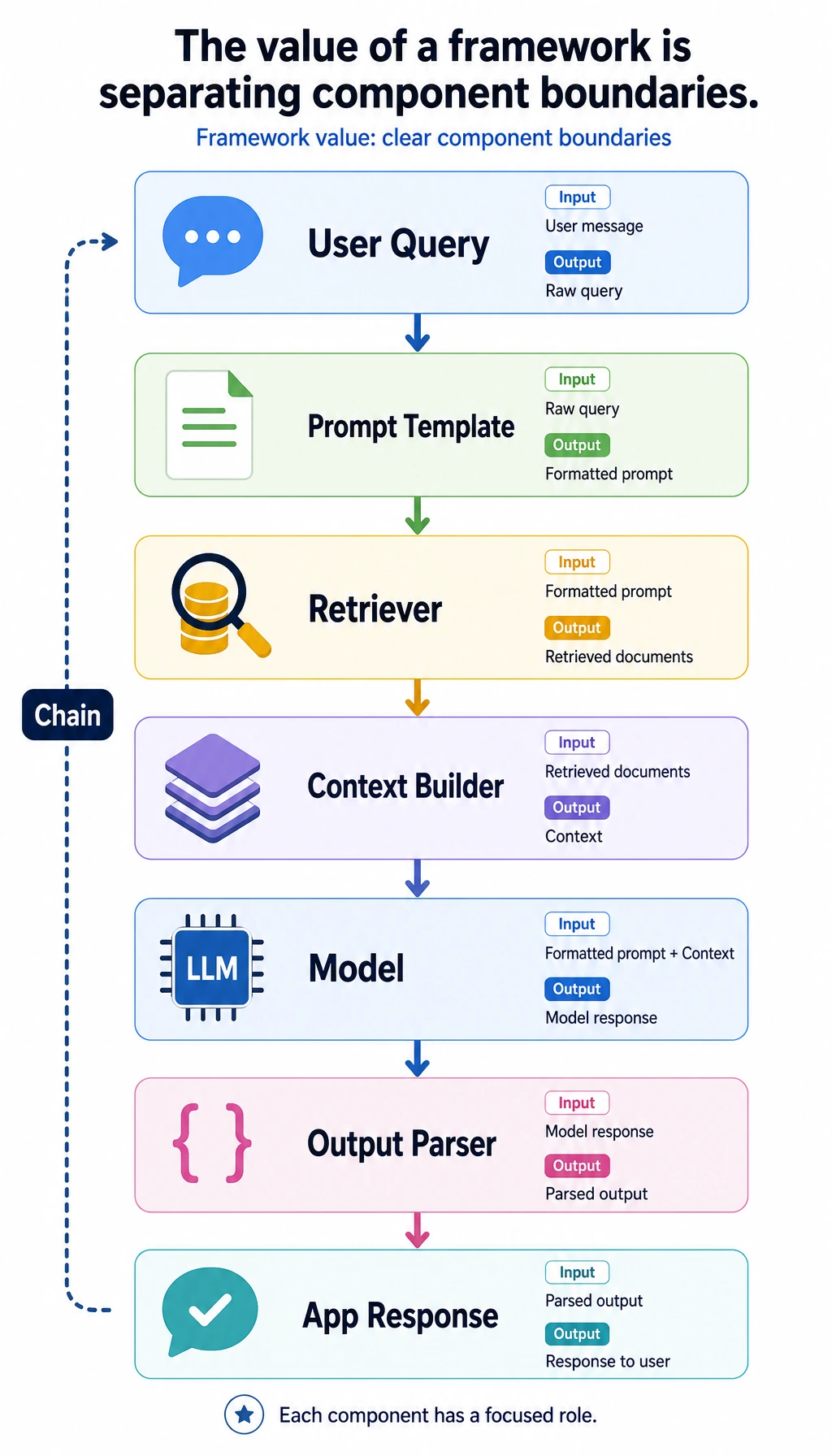
Turn each step into a small component with a clear responsibility, then connect them in order.
That is the core LangChain feeling.
A Minimal Chain Example
Section titled “A Minimal Chain Example”class SimpleChain: def __init__(self, steps): self.steps = steps
def run(self, value): for step in self.steps: value = step(value) return value
def normalize_query(text): return text.strip().lower()
def retrieve_docs(query): if "refund" in query: return {"query": query, "docs": ["Courses can be refunded within 7 days after purchase."]} return {"query": query, "docs": []}
def format_answer(payload): if payload["docs"]: return f"According to the materials: {payload['docs'][0]}" return "No relevant information found."
chain = SimpleChain([ normalize_query, retrieve_docs, format_answer])
print(chain.run(" What is the refund policy? "))Expected output:
According to the materials: Courses can be refunded within 7 days after purchase.What is this code teaching?
Section titled “What is this code teaching?”It is already teaching you the most important thing in LangChain:
Each step only cares about its own input and output, and the whole system completes the task by chaining them together.
That is the core value of chain-based applications.
What Role Does Prompt Play in the Chain?
Section titled “What Role Does Prompt Play in the Chain?”Prompt is not “extra copy”; it is a component
Section titled “Prompt is not “extra copy”; it is a component”In many pipelines, Prompt itself is one of the intermediate steps:
- take the query
- generate a clearer prompt template
A simple example
Section titled “A simple example”def build_prompt(payload): docs = payload["docs"] query = payload["query"] return f"Please answer the question based on the following materials: materials={docs}, question={query}"
payload = {"query": "What is the refund policy", "docs": ["Courses can be refunded within 7 days after purchase."]}print(build_prompt(payload))Expected output:
Please answer the question based on the following materials: materials=['Courses can be refunded within 7 days after purchase.'], question=What is the refund policyThis example is reminding you that:
Prompt can also be viewed as an intermediate transformation node in the chain.
Add a “Model” Step
Section titled “Add a “Model” Step”To keep the example runnable offline, we will continue using a mock model.
def mock_llm(prompt):    return f"Model output: {prompt}"
chain = SimpleChain([    normalize_query,    retrieve_docs,    build_prompt,    mock_llm])
print(chain.run("What is the refund policy?"))
Expected output:
Model output: Please answer the question based on the following materials: materials=['Courses can be refunded within 7 days after purchase.'], question=what is the refund policy?The key takeaway from this step
Section titled “The key takeaway from this step”You will start to see that:
- retriever
- prompt builder
- model
are all just different nodes in the chain.
This is also why LangChain feels like a “component assembly framework.”
Why Does the Output Parser Also Matter?
Section titled “Why Does the Output Parser Also Matter?”Many people only focus on the input prompt and the model output, while ignoring this:
After the model outputs text, the system often still needs to perform structured processing.
For example:
- keep only part of the fields
- convert to JSON
- map to a front-end display format
A Minimal Example
Section titled “A Minimal Example”def output_parser(text): return { "answer": text.replace("Model output: ", ""), "ok": True }
chain = SimpleChain([ normalize_query, retrieve_docs, build_prompt, mock_llm, output_parser])
print(chain.run("What is the refund policy?"))Expected output:
{'answer': "Please answer the question based on the following materials: materials=['Courses can be refunded within 7 days after purchase.'], question=what is the refund policy?", 'ok': True}This step helps you more clearly realize that:
The real value of LangChain often lies in “making the boundaries between different components clear.”
Why Is It Especially Good for Prototyping?
Section titled “Why Is It Especially Good for Prototyping?”Because many early-stage LLM applications are very similar:
- a fairly linear flow
- several components executed one after another
For example:
- clean the query
- retrieve
- build the prompt
- call the model
- parse the result
This is exactly the kind of scenario where a chain abstraction feels most natural.
When Does It Start to Strain?
Section titled “When Does It Start to Strain?”If your workflow starts to become:
- if retrieval fails, rewrite the query and search again
- if the answer is not stable enough, ask a reviewer to check it
- some requests should use tools, others should not
In this case, a “single straight chain” becomes more and more awkward.
In other words:
When the system starts to have obvious state branches and loops, chain abstraction may no longer be enough.
That is also why frameworks like LangGraph are needed later on.
A Very Important Engineering Reminder
Section titled “A Very Important Engineering Reminder”The most common mistake people make when learning LangChain is:
- memorizing a bunch of class names and interfaces from the start
But a more stable approach is usually:
- First understand what problem chain abstraction is solving
- Then look at the specific API
Otherwise, it is easy to end up with:
- knowing how to write framework code
- but not knowing why it is organized that way
The Most Stable Way for Beginners to Use LangChain for the First Time
Section titled “The Most Stable Way for Beginners to Use LangChain for the First Time”A more reliable sequence is usually:
- Start with only one linear workflow
- Print the input and output of each node clearly
- Then add retrieval, parsers, and more complex components
- Only then consider more complex graph-style workflows
Evidence to Keep
Section titled “Evidence to Keep”Keep this page’s proof of learning as a small evidence card:
- Request
- input, state, tools/context, and expected output contract
- Validated Output
- parser/schema or business-rule check result
- Trace
- model call, tool/function call, document parse, or dialogue state
- Failure Check
- invalid format, missing field, stale state, or wrong tool
- Next Action
- prompt, schema, state, API, or parsing improvement
Summary
Section titled “Summary”The most important thing in this section is not remembering a specific class, but understanding this:
The core value of LangChain is organizing high-frequency components like prompt, retrieval, model, and parsing into a clearer linear workflow.
Once this chain mindset is in place, reading real framework APIs later will feel much smoother.
What Should You Take Away from This Section?
Section titled “What Should You Take Away from This Section?”- LangChain is not replacing the model; it is organizing multi-step applications
- Understanding the chain first, then learning the framework, is more stable than memorizing APIs directly
- It is especially suitable for prototypes and linear workflows, but it is not the end point for every complex system
Exercises
Section titled “Exercises”- Add one more step to this
SimpleChainto rewrite the query so it is better suited for retrieval. - Explain in your own words: why can Prompt also be seen as a component in the chain?
- Think about it: when a workflow starts to have complex branches, why does chain abstraction become strained?
- Explain in your own words: what kind of problem shape is LangChain best suited to solve?
Reference implementation and walkthrough
- The rewrite step can normalize synonyms and produce a retrieval-focused query while preserving the original intent.
- Prompt is a component because it transforms inputs into instructions and constrains the output shape.
- Chains become strained when branching, retries, stateful decisions, and tool loops dominate the workflow.
- LangChain fits composed LLM workflows with reusable prompts, retrievers, tools, and parsers, especially when the flow is mostly predictable.