
6.3.4 Classic CNN Architectures
Learning Objectives
Section titled “Learning Objectives”- Explain what LeNet, AlexNet, VGG, and ResNet each contributed.
- Read classic architectures by asking “what problem did this design solve?”
- Compare large kernels with stacked small kernels.
- Implement a minimal residual block.
- Decide what ideas still matter in modern CNN practice.
See the Evolution First
Section titled “See the Evolution First”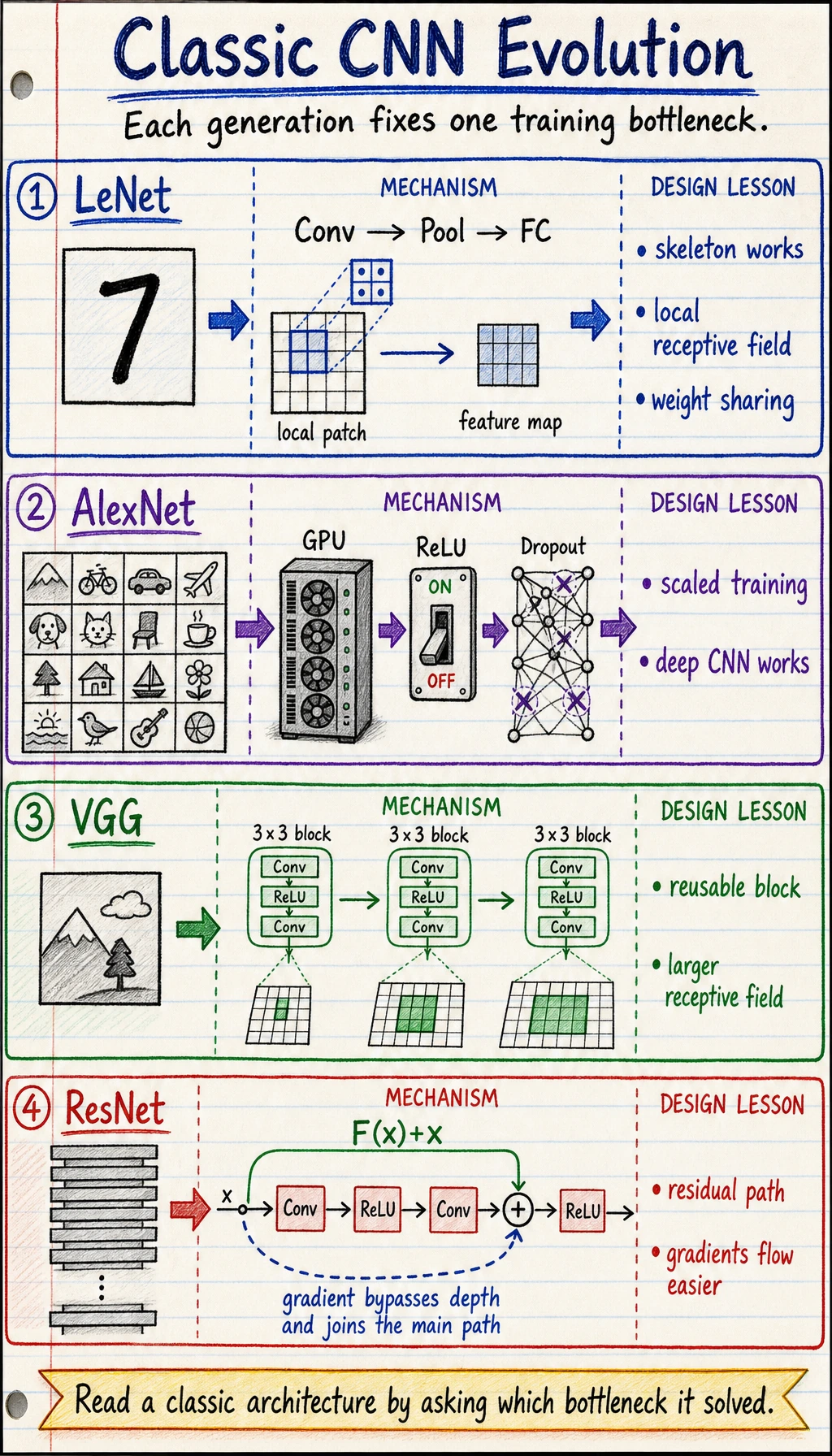
Read the timeline like this:
| Architecture | What to remember | Main lesson |
|---|---|---|
| LeNet | early CNN skeleton | conv and pooling can recognize images |
| AlexNet | scale plus GPU training | deeper CNNs work when data, compute, and training tricks align |
| VGG | repeated 3 x 3 blocks | small kernels can build large receptive fields cleanly |
| ResNet | residual paths | very deep networks need easier gradient and information flow |
The point is not to copy these models exactly today. The point is to inherit the design questions they answered.
LeNet: The CNN Skeleton
Section titled “LeNet: The CNN Skeleton”LeNet is old, but the skeleton is still familiar:
It taught three durable ideas:
- do not flatten images before extracting local patterns;
- use pooling to compress local responses;
- let later layers classify using higher-level features.
If you understand LeNet, you understand the minimum structure behind many image classifiers.
AlexNet: Scale Made CNNs Convincing
Section titled “AlexNet: Scale Made CNNs Convincing”AlexNet mattered because it combined several forces at once:
- larger dataset;
- deeper CNN;
- GPU training;
- ReLU for faster optimization;
- Dropout for regularization.
Its lesson is practical: architecture alone rarely wins. Data, compute, training stability, and regularization all have to fit together.
For an experienced reader, this is the first systems lesson in CNN history: model quality is a stack, not a single clever layer.
VGG: Small Kernels, Repeated Blocks
Section titled “VGG: Small Kernels, Repeated Blocks”VGG made a simple recipe popular:
Why stack small kernels instead of using one large kernel?
- stacked layers grow receptive field;
- each layer adds another nonlinearity;
- parameters can be more controlled;
- repeated blocks are easy to read and reproduce.
Lab 1: Compare Kernel Parameter Counts
Section titled “Lab 1: Compare Kernel Parameter Counts”This comparison is not the whole story, but it gives a useful intuition.
from torch import nn

def count_params(module):    return sum(p.numel() for p in module.parameters() if p.requires_grad)

one_large_kernel = nn.Conv2d(16, 16, kernel_size=7, padding=3)three_small_kernels = nn.Sequential(    nn.Conv2d(16, 16, kernel_size=3, padding=1),    nn.ReLU(),    nn.Conv2d(16, 16, kernel_size=3, padding=1),    nn.ReLU(),    nn.Conv2d(16, 16, kernel_size=3, padding=1),)
print("kernel_param_lab")print("one 7x7 conv :", count_params(one_large_kernel))print("three 3x3 conv:", count_params(three_small_kernels))
Expected output:
kernel_param_labone 7x7 conv : 12560three 3x3 conv: 6960The stacked 3 x 3 version has fewer parameters in this setup and adds nonlinear steps between convolutions. That is why VGG-style thinking became such a clean baseline.
Lab 2: Run a VGG-Style Block
Section titled “Lab 2: Run a VGG-Style Block”import torchfrom torch import nn
vgg_block = nn.Sequential( nn.Conv2d(3, 16, kernel_size=3, padding=1), nn.ReLU(), nn.Conv2d(16, 16, kernel_size=3, padding=1), nn.ReLU(), nn.MaxPool2d(2),)
x = torch.randn(2, 3, 32, 32)y = vgg_block(x)
print("vgg_block_lab")print("input:", tuple(x.shape))print("output:", tuple(y.shape))Expected output:
vgg_block_labinput: (2, 3, 32, 32)output: (2, 16, 16, 16)Read it as:
- two
3 x 3convolutions refine features; - pooling halves height and width;
- output channels become
16.
ResNet: Making Depth Trainable
Section titled “ResNet: Making Depth Trainable”A deeper network should be more expressive, but it can become harder to optimize. ResNet’s key idea is the residual connection:
output = learned_change(x) + xInstead of forcing every block to learn a completely new representation, the block can learn a change on top of the input. If the block is not useful yet, the shortcut still carries information forward.
Lab 3: Implement a Residual Block
Section titled “Lab 3: Implement a Residual Block”import torchfrom torch import nn
class ResidualBlock(nn.Module): def __init__(self, channels): super().__init__() self.conv1 = nn.Conv2d(channels, channels, kernel_size=3, padding=1) self.relu = nn.ReLU() self.conv2 = nn.Conv2d(channels, channels, kernel_size=3, padding=1)
def forward(self, x): identity = x out = self.relu(self.conv1(x)) out = self.conv2(out) out = out + identity return self.relu(out)
block = ResidualBlock(8)x = torch.randn(2, 8, 16, 16)y = block(x)
print("residual_block_lab")print("input:", tuple(x.shape))print("output:", tuple(y.shape))Expected output:
residual_block_labinput: (2, 8, 16, 16)output: (2, 8, 16, 16)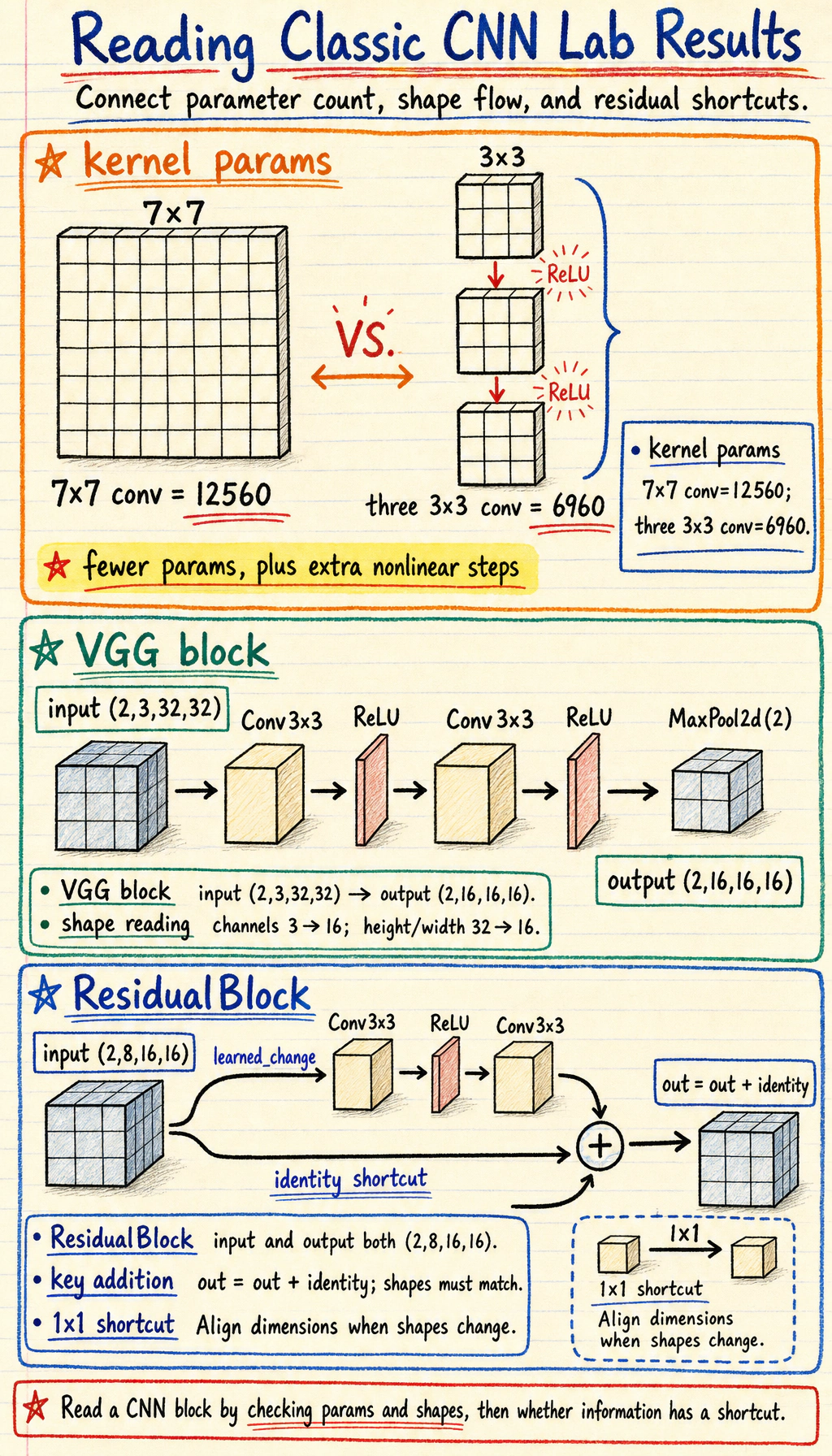
The most important line is:
out = out + identityThat addition is element-wise, so the shapes must match. Real ResNet variants use a 1 x 1 convolution in the shortcut when channel count or spatial size changes.
How to Read an Architecture Diagram
Section titled “How to Read an Architecture Diagram”When you see a new CNN architecture, ask these questions:
| Question | Why it matters |
|---|---|
| How does the first stage reduce spatial size? | too much early compression loses detail |
| Where do channels increase? | channels store feature diversity |
| Are blocks repeated? | repeated blocks make the architecture scalable |
| Is there a shortcut path? | shortcuts help optimization and information flow |
| How does the classifier head work? | Flatten and GAP have different parameter costs |
This is more useful than memorizing exact layer counts.
What Still Matters Today?
Section titled “What Still Matters Today?”You may not start a modern project from LeNet or AlexNet, but their ideas still show up:
- LeNet: the feature-extractor/classifier split;
- AlexNet: data, compute, activation, and regularization as a system;
- VGG: repeated simple blocks;
- ResNet: residual paths as a default design tool.
Modern CNN backbones and hybrid vision models still reuse these ideas, even when the names and blocks look newer.
Evidence to Keep
Section titled “Evidence to Keep”Make one architecture memory card:
- LeNet
- conv feature extractor + classifier head
- AlexNet
- scale, GPU, ReLU, regularization
- VGG
- repeated small 3x3 blocks
- ResNet
- shortcut path makes depth trainable
- Code Clue
- residual block uses out + identity
This is the level of history worth remembering for engineering. You do not need to memorize every layer count before you can read a modern backbone.
Common Mistakes
Section titled “Common Mistakes”| Mistake | Better view |
|---|---|
| memorizing model names | remember the bottleneck each model solved |
| thinking VGG is only “many layers” | its real lesson is repeated small-kernel blocks |
| thinking ResNet is only “very deep” | its real lesson is making depth trainable |
| copying classic models directly | usually start from a pretrained modern backbone |
| ignoring compute cost | architecture choice must fit data size and deployment limits |
Exercises
Section titled “Exercises”- Summarize LeNet, AlexNet, VGG, and ResNet in one sentence each.
- Change
ResidualBlock(8)toResidualBlock(16)and update the input tensor. - Remove one
3 x 3convolution from the VGG-style block. What changes and what stays the same? - Explain why
out + identityfails if channel counts differ. - Pick a modern CNN backbone and identify which classic ideas it still uses.
Reference implementation and walkthrough
- LeNet established the early CNN skeleton; AlexNet proved CNNs could scale; VGG made repeated small kernels systematic; ResNet made very deep networks easier to optimize.
- If the block uses
16channels, the input tensor must also have16channels or the block needs a projection layer to match dimensions. - Removing one
3 x 3convolution reduces depth, parameters, and nonlinear transformations. The output spatial size can stay the same if padding and stride are unchanged. out + identityis elementwise addition, so batch, channel, height, and width must match. Different channel counts require a projection such as1 x 1convolution.- Modern backbones still reuse classic ideas: local kernels, repeated blocks, normalization, residual paths, scaling depth/width, and compact classifier heads.
Key Takeaways
Section titled “Key Takeaways”- Classic CNNs are a design evolution, not a name list.
- LeNet gave the skeleton; AlexNet proved scale; VGG made repeated small blocks clean; ResNet made depth easier to train.
- Stacked small kernels can be parameter-efficient and expressive.
- Residual connections preserve information and improve optimization.
- The practical skill is reading the design motivation behind an architecture.