
E.A.4 Inference Engines
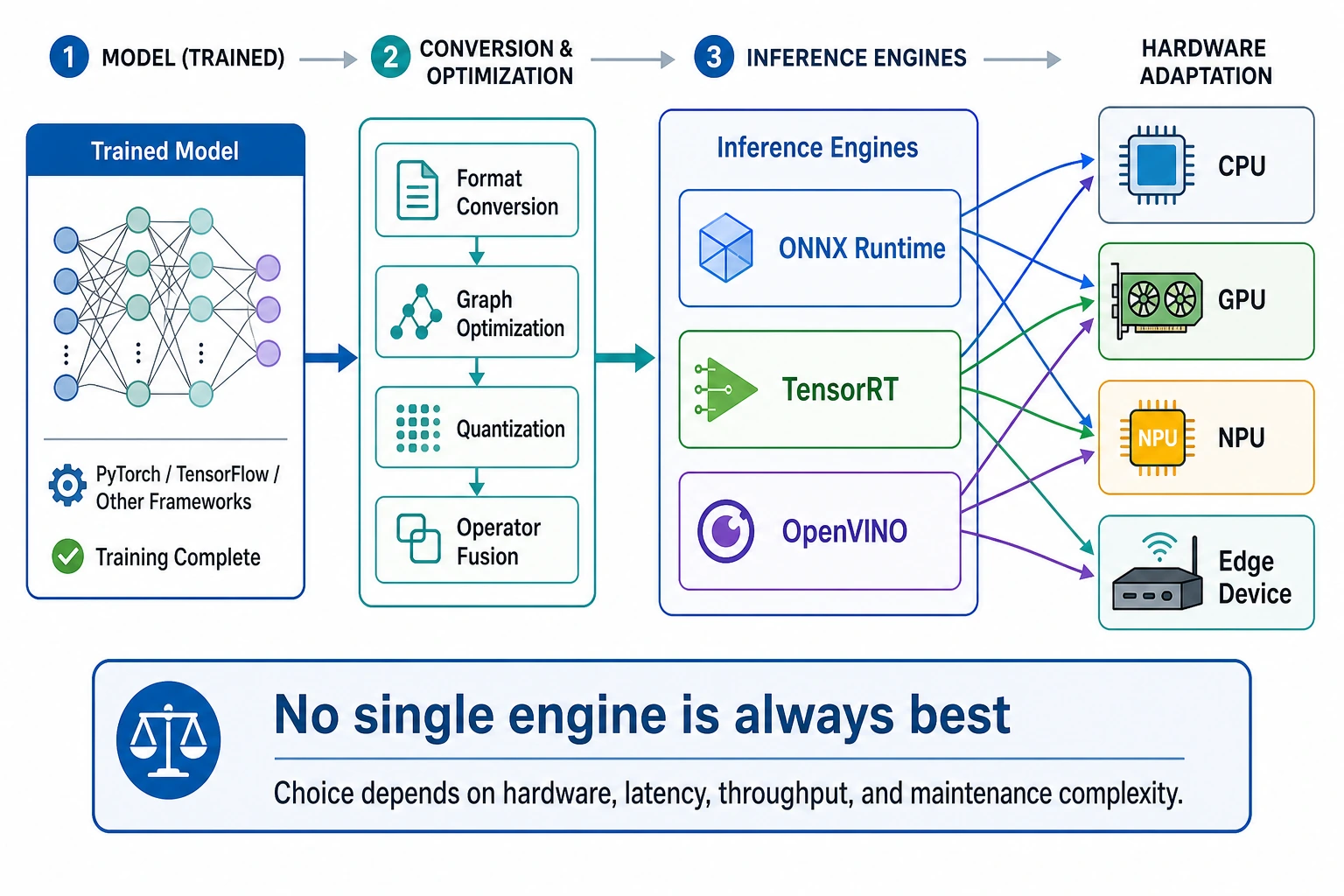
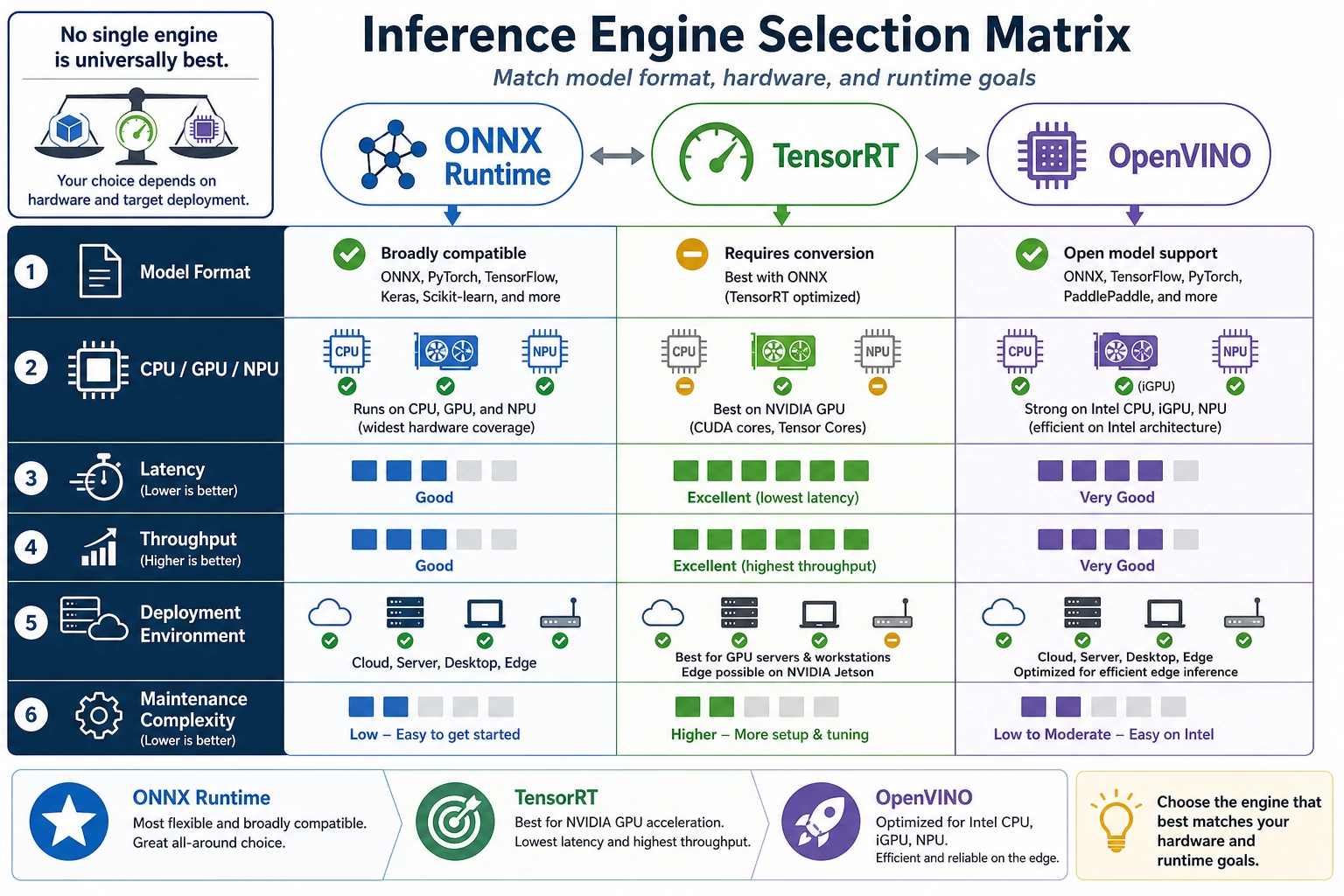
An inference engine is the runtime layer between a trained model and real hardware. The model says what to compute; the engine decides how to execute that graph efficiently on CPU, GPU, NPU, or edge hardware.
Use this lesson as a first selection drill. Do not memorize one engine as always best. Match the engine to the deployment constraint.
What You Need
Section titled “What You Need”- Python 3.10+
- No external packages
- Five minutes to run and edit the scoring script
Key Terms
Section titled “Key Terms”- Latency: how long one request waits for a result.
- Throughput: how many requests the system can finish per second.
- Backend: the hardware-specific execution path, such as CPU, CUDA, TensorRT, or OpenVINO.
- ONNX: a common model exchange format.
- Operator: one model graph operation, such as matrix multiplication, convolution, or normalization.
Run The Engine Selector
Section titled “Run The Engine Selector”Create engine_selector.py:
engines = [    {        "name": "ONNX Runtime",        "hardware": ["cpu", "nvidia"],        "formats": ["onnx"],        "latency": "medium",        "ops": "easy",    },    {        "name": "TensorRT",        "hardware": ["nvidia"],        "formats": ["onnx", "engine"],        "latency": "low",        "ops": "hard",    },    {        "name": "OpenVINO",        "hardware": ["cpu", "intel"],        "formats": ["onnx", "ir"],        "latency": "low",        "ops": "medium",    },]
need = {"hardware": "nvidia", "format": "onnx", "latency": "low"}
for engine in engines:    score = 0    score += 2 if need["hardware"] in engine["hardware"] else -3    score += 2 if need["format"] in engine["formats"] else -2    score += 1 if need["latency"] == engine["latency"] else 0    score -= 1 if engine["ops"] == "hard" else 0    engine["score"] = score
best = max(engines, key=lambda item: item["score"])
for engine in engines:    print(engine["name"], engine["score"])
print("selected:", best["name"])
Run it:
python engine_selector.pyExpected output:
ONNX Runtime 4TensorRT 4OpenVINO 0selected: ONNX RuntimeThe script gives ONNX Runtime and TensorRT the same score, then selects the first one. That is intentional: in real deployment, if a faster path adds extra operational cost, the simpler path can be the better first release.
Change One Constraint
Section titled “Change One Constraint”Now change:
need = {"hardware": "nvidia", "format": "onnx", "latency": "low"}print(need)Expected output for the first snippet:
{'hardware': 'nvidia', 'format': 'onnx', 'latency': 'low'}to:
need = {"hardware": "intel", "format": "onnx", "latency": "low"}print(need)Expected output for the second snippet:
{'hardware': 'intel', 'format': 'onnx', 'latency': 'low'}Run again. Expected result:
ONNX Runtime -1TensorRT -2OpenVINO 5selected: OpenVINOThis is the core idea: engine choice changes when hardware changes.
Practical Selection Rule
Section titled “Practical Selection Rule”Use this order before trying advanced tuning:
- Confirm the target hardware.
- Confirm the model format the engine can load.
- Check whether unsupported operators exist.
- Compare latency and throughput with the same input size.
- Choose the simplest engine that meets the target.
Evidence to Keep
Section titled “Evidence to Keep”Keep this page’s proof of learning as a small evidence card:
- Deployment Target
- local inference, edge device, model server, or optimization experiment
- Artifact
- C++ snippet, benchmark, model artifact, serving config, or deployment note
- Metric
- latency, memory, throughput, model size, accuracy drop, or reliability
- Failure Check
- ABI/build issue, hardware mismatch, quantization loss, or serving bottleneck
- Expected Output
- reproducible deployment or optimization evidence, not only theory notes
Common Mistakes
Section titled “Common Mistakes”- Choosing TensorRT only because it is fast, even when the team cannot maintain the engine build pipeline.
- Testing with a tiny input, then discovering production input is much slower.
- Forgetting unsupported operators until the final deployment week.
Practice
Section titled “Practice”Add a memory field to each engine and subtract one point if it uses more memory than your device allows. Then rerun the selector for CPU-only, NVIDIA GPU, and Intel device scenarios.
Reference implementation and walkthrough
A good answer adds memory as another hard constraint, not as a decorative column. For example, if a target device allows memory_limit=1024, an engine with memory=1800 should lose a point or be marked risky even if its latency score is strong.
Expected reasoning:
- CPU-only usually favors the engine that supports CPU well and stays within memory.
- NVIDIA GPU may favor TensorRT if format and operators fit.
- Intel hardware should usually push the selector toward OpenVINO.
- The final choice should mention both score and deployment risk, not just the fastest engine.