
11.5.5 CTC and Deep Speech: Sequence Alignment in Speech Recognition
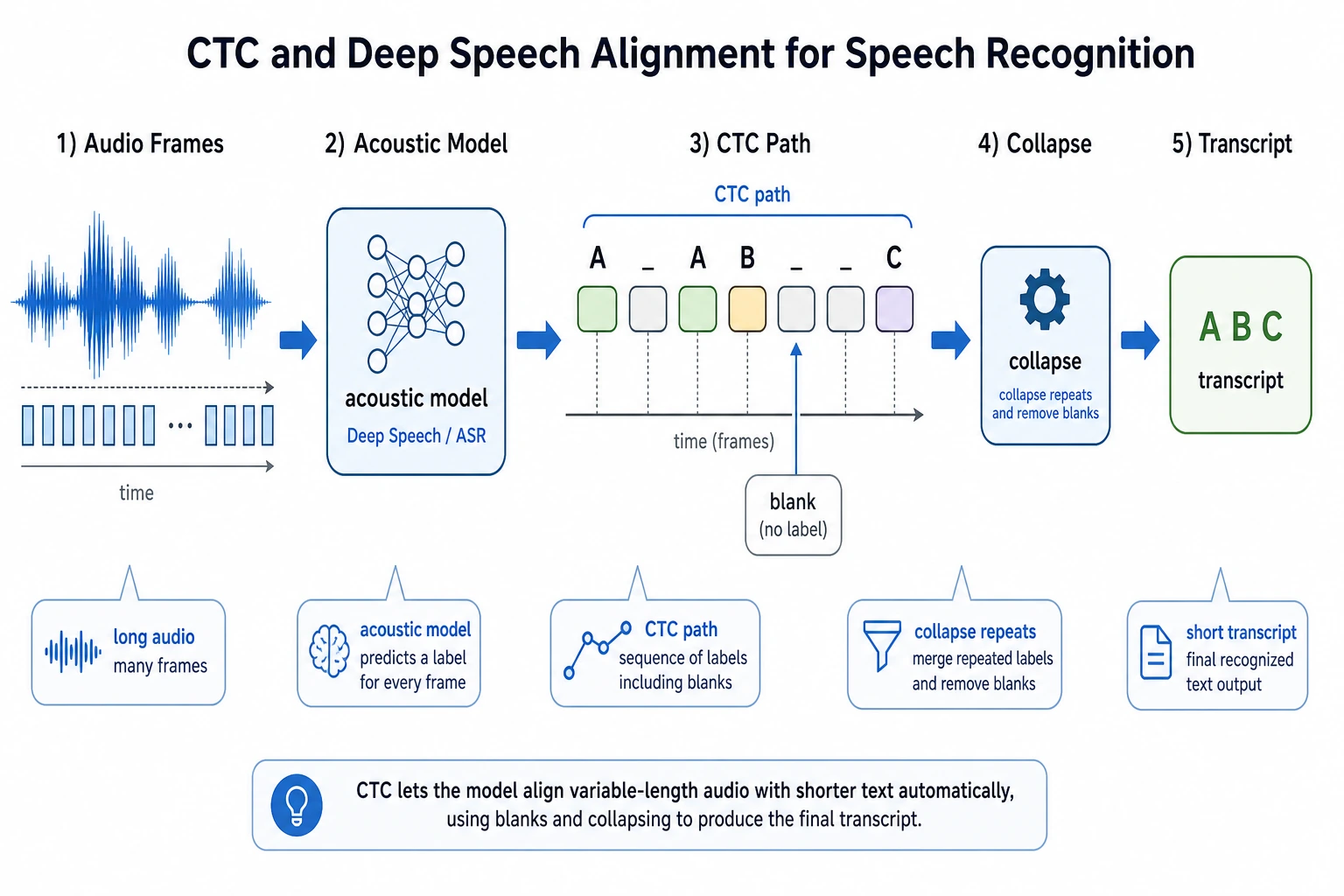
Why is speech recognition more troublesome than text classification?
Section titled “Why is speech recognition more troublesome than text classification?”Text classification is usually:
one sentence -> one labelMachine translation is usually:
one sequence of tokens -> another sequence of tokensBut speech recognition is:
a long sequence of audio frames -> a sequence of textThe problem is:
- There are many audio frames, but only a few text tokens
- One character may span multiple audio frames
- Training data usually tells you only the full transcription, not which character corresponds to each frame
This is the sequence alignment problem.
You can picture the difficulty like this:
flowchart LR A["audio frame 1"] --> M["speech model"] B["audio frame 2"] --> M C["audio frame 3"] --> M D["audio frame 4"] --> M M --> P["_ I I love"] P --> CTC["CTC collapse<br/>merge repeats + remove blanks"] CTC --> T["I love"]The model sees many small time slices. The label only says the final sentence. CTC is the bridge between these two worlds.
The core intuition of CTC: let the model first output paths with blanks and repeats
Section titled “The core intuition of CTC: let the model first output paths with blanks and repeats”CTC introduces a special symbol, blank. The model can first output a longer path, and then get the final text by “removing repeats and blanks.”
For example:
Model path: _ I I _ love love _ AI _Collapsed result: I love AIThis means the model does not need to know in advance:
- Which frame “I” starts on
- How long “love” lasts
- Which frames are just pauses or transitions
It only needs to learn this: among all paths that collapse to the correct text, the overall probability should become larger.
Why is Deep Speech an important milestone?
Section titled “Why is Deep Speech an important milestone?”Deep Speech represents an important route into end-to-end speech recognition in the deep learning era.
Traditional ASR systems often consist of many modules:
- Acoustic model
- Pronunciation lexicon
- Language model
- Decoder
Work like Deep Speech pushed a more end-to-end approach:
Learn text output directly from audio features, and compress a complex pipeline into a trainable model.
For beginners, you do not need to reproduce a full ASR system at the start. It is enough to understand why it matters:
- It makes speech recognition look more like one unified training problem
- CTC allows unaligned sequences to be trained
- Later models like Whisper continue pushing speech recognition toward more general pretraining approaches
A minimal collapse example
Section titled “A minimal collapse example”def ctc_collapse(path, blank="_"): result = [] prev = None
for token in path: if token != blank and token != prev: result.append(token) prev = token
return result
path = ["_", "I", "I", "_", "love", "love", "_", "AI", "_"]print(ctc_collapse(path))The output will be close to:
['I', 'love', 'AI']This example cannot replace the CTC formula, but it can help you build intuition first:
The model can first produce a long frame-level path, and then collapse it into the final short text.
A tiny alignment search you can run
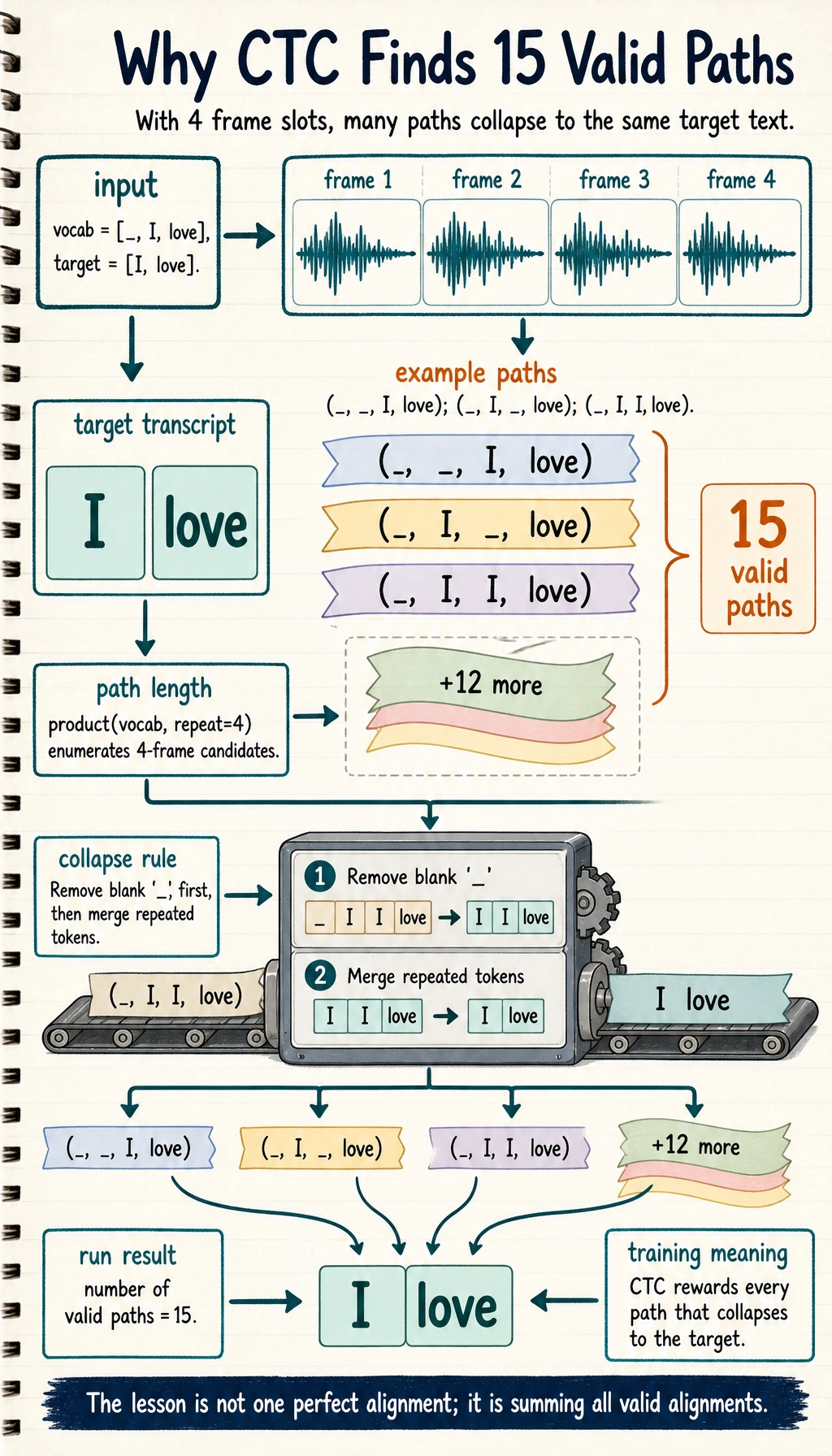
Section titled “A tiny alignment search you can run”The key idea is not that there is only one correct frame-level path. Instead, many paths can collapse into the same text. CTC training sums the probability of all valid paths.
The following toy program enumerates short paths that can become ["I", "love"]:
from itertools import product
def ctc_collapse(path, blank="_"):    result = []    prev = None
    for token in path:        if token != blank and token != prev:            result.append(token)        prev = token
    return result
vocab = ["_", "I", "love"]target = ["I", "love"]valid_paths = []
for path in product(vocab, repeat=4):    if ctc_collapse(path) == target:        valid_paths.append(path)
print("number of valid paths:", len(valid_paths))for path in valid_paths[:8]:    print(path, "->", ctc_collapse(path))
Expected output begins like this:
number of valid paths: 15('_', '_', 'I', 'love') -> ['I', 'love']('_', 'I', '_', 'love') -> ['I', 'love']('_', 'I', 'I', 'love') -> ['I', 'love']The key result is not the exact list order, but the count and the idea: many frame-level paths can collapse into the same transcript.
When beginners first see CTC, the most important realization is:
- The model is allowed to be uncertain about exact frame boundaries
- Repeated tokens can represent a sound lasting longer
- Blank tokens can represent pauses and transitions
- Training rewards all paths that collapse to the correct transcript
So CTC is not asking humans to label every frame. It is asking the model to distribute probability over many possible alignments.
The relationship between CTC, Seq2Seq, and Transformer ASR
Section titled “The relationship between CTC, Seq2Seq, and Transformer ASR”| Method | How to understand it first |
|---|---|
| CTC | Train with all possible paths when the input and output are not precisely aligned |
| Seq2Seq Attention | The decoder dynamically attends to input positions while generating |
| Transformer ASR | Model long audio context with a stronger attention structure |
| Whisper | Large-scale weakly supervised speech data + Transformer, making ASR more general |
This shows that speech recognition is not an isolated topic; it is connected to Seq2Seq, attention, and Transformer in this chapter.
Assigning historical milestones to course sections
Section titled “Assigning historical milestones to course sections”| Historical milestone | Problem it solves | Corresponding course section |
|---|---|---|
| CTC | How to train sequence models when input and output are not aligned | Section 5.5, Section 5.2 Seq2Seq |
| Deep Speech | End-to-end deep learning approach for speech recognition | Section 5.5, Section 12.3 Speech and multimodality |
| Seq2Seq Attention | Dynamically align input positions at each output step | Section 5.3 NLP attention mechanisms |
| Transformer ASR / Whisper | Large-scale pretrained speech recognition | Section 12 AIGC and multimodal extensions |
The intuition you should have after this section
Section titled “The intuition you should have after this section”The hardest part of speech recognition is not just “turning sound into text,” but:
- The input and output lengths are different
- There are no frame-level alignment labels
- Speech contains pauses, stretching, repetition, and noise
The beauty of CTC is: It does not force humans to label every frame. Instead, it lets the model learn from all possible alignment paths on its own.
Evidence to Keep
Section titled “Evidence to Keep”Keep this page’s proof of learning as a small evidence card:
- Source Target
- source text, target text, and task type
- Decoded Output
- generated summary, translation, transcript, or sequence result
- Alignment Note
- attention, CTC path, coverage, or copied source evidence
- Failure Check
- omission, repetition, hallucination, wrong alignment, or weak evaluation
- Expected Output
- generated text with factual or alignment review notes
Review notes and pass criteria
- A passing review should explain why the
15valid paths are evidence of many-to-one alignment, not a quality score. - Change the frame length or vocabulary once and rerun the toy script. If the valid-path count changes, explain which new blanks or repeats became possible.
- Inspect one collapsed path by hand and mark where blanks, repeated tokens, and final transcript tokens appear.
- The page is complete when you can explain why CTC can train from transcript labels without asking humans for a single frame-by-frame alignment.