
8.4.1 Engineering Roadmap: Async, API, Logs, Deploy
Engineering turns a working LLM demo into software that can be deployed, debugged, measured, and maintained after prompts, models, documents, and users change.
See the LLMOps Loop First
Section titled “See the LLMOps Loop First”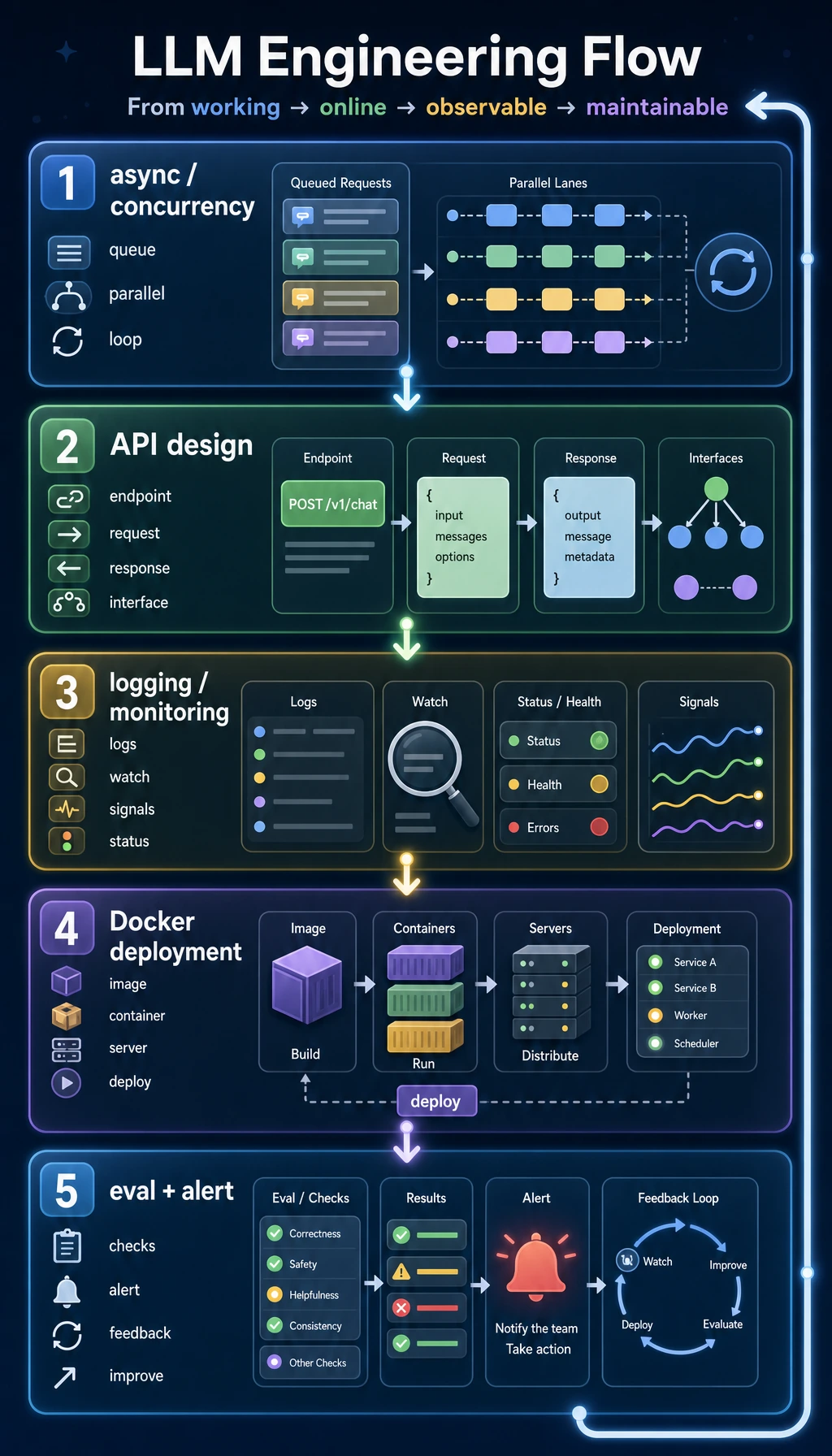
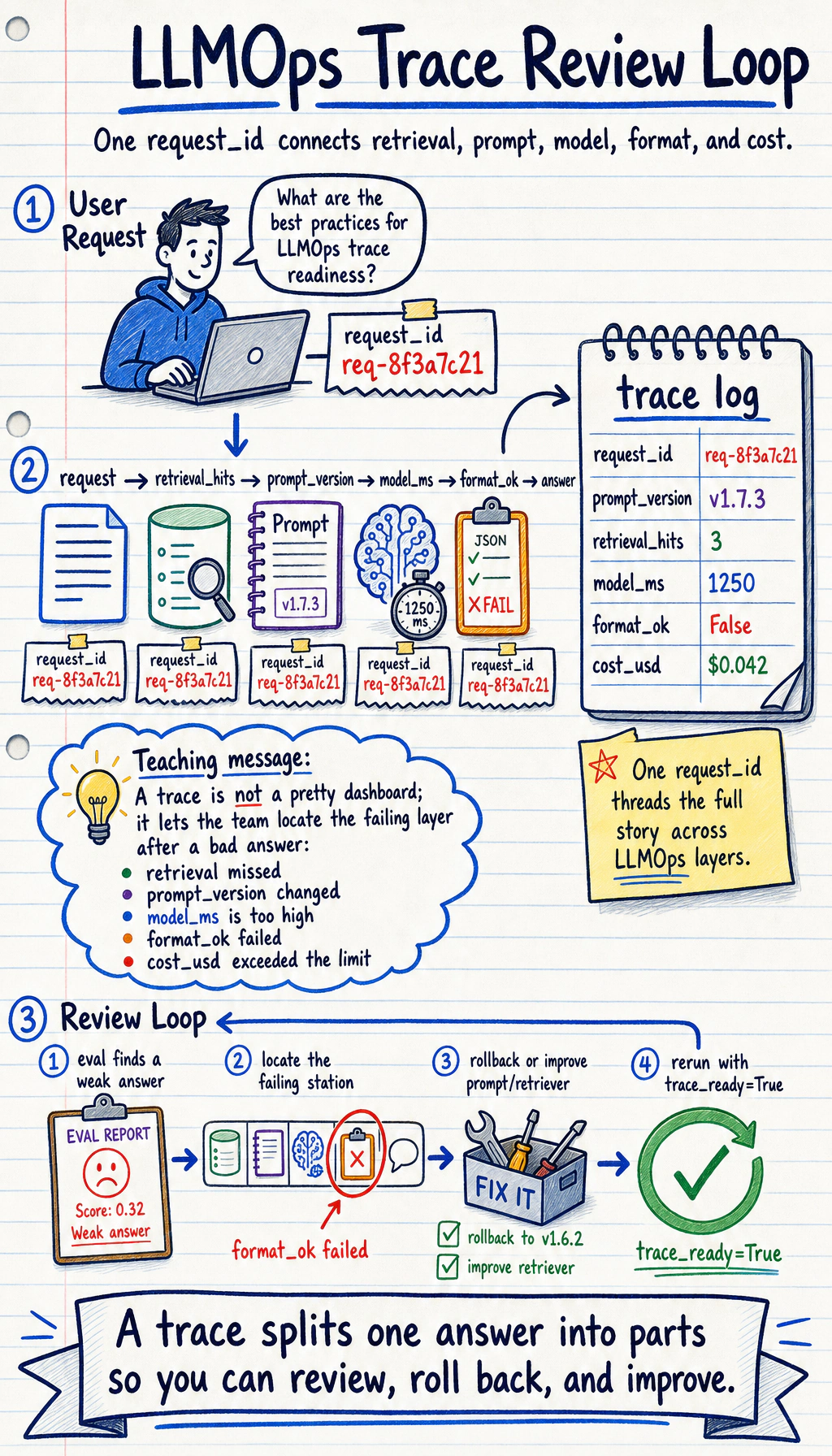
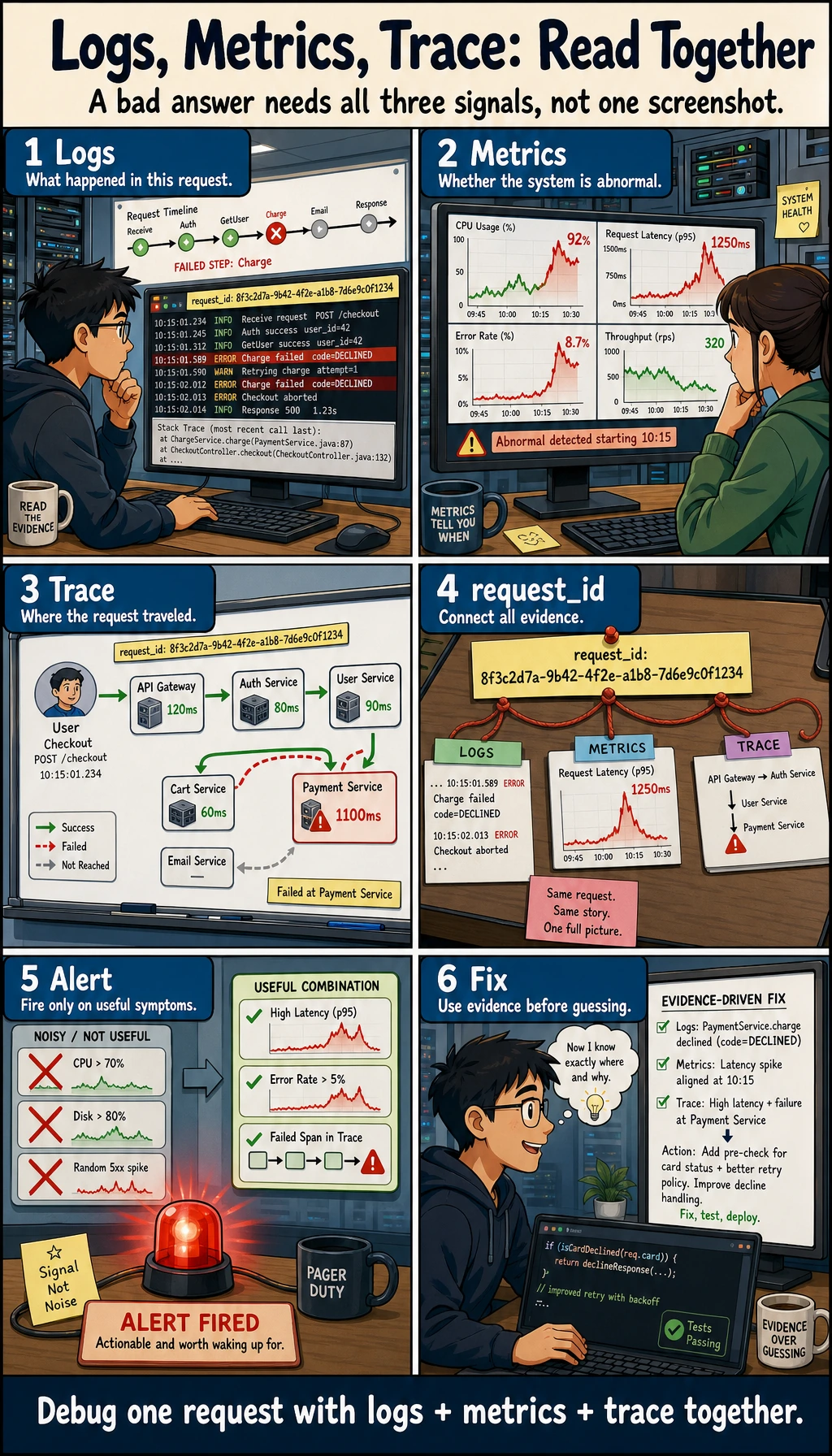
Your first engineering goal is simple: when an answer is wrong, you can explain which layer caused it.
Run a Trace Readiness Check
Section titled “Run a Trace Readiness Check”Every production-style LLM feature needs enough trace fields to debug one bad answer.
trace = {    "request_id": "demo-001",    "prompt_version": "rag-v2",    "retrieval_hits": 2,    "model_ms": 850,    "format_ok": True,    "cost_usd": 0.003,}
required = ["request_id", "prompt_version", "retrieval_hits", "model_ms", "format_ok", "cost_usd"]
print("trace_ready:", all(field in trace for field in required))print("debug_fields:", ", ".join(required))
Expected output:
trace_ready: Truedebug_fields: request_id, prompt_version, retrieval_hits, model_ms, format_ok, cost_usdIf these fields are missing, debugging becomes guesswork. Add logs before adding more features.
Learn in This Order
Section titled “Learn in This Order”| Step | Read | Practice Output |
|---|---|---|
| 1 | Async programming | Add timeout, retry, concurrency limit, and cancellation thinking |
| 2 | API design | Define request/response schema and error codes |
| 3 | Logging and monitoring | Record prompt version, retrieval hits, latency, cost, and failures |
| 4 | Docker deployment | Package the app with reproducible run instructions |
| 5 | Long context, RAG, and memory decision | Choose the simplest evidence strategy for bounded sources, searchable corpora, or persistent state |
Evidence to Keep
Section titled “Evidence to Keep”Keep this page’s proof of learning as a small evidence card:
- Service Contract
- endpoint, input schema, output schema, error schema
- Run Signal
- latency, throughput, logs, health check, or container status
- Observability
- request id, trace id, structured log, or metric
- Context Strategy
- long context, RAG, memory, or hybrid decision with reason
- Failure Check
- timeout, retry storm, missing log, deployment mismatch
- Ops Action
- backoff, queue, alert, rollout, or rollback
Pass Check
Section titled “Pass Check”You pass this chapter when your minimal app has a run command, API contract, error handling, logs, and one documented failure investigation.
The exit mini project is an engineering evidence pack: one trace log, one common error, one fix, one regression check, and one deployment note.
Check reasoning and explanation
- A passing answer traces the full path from query to chunks, retrieval scores, cited evidence, answer, and fallback behavior.
- The evidence should include retrieved passages, source metadata, a cited answer, and at least one empty-retrieval or wrong-retrieval case.
- A good self-check explains whether a failure came from chunking, retrieval, ranking, prompt assembly, missing sources, or unsupported generation.